The book aims to give a mathematical presentation of the theory of general relativity (that is, spacetime-geometry-based gravitation theory) to advanced undergraduate mathematics students. Mathematicians will find spacetime physics presented in the definition-theorem-proof format familiar to them. The given precise mathematical definitions of physical notions help avoiding pitfalls, especially in the context of spacetime physics describing phenomena that are counter-intuitive to everyday experiences. In the first part, the differential geometry of smooth manifolds, which is needed to present the spacetime-based gravitation theory, is developed from scratch. Here, many of the illustrating examples are the Lorentzian manifolds which later serve as spacetime models. This has the twofold purpose of making the physics forthcoming in the second part relatable, and the mathematics learnt in the first part less dry. The book uses the modern coordinate-free language of semi-Riemannian geometry. Nevertheless, to familiarise the reader with the useful tool of coordinates for computations, and to bridge the gap with the physics literature, the link to coordinates is made through exercises, and via frequent remarks on how the two languages are related. In the second part, the focus is on physics, covering essential material of the 20th century spacetime-based view of gravity: energy-momentum tensor field of matter, field equation, spacetime examples, Newtonian approximation, geodesics, tests of the theory, black holes, and cosmological models of the universe. Prior knowledge of differential geometry or physics is not assumed. The book is intended for self-study, and the solutions to all the 283 exercises are included. The second edition corrects errors from the first edition, and includes 60 new exercises, 10 new remarks, 29 new figures, some of which cover auxiliary topics that were omitted in the first edition. Request Inspection Copy Sample Chapter(s) Preface Chapter 1: Smooth manifolds Contents: Smooth Manifolds Tangent and Cotangent Spaces Vector Fields and 1-Form Fields Tensor Fields Lorentzian Manifolds Levi-Civita Connection Parallel Transport Geodesics Curvature Form Fields Integration Minkowski Spacetime Physics Matter Field Equation Black Holes Cosmology Readership: Advanced undergraduate and beginning graduate students in Mathematics and Physics.
還沒有人留下心得,快來搶頭香!
為您推薦

類似書籍推薦給您
Anyone with an interest in learning about the mathematical modeling of prices of financial derivatives such as bonds, futures, and options can start with this book, whereby the only mathematical prerequisite is multivariable calculus. The necessary theory of interest, statistical, stochastic, and differential equations are developed in their respective chapters, with the goal of making this introductory text as self-contained as possible. In this edition, the chapters on hedging portfolios and extensions of the Black–Scholes model have been expanded. The chapter on optimizing portfolios has been completely re-written to focus on the development of the Capital Asset Pricing Model. The binomial model due to Cox–Ross–Rubinstein has been enlarged into a standalone chapter illustrating the wide-ranging utility of the binomial model for numerically estimating option prices. There is a completely new chapter on the pricing of exotic options. The appendix now features linear algebra with sufficient background material to support a more rigorous development of the Arbitrage Theorem. The new edition has more than doubled the number of exercises compared to the previous edition and now contains over 700 exercises. Thus, students completing the book will gain a deeper understanding of the development of modern financial mathematics. Request Inspection Copy Sample Chapter(s) Chapter 1: The Theory of Interest Contents: The Theory of Interest Discrete Probability The Arbitrage Theorem Optimal Portfolio Choice Forwards and Futures Options Approximating Option Prices Using Binomial Trees Normal Random Variables of Probability Random Walks and Brownian Motion Black–Scholes Equation and Option Formulas Extensions of the Black–Scholes Model Derivatives of Black–Scholes Option Prices Hedging Exotic Options Appendix A: Linear Algebra Primer Readership: Undergraduate students in finance, economics, actuarial science, and applied mathematics; professionals in banking, insurance, actuarial careers, and finance.
類似書籍推薦給您
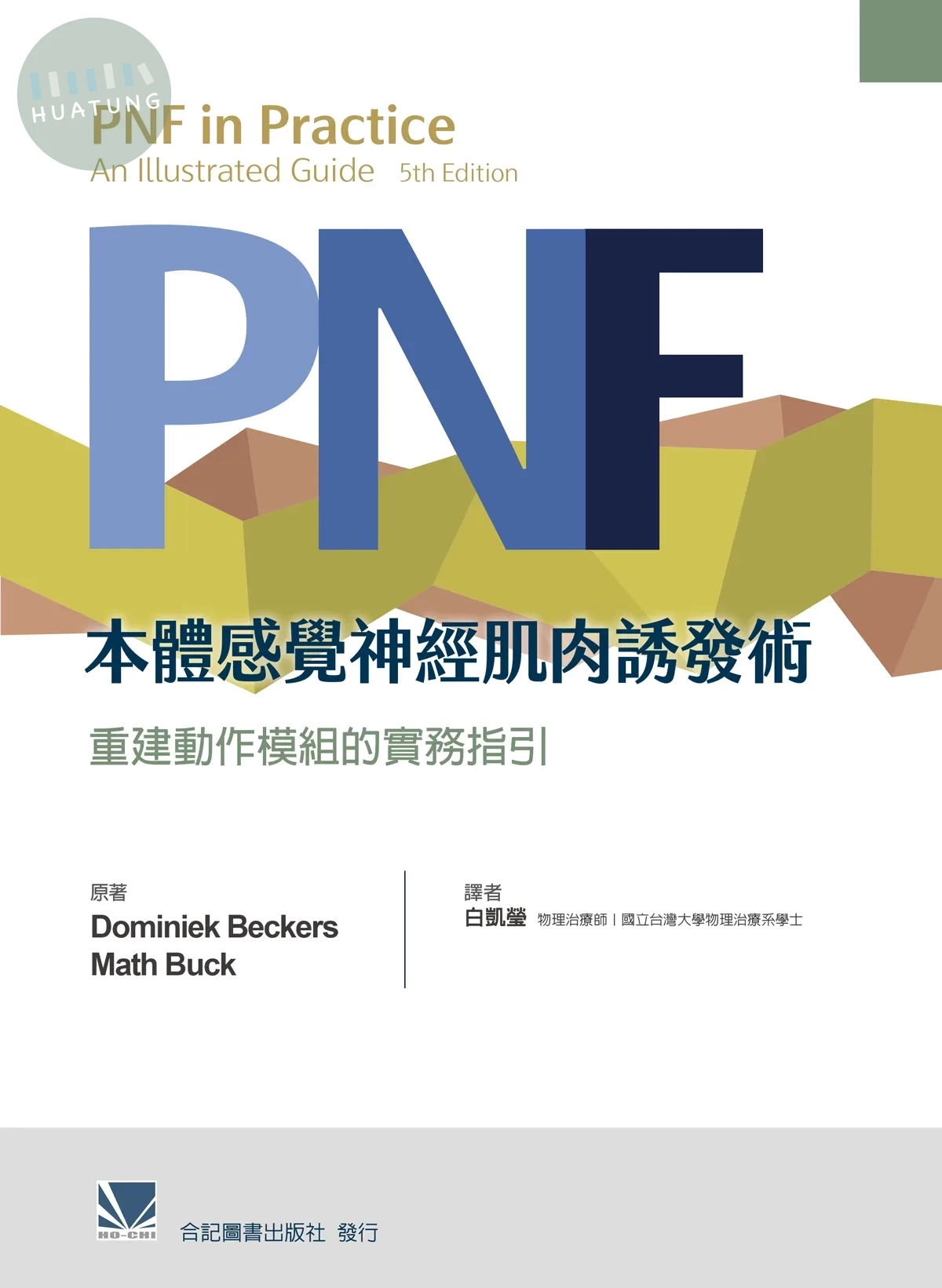
【簡介】 《PNF本體感覺神經肌肉誘發術:重建動作模組的實務指引》第五版是一本結合理論深度與臨床實用性的專業指南,全面呈現PNF技術的發展脈絡與操作精髓。書中詳述 PNF 的神經生理學基礎、治療原則與技巧,並以豐富的圖像輔助說明動作模組的應用,涵蓋肩胛、骨盆、四肢、軀幹、步態訓練及日常生活活動等多元面向。特別納入ICF模型與動作學習原則,強調功能導向與個案潛能激發。本書不僅適用於神經、骨科及小兒科領域,更是物理治療師進行PNF訓練與臨床介入的權威參考。透過系統化架構與臨床案例解析,本書協助讀者掌握PNF的核心理念與實踐策略,是連結動作控制與復健目標的橋樑。 【目錄】 1 介紹 1 現代整體治療本體感覺神經肌肉誘發術概念之定位 2 本體感覺神經肌肉誘發術:定義、哲理及神經生理學基礎 11 學習測驗:問題與討論 13 參考文獻 13 2 本體感覺神經肌肉誘發術之基本原則與流程 17 阻力最佳化 20 輻射及增強 22 觸覺刺激(徒手接觸) 23 身體姿勢與身體力學 25 口語刺激(口令) 26 視覺刺激 27 牽引與關節迫近 28 伸展 29 動作時序 30 動作模組 30 學習測驗:問題與討論 32 參考文獻 33 3 本體感覺神經肌肉誘發術之治療技巧 37 介紹 38 節律性起始 39 等張收縮組合 40 拮抗肌反轉收縮 41 反覆性伸展(反覆性收縮) 47 收縮-放鬆 50 固定-放鬆 52 動作複製 54 本體感覺神經肌肉誘發術和目的 55 學習測驗:問題與討論 55 參考文獻 55 4 個案評量與治療 59 介紹 60 評估 60 假設 62 治療導向的損傷成因和活動受限測試 62 治療目標 62 治療計畫與治療設計 63 損傷成因與活動受限再測試 65 治療範例 66 適應症與禁忌症 67 學習測驗:問題與討論 67 參考文獻 67 5 誘發的動作模組 73 介紹 74 本體感覺神經肌肉誘發術的動作模組 74 學習測驗:問題與討論 76 參考文獻 68 6 肩胛與骨盆 79 介紹 80 應用 80 基本流程 80 肩胛對角線 82 骨盆對角線 89 對稱、交替及非對稱運動 96 學習測驗:問題與討論 99 參考文獻 99 7 上肢 101 簡介 103 基本流程 103 屈曲-外展-外轉(圖7.2) 105 伸直-內收-內轉(圖7.5) 112 屈曲-內收-外轉(圖7.8) 118 伸直-外展-內轉(圖7.11) 124 推進及收回的組合 131 雙側上肢動作模組 133 改變個案位置 135 手臂動作模組的治療應用 139 學習測驗:問題與討論 139 參考文獻 139 8 下肢 141 介紹 143 基本流程 143 屈曲-外展-內轉(圖8.2) 145 伸直-內收-外轉(圖8.5) 151 屈曲-內收-外轉(圖8.8) 157 伸直-外展-內轉(圖8.11) 162 雙腿的動作模組 168 改變個案位置 168 下肢動作模組的治療適應症 172 學習測驗:問題與討論 179 參考文獻 179 9 頸部 181 介紹 182 基本流程 182 適應症 187 向左屈曲、向右伸直(圖9.1) 187 頸部帶動軀幹 189 學習測驗:問題與討論 194 參考文獻 194 10 軀幹 195 介紹 196 治療流程 196 砍柴及抬起動作模組 197 雙側下肢動作模組帶動軀幹 203 結合動作模組帶動軀幹 209 學習測驗:問題與討論 213 參考文獻 213 11 墊上運動 215 介紹:為什麼要做墊上運動 216 基本流程 216 技巧 217 墊上運動 217 本體感覺神經肌肉誘發術於小兒科的應用 252 墊上運動的個案討論 254 治療應用 258 學習測驗:問題與討論 259 參考文獻 259 12 步態訓練 261 介紹:行走的重要 262 正常步態的基本介紹 262 步態分析:觀察及徒手評估 266 步態訓練理論 267 步態訓練的流程 268 步態的訓練 270 步態訓練的個案討論 292 學習測驗:問題與討論 298 參考文獻 298 13 生理機能 301 介紹 302 刺激與誘發 302 顏面肌肉 302 舌部動作 312 吞嚥功能 314 語言障礙 314 呼吸 315 學習測驗:問題與討論 318 參考文獻 318 14 日常生活活動 321 介紹 322 轉位 323 穿脫衣服 325 學習測驗:問題與討論 328 參考文獻 328 15 學習測驗:問題與答案 331 附錄 詞彙表 338 索引 341
 資訊
資訊
 工程
工程
 數學與統計學
 機率與統計
機率與統計
 自然科學
自然科學
 健康科學
健康科學
 地球與環境
地球與環境
 建築、設計與藝術
 人文與社會科學
 教育
教育
 語言學習與考試
 法律
法律
 會計與財務
會計與財務
 大眾傳播
大眾傳播
 觀光與休閒餐旅
 考試用書
考試用書
 研究方法
研究方法
 商業與管理
商業與管理
 經濟學
經濟學
 心理學
心理學
 生活
生活
 生活風格商品
 參考書/測驗卷/輔材