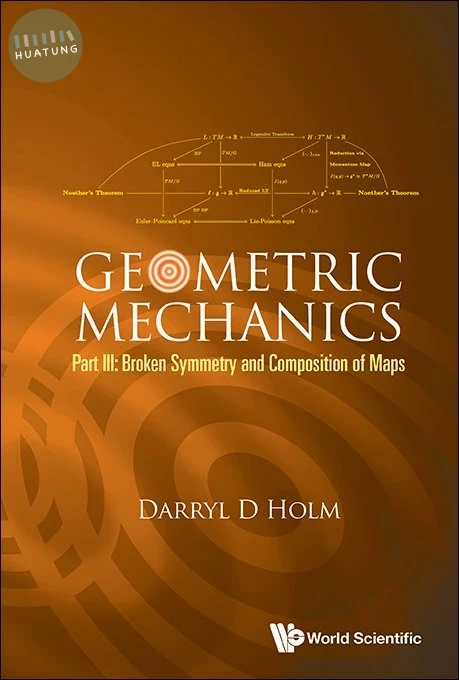
【簡介】 Geometric Mechanics: Part III is a textbook presented in a lecture notes format, providing precise definitions and practical examples across a series of 31 lectures that have been developed from the author’s extensive experience of teaching and research. Geometric mechanics is an incredibly rich field of study: beyond its mathematical depth and beauty, it provides a robust framework for exploring the geometric structures underpinning many dynamical systems crucial to physics.The first part introduces undergraduate mathematics and physics students to the applications of geometric mechanics in finite dimensional dynamical systems of ordinary differential equations. The second part covers the essential theory of manifolds and Lie groups to prepare senior undergraduates and graduate students for the modern applications of geometric mechanics. These applications are introduced in the third part, which delves into the geometric mechanics of partial differential equations that govern the dynamics of ideal continuum mechanics, including fluids and plasmas, at the cutting edge of current research.This textbook is designed to facilitate both course learning and individual study. With focused notes, numerous examples, and nearly 200 exercises, it serves as a valuable resource for postgraduate students, course instructors, and researchers.
還沒有人留下心得,快來搶頭香!
為您推薦
類似書籍推薦給您
This monograph is the first in which the theory of groupoids and algebroids is applied to the study of the properties of uniformity and homogeneity of continuous media. It is a further step in the application of differential geometry to the mechanics of continua, initiated years ago with the introduction of the theory of G-structures, in which the group G denotes the group of material symmetries, to study smoothly uniform materials. The new approach presented in this book goes much further by being much more general. It is not a generalization per se, but rather a natural way of considering the algebraic-geometric structure induced by the so-called material isomorphisms. This approach has allowed us to encompass non-uniform materials and discover new properties of uniformity and homogeneity that certain material bodies can possess, thus opening a new area in the discipline. Sample Chapter(s) Preface Chapter 2: Continuum Mechanics: Elastic Simple Bodies Contents: Preface About the Authors Introduction Fundamentals: Continuum Mechanics: Elastic Simple Bodies Groupoids Algebroids Material Groupoid: Material Algebroid Characteristic Distributions and Material Bodies Appendices: Foliations and Distributions Covariant Derivatives Principal Bundles and Connections Bibliography Index Readership: Graduate and postgraduate students interested in Continuum Mechanics, Mathematical Physics and Differential Geometry. Researchers in Elasticity, Applied Mathematics and Differential Geometry. And those taking a master or doctorate course that seeks the interaction between mathematics and mechanical engineering.
類似書籍推薦給您
類似書籍推薦給您
資訊
工程
數學與統計學
機率與統計
自然科學
健康科學
地球與環境
建築、設計與藝術
人文與社會科學
教育
語言學習與考試
法律
會計與財務
大眾傳播
觀光與休閒餐旅
考試用書
研究方法
商業與管理
經濟學
心理學
生活
生活風格商品
參考書/測驗卷/輔材