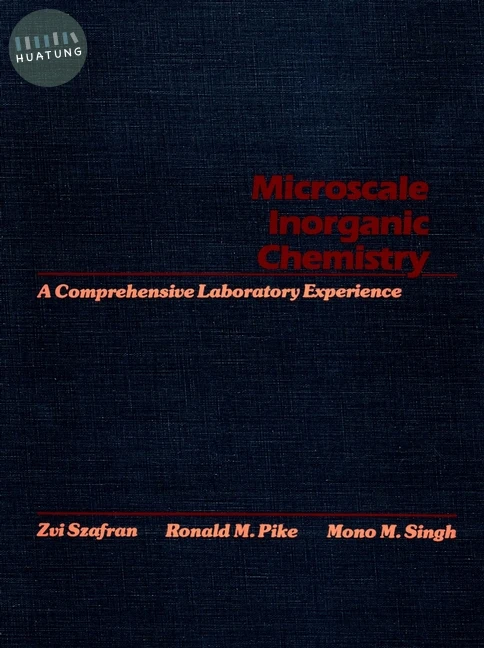
Microscale Inorganic Chemistry
$5759元可訂購
簡介
This text is intended to provide students with instruction and valuable laboratory experience in the often neglected area of inorganic chemistry. Divided into four main parts, the book covers chemistry of the main group elements, chemistry of the transition metals, organometallic chemistry, and bioinorganic chemistry. Recognizing the high cost of materials, difficulties in waste disposal, and dangers of toxicity, the authors have adopted a ``microscale'' approach to experiments in the book, thereby also reducing the time students spend in preparation. With over 45 experiments, Microscale Inorganic Chemistry incorporates the use of a broad sampling of elements and also covers such topics as laboratory safety, equipment, report writing, and literature searching.
目錄
List of Tables xvii
Introduction 1–3
A. A Brief History of Inorganic Chemistry 1
B. The Microscale Approach 2
C. A Word to the Student 3
Chapter 1 Safety in the Laboratory 5–17
1.A General Safety Rules 5
1.A.1 Introduction 5
1.A.2 Before the Laboratory 6
1.A.3 Safety Rules in the Laboratory 6
1.B Planning for Chemicaly Safety 8
1.B.1 Introduction 8
1.B.2 Use of MSD Sheets 8
1.B.3 The Merck Index 12
1.B.4 Compressed Gas Cylinders and Lecture Bottles 13
1.B.5 Fire Safety 16
Chapter 2 Laboratory Equipment 19–29
2.A Glassware 19
2.B Other Locker Equipment 21
2.C Measuring Quantities of Chemicals 22
2.C.1 Weighing 22
2.C.2 Liquid Volumes 22
2.D Heating Methods 25
2.D.1 The Microburner 25
2.D.2 Steam Bath 25
2.D.3 Oil Baths 25
2.D.4 Infrared Lamp 26
2.D.5 Sand Bath or Aluminum Block with Magnetic Stirring Hot Plate 26
2.E Stirring 27
2.F Reflux and Distillation 27
Chapter 3 Writing Laboratory Reports 31–35
3.A Introduction 31
3.B Maintenance of the Laboratory Notebook 31
3.C The Laboratory Report 34
3.D Proper Citation and Plagiarism 35
Chapter 4 Literature Searching and the Inorganic Literature 37–47
4.A Literature Searching 37
4.A.1 Chemical Abstracts Method 37
Searching a Topic in Chemical Abstracts 38
Use of the Formula Index 38
Use of the General Subject Index 40
CAS Online 40
Advantages and Disadvatages of Chemical Abstracts 40
4.A.2 Use of the Science Citation Index 41
Searching Using the Printed Science Citation Index 41
Searching Using the Compact Disc Science Citation Index 42
Searching Using the Citation Index 42
Advantages and Disadvatages of the Science Citation Index 44
4.A.3 Comparison of the Two Methods 44
4.B The Inorganic Chemical Literature 44
4.B.1 Introduction 44
4.B.2 Purely Inorganic Journals 44
4.B.3 General Coverage Journals 45
4.B.4 Review Journals and Monographs Covering Inorganic Chemistry 45
4.B.5 Major Comprehensive Books on Inorganic Chemistry 46
Chapter 5 Inorganic Microscale Laboratory Techniques 49–105
5.A Microscale Determination of Magnetic Susceptibility 49
5.A.1 Introduction 49
5.A.2 Measurement of Magnetic Susceptibility 50
5.A.3 Calculation of Magnetic Moment from Magnetic Susceptibility 52
5.A.4 Operation of the Evans–Johnson Matthey Balance for Solids 54
5.A.5 Operation for Liquids and Solutions 55
5.A.6 Determining Magnetic Susceptibility by NMR Spectroscopy 56
5.B Thermal Analysis 57
5.B.1 Introduction 57
5.B.2 Differential Scanning Calorimetry and Differential Thermal Analysis 57
5.B.3 Thermogravimetric Analysis 58
5.B.4 Variables in Thermal Analysis 58
5.B.5 Analysis of the Thermogram 59
5.B.6 Theoretical Aspects 60
5.B.7 Applications 61
5.C Vacuum and Inert Atmosphere Techniques 62
Introduction 62
5.C.1 Purging with an Inert Gas 62
5.C.2 Use of Manifold for Inert Gas or Vacuum 64
Rough Pump 64
Cold Trap 64
Manifold 65
Multiple Vacuum Lines in Series 65
Use and Operation of Manifolds 65
5.C.3 Cannula Techniques 66
5.D Crystallization Techniques 67
5.D.1 Introduction 67
5.D.2 Crystallization from Solution 67
5.D.3 Isolation of Crystalline Products (Suction Filtration) 69
5.D.4 The Craig Tube Method 69
5.D.5 Recrystallization Pipet 70
5.D.6 Removal of Suspended Particles from Solution 71
5.D.7 Washing of the Collected Crystals 71
5.D.8 Decolorization 72
5.D.9 Drying Techniques 73
5.E Determination of Melting Points 74
5.E.1 Introduction 74
5.E.2 Theory 74
5.E.3 Mixture Melting Point Determination 75
5.E.4 Correcting Melting Points 76
5.E.5 Determination of the Melting Point Range 77
5.E.6 Melting Point Apparatus 78
The Thiele Tube 78
The Mel-Temp Apparatus 78
The Fisher–Johns Apparatus 78
The Thomas–Hoover Apparatus 81
5.F Concentration of Solutions 81
5.F.1 Introduction 81
5.F.2 Evaporation Techniques 81
5.F.3 Removal of Solvent Under Reduced Pressure 81
5.G Chromatography 82
5.G.1 Introduction 82
5.G.2 Thin-Layer Chromatography 84
5.G.3 Gas Chromatography: Introduction 86
Components of the Gas Chromatograph 87
5.G.4 Liquid Chromatography 89
Ion and Ion Exchange Chromatography 89
High-Performance Liquid Chromatography 90
5.H Sublimation 92
5.H.1 Introduction 92
5.H.2 Theory 93
5.H.3 Sublimation Technique 93
5.I Solvent Extraction 94
5.I.1 Introduction 94
5.I.2 Theory 94
5.I.3 Extraction Procedures: Simple Extraction 97
Use of the Separatory Funnel 97
Pasteur Filter Pipet Extractions 99
5.I.4 Continuous Extraction 100
5.I.5 Drying of the Wet Organic Layer 100
5.I.6 Drying of Organic Solvents 101
5.J Conductivity Measurements 102
5.J.1 Introduction 102
5.J.2 Experimental Procedure 104
5.J.3 Non-Aqueous Solutions 105
Chapter 6 Spectroscopy 107–146
6.A Introduction 107
6.A.1 Spectrometer Components 108
6.B Visible Spectroscopy 109
6.B.1 Introduction and Theory 109
6.B.2 The Visible Spectrum 110
6.B.3 Molar Absorbance and Color 111
6.B.4 Size of the Crystal Field Splitting 112
6.B.5 Energy Level Diagrams l12
6.C Infrared Spectroscopy 114
6.C.1 Introduction 114
6.C.2 Sample Handling 115
6.C.3 Bond Vibrations 1l6
6.C.4 Vibrational Modes 119
6.C.5 Inorganic Functional Groups 121
6.C.6 Synergistic Effects 121
6.C.7 Interpretation of IR Spectra 122
6.C.8 Fourier Transform lnfrared 123
6.D Nuclear Magnetic Resonance Spectroscopy 125
6.D.1 Introduction 125
6.D.2 Sample Preparation 128
6.D.3 Reference Materials 129
6.D.4 The Chemical Shift 129
6.D.5 Integration 131
6.D.6 Spin–Spin Coupling 132
6.D.7 13C-NMR Spectroscopy 133
6.D.8 Quadrupolar Nuclei 136
6.D.9 The Coupling Constant 136
6.D.10 Interpretation of Inorganic Spectra 137
6.D.11 Spectral Collapse l38
6.D.12 Decoupling 139
6.D.13 Identification of Isomers 139
6.E Atomic Absorption Spectroscopy 141
6.E.1 Introduction 141
6.E.2 Theory 141
6.E.3 The Instrument 142
The Flame 142
The Nebulizer Burner System 142
The Light Source 144
The Monochromator 144
The Detector 144
6.E.4 Measurement of Concentration 144
6.E.5 Other Considerations 145
Chapter 7 Chemistry of the Main Group Elements 147–215
Experiment 1 Preparation of Sodium Amide 148
Experiment 2 Synthesis and Thermal Analysis of the Group 2 (IIA)
Metal Oxalate Hydrates 152
Experiment 3 Atomic Absorption Analysis of Magnesium and Calcium 155
Experiment 4 Preparation of Trialkoxyborates 158
Part A Preparation of Tri-n-propylborate 160
Part B Preparation of a Poly(vinylalcohol)–Borate Copolymer 161
Experiment 5 Synthesis of Tetrafluoroberyllate and
Tetrafluoroborate Complexes 163
Part A Synthesis of Ammonium Tetrafluoroberyllate, (NH 4 ) 2 [BeF 4 ] 164
Part B Synthesis of Ammonium Tetrafluoroborate, NH 4 [BF 4 ] 165
Experiment 6 Synthesis of Dichlorophenylborane 167
Experiment 7 Synthesis and Reactions of Carboranes 170
Part A Preparation of Potassium Dodecahydro-7-8-dicarba-nido-undecarborate(1-), a Carborane Anion 172
Part B Preparation of 3-[η5-Cyclopentadienyl)-1,2-dicarba-3-cobalta-closo-dodecaborane(11), a Metal Carborane 173
Experiment 8 Silicone Polymers: Preparation of Bouncing Putty 176
Experiment 9 The Oxidation States of Tin 181
Part A Preparation of Tin(IV) Iodide 183
Part B Preparation of Tin(II) Iodide 184
Experiment 10 Relative Stabilities of Tin(IV) and Lead(IV) 186
Part A Preparation of Ammonium Hexachlorostannate(IV) 186
Part B Preparation of Ammonium Hexachloroplumbate(IV) 187
Experiment 11 Preparation of Substituted 1,2,3,4-Thiatriazoles 189
Part A Preparation of 5-Anilino-1,2,3,4-thiatriazole 190
Part B Preparation of 5-Amino-1,2,3,4-thiatriazole 191
Experiment 12 Synthesis of Hexakis(4-nitrophenoxy) cyclotriphosphazene 193
Part A Preparation of Potassium 4-Nitrophenoxide 194
Part B Preparation of Hexakis(4-nitrophenoxy) cyclotriphosphazene 195
Experiment 13 Synthesis of Ammonium Phosphoramidate 197
Experiment 14 Preparation of an Explosive: Nitrogen Triiodide Ammoniate 199
Experiment 15 Synthesis of Trichlorodiphenylantimony[V) Hydrate 201
Experiment 16 Preparation of Tetrathionate 204
Part A Determination of Reaction Quantities 205
Part B Quantitative Preparation of Sodium Tetrathionate 206
Experiment 17 Thione Complexes of Cobalt(II) Nitrate Hexahydrate 207
Part A Synthesis of Co(mimt) 4 (NO 3 ) 2 ·H 2 O 209
Part B Synthesis of Co(mimt) 2 (NO 3 ) 2 209
Experiment 18 Positive Oxidation States of Iodine: Preparation of Dipyridineiodine(I) Nitrate 210
Experiment 19 Synthesis of Interhalogens: Iodine Trichloride 213
Chapter 8 Chemistry of the Transition Metals 217
Experiment 20 Metal Complexes of Dimethyl Sulfoxide 218
Part A Preparation of CuCl 2 ·2DMSO 220
Part B Preparation of PdCl 2 ·2DMSO 221
Part C Preparation of RuCl 2 ·4DMSO 221
Experin1ent 21 Preparation of trans-Dichlorotetrapyridinerhodium(III) Chloride 222
Experiment 22 Synthesis of Metal Acetylacetonates 224
Part A Preparation of Tris(2,4-pentanedionato) chromium(III) 226
Part B Preparation of Tris(2,4-pentanedionato) manganese(III) 227
Experiment 23 Gas Chromatographic Analysis of Brominated Tris(2,4-pentanedionato) chromium(III) 229
Experiment 24 Determination of Magnetic Moments in Metal–Metal Bonded Complexes 231
Part A Synthesis of Rhodium(II) Acetate Ethanolate 232
Part B Synthesis of Copper(II) Acetate Monohydrate 234
Experiment 25 Multiply Bonded Species: Preparation of Tetrabutylammonium Octachlorodirhenate(III) 235
Experiment 26 Geometic Isomerism 239
Part A Synthesis of trans-Dichlorobis(ethylenediamine)cobalt(III) Chloride 241
Part B Synthesis of cis-Dichlorobis(ethylenediamine)cobalt(III) Chloride 242
Experiment 27 Optical Isomers: Separation of an Optical Isomer of
cis-Dichlorobis (ethylenediamine)cobalt(III) Chloride 243
Experiment 28 Ion Exchange Separation of the Oxidation States of Vanadium 246
Experiment 29 Determination of Δ 0 in Cr(III) Complexes 248
Experiment 30 Preparation and Study of a Cobalt(II) Oxygen Adduct Complex 252
Part A Preparation of N,N' -Bis(salicylaldehyde) ethylenediimine, salenH2 254
Part B Preparation of Co(salen) 254
Part C Determination of Oxygen Absorption by Co(salen) 256
Part D Reaction of Oxygen Adduct with Chloroform 257
Experiment 31 Preparation of Dichloro-1,3-bis[diphenylphosphino)propanenickel(II) 257
Experiment 32 Preparation of Iron(II) Chloride (Use of FeCl 3 as a Friedel–Crafts Chlorination Source) 260
Experiment 33 Reaction of Cr(III) with a Multidentate Ligand: A Kinetics Experiment 263
Experiment 34 Organometallic Compounds and Catalysis: Synthesis and Use of Wilkinson’s Catalyst 271
Part A Synthesis of RhCl(PPh 3 ) 3 , Wilkinson’s Catalyst 276
Part B Substitution of the Chloro Ligand in Wilkinson’s Catalyst 277
Part C Reaction of Wilkinson’s Catalyst with Aldehydes 278
Part D Reaction of Wilkinson’s Catalyst with Ethylene 279
Part E Absorption of Hydrogen by Wilkinson’s Catalyst 279
Part F Catalytic Hydrogenation of Olefins in the Presence of Wilkinson’s Catalyst 281
Experiment 35 Synthesis and Reactions of Cobalt Phenanthroline Complexes 282
Part A Preparation of Tris(1, 10-phenanthroline) cobalt(II) Bromide 283
Part A (Alternate): Preparation of Tris(1, 10-phenanthroline) cobalt(II) Antimonyl-d-tartrate 284
Part B Preparation of Tris(1, 10-phenanthroline) cobalt(III) Tetrafluoroborate 285
Part C Preparation of Tris(1, 10-phenanthroline-5,6-quinone)cobalt(III) Hexafluorophosphate 286
Part D Isolation of 1, 10-phenanthroline-5,6-quinone 287
Experiment 36 Preparation of Tetrakis(triphenylphosphine)platinum(0) 288
Experiment 37 Platinum(II) Complexes––the Trans Effect 290
Part A Preparation of cis-Dichloro(dipyridine) platinum(II) 291
Part B Preparation of trans-Dichloro(dipyridine) platinum(II) 291
Chapter 9 Chemistry of Organometallic and Related Compounds 295
Experiment 38 Organoplatinum[II) Complexes: Preparation of η4-C 8 H 12 PtCl 2 296
Experiment 39 NMR Investigation of Molecular Fluxionality: Synthesis of Allylpalladium Complexes 298
Experiment 40 Preparation and Use of Ferrocene 302
Part A Preparation of Cyclopentadiene 304
Part B Preparation of Ferrocene 305
Part C Acetylation of Ferrocene 307
Part D HPLC Analysis of the Acetylation Reaction 309
Experiment 41 Preparation of Organopalladium Complexes 310
Part A Preparation of Dichloro-bis-(benzonitrile) palladium(II) 311
Part B Preparation of Di-µ-chlorodichlorodiethylenedipalladium(II) 312
Experiment 42 Synthesis of Metal Carbonyls 313
Part A Preparation of trans-Chlorocarbonylbis (triphenylphosphine)rhodium(I) 315
Part B Preparation of mer-Carbonyltrichlorobis (triphenylphosphine)rhodium(III) 316
Part C Synthesis of the SO 2 Adduct of trans Chlorocarbonylbis(triphenylphosphine)rhodium(I) 317
Experiment 43 Sunlight Photochemistry: Preparation of Dicarbonyl(η5-methylcyclopentadienyl)triphenylphosphinemanganese (0) 318
Experiment 44 Synthesis of Metal Nitrosyl Complexes 320
Part A Preparation of Trichloronitrosyl-bis(triphenylphosphine)ruthenium(II) 321
Part B Preparation of Dinitrosylbis(triphenylphosphine)ruthenium(– II) 323
Experiment 45 13C NMR Analysis of Cyclopentadienylirondicarbonyl Dimer 324
Part A Preparation of [(η5-C 5 H 5 )Fe(CO) 2 ] 2 325
Part B Variable Temperature 13C NMR lnvestigation of [η5-C 5 H 5 )Fe(CO) 2 ] 2 327
Chapter 10 Bioinorganic Chemistry 329
Experiment 46 Synthesis of Palladium Nucleosides 330
Part A Preparation of cis-[Dichlorobis(inosine) palladium(II)] 331
Part B Preparation of cis-[Bis(lnosinato) palladium(II)] 332
Part C Preparation of trans-[Bis(inosinato) palladium(II)] 333
Experiment 47 Metal Complexes of Saccharin 334
Part A Preparation of Tetraaqua-bis(o-sulfobenzoimido)copper(II) 336
Part B Preparation of Tetraaqua-bis(o-sulfobenzoimido)cobalt(II) 336
Experiment 48 Synthesis of cis-Diamminedihaloplatinum(II) Compounds 337
Part A Preparation of cis-Diamminediiodoplatinum(II) 338
Part B Preparation of cis-diamminedichloroplatinum(II), Cisplatin 339
Experiment 49 Preparation of Copper Glycine Complexes 341
Part A Preparation of cis-Bis(glycinato) copper(II) Monohydrate 342
Part B Preparation of trans-Bis(glycinato) copper(II) 342
Appendix A Safety Data for Common Solvents 345
Appendix B List of Common Acids and Bases 347
Appendix C Table of Reagents and Selected Solvents Used in Experiments 349
Appendix D Table of Instrumental Techniques Used in Experiments 353
Appendix E Companies and Addresses 355
Index 359