Experimental Organic Chemistry
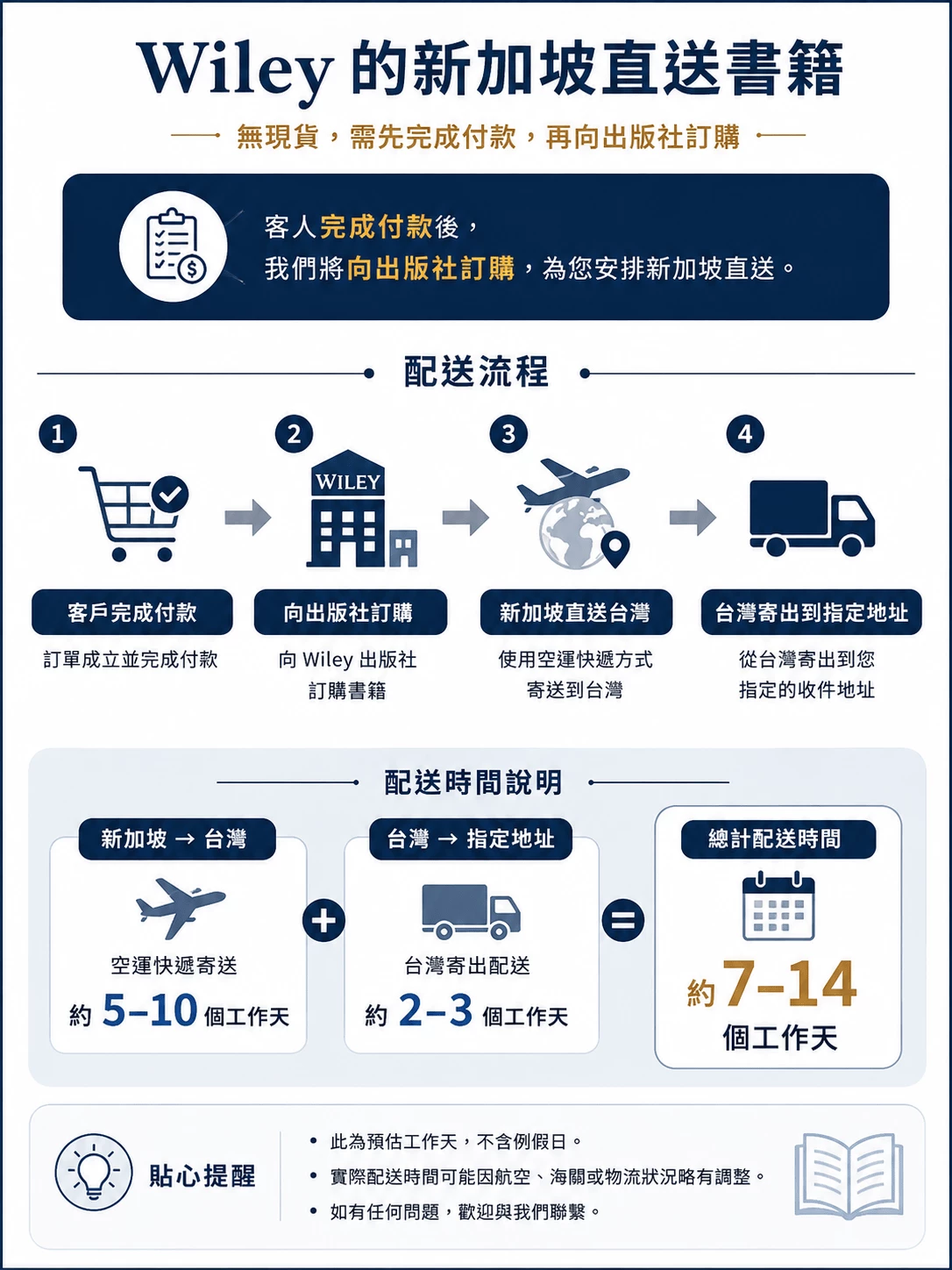
$8088元可訂購
簡介
Experimental Organic Chemistry, is designed for a two semester, sophomore level organic lab course and can be used as a primary text or a valuable reference tool for students. Rather than emphasizing microscale or macroscale, this lab manual focuses on the actual experiments and the learning process by using a multiscale approach. Palleros has great depth and a wide variety of experiments targeting chemistry, pre-med, biochemistry, and molecular biology students.
目錄
Section 1 The Basics 1
Unit 1 Laboratory Safety 3
1.1 General Safety Guidelines 3
1.2 Chemical Toxicity 6
1.3 Dealing with Chemicals and Waste Disposal 7
1.4 Online Safety Resources 15
Unit 2 Basic Concepts 19
2.1 Polarity and H-Bonds 19
2.2 Physical Data 23
2.3 Solvents 24
2.4 Balancing Chemical Equations 26
2.5 Concentration Units 28
2.6 Moles and Millimoles 29
2.7 Mineral Acids 31
2.8 Calculation of Yields 32
2.9 Scaling Up, Scaling Down 34
2.10 Keeping Lab Books and Writing Lab Reports 34
2.11 Chemical Literature 35
Unit 3 Basic Operations 45
3.1 Handling Liquids 45
3.2 Heating 46
3.3 Filtration 47
3.4 Refluxing 51
3.5 Evaporation 53
3.6 Centrifugation 55
3.7 Caring for Glassware 55
3.8 Measuring Pressure 57
Section 2 The Experiments 59
Unit 4 Recrystallization and Melting Point 61
4.1 Overview 61
4.2 Recrystallization 62
4.3 Decolorizing Charcoal 69
4.4 Recrystallization from Mixed Solvents 70
4.5 Microscale Recrystallization 70
4.6 Melting Point 71
4.7 Sublimation 75
Experiment 4 Recrystallization of Acetanilide and Urea 79
E4.1 Recrystallization of Acetanilide 80
E4.2 Microscale Recrystallization of Urea 82
E4.3 Determination of Melting Points 82
Unit 5 Extraction 86
5.1 Introduction 86
5.2 Solvent-Solvent Partitioning 86
5.3 Macroscale Liquid-Liquid Extraction 92
5.4 Microscale Liquid-Liquid Extraction 93
5.5 Drying the Organic Layer 94
5.6 Solid-Liquid Extraction 95
5.7 Countercurrent Distribution 97
Experiment 5 Isolation of Caffeine from Tea 103
E5.1 Tea, Coffee, and Caffeine 103
E5.2 Caffeine from Tea: Overview of the Experiment 105
E5.3 Isolation of Caffeine 109
E5.4 Purification of Caffeine by Sublimation 110
E5.5 Purification of Caffeine by Recrystallization (Alternative Procedure) 111
Unit 6 Distillation — Separation and Purification of Organic Liquids 113
6.1 Boiling Point 113
6.2 Boiling Point and Molecular Structure 114
6.3 Simple Distillation 115
6.4 Fractional Distillation 120
6.5 Ideal and Nonideal Solutions 123
6.6 Azeotropic Mixtures 124
6.7 Fractionating Columns 125
6.8 Microscale Distillation 126
6.9 Boiling Point Determination 128
6.10 Vacuum Distillation 129
6.11 Steam Distillation 130
Experiment 6A Distillation of Alcohols 136
E6A.1 Distillation of Methanol from a Mixture with Ferric Chloride 136
E6A.2 Separation of Methanol-Water by Simple Distillation 137
E6A.3 Separation of Methanol-Water by Fractional Distillation 138
E6A.4 Analysis of the Distillation Fractions by Density 139
Experiment 6B Isolation of Anise Oil 142
E6B.1 Overview 142
E6B.2 Isolation of Anise Oil 142
Unit 7 Gas Chromatography 144
7.1 Introduction 144
7.2 The Chromatographic Methods 144
7.3 Partition Chromatography 146
7.4 Gas Chromatography 149
7.5 The Gas Chromatograph 151
7.6 Measuring the Retention Time 155
7.7 Integration 156
7.8 Quantitative Analysis 157
7.9 Quantitative Analysis: A Closer Look (Advanced Level) 158
7.10 Qualitative Analysis 161
7.11 Running GC: Step by Step 162
7.12 Gas Chromatography Do’s and Don’ts 163
Experiment 7A Gas Chromatography of Alcohols 167
E7A.1 Analysis of Alcohols 167
E7A.2 Separation of Methanol and Water 168
Experiment 7B Analysis of Anise Oil 170
E7B Analysis of Anise Oil 170
Unit 8 Thin-Layer Chromatography 172
8.1 Overview 172
8.2 The Adsorption Process 173
8.3 Selection of TLC Conditions 175
8.4 Running TLC Plates 178
8.5 Adsorption Isotherms (Advanced Level) 182
8.6 Applications of TLC 184
8.7 Other Stationary Phases 186
8.8 TLC Do’s and Don’ts 186
Experiment 8 TLC Analysis of Vegetable Extracts 190
E8.1 Plant Pigments 190
E8.2 Isolation and Analysis of Plant Pigments 192
Unit 9 Column Chromatography 197
9.1 Overview 197
9.2 Practical Aspects 197
9.3 Applications 202
9.4 Column Chromatography Do’s and Don’ts 203
Experiment 9 Isolation of C60 from Fullerene Soot 206
E9.1 Fullerenes 206
E9.2 Isolation of Fullerenes 207
E9.3 A Chemical Test for Fullerenes 208
E9.4 Overview of the Experiment 209
E9.5 Isolation of C60 from Fullerene Soot 209
Unit 10 High-Performance Liquid Chromatography 214
10.1 Overview 214
10.2 HPLC Systems 214
10.3 HPLC Versus GC 215
10.4 Solvents 216
10.5 Pumps 217
10.6 Injection Port 217
10.7 Columns 218
10.8 Detectors 219
10.9 Why is HPLC High Performance? 220
10.10 Reversed-Phase Chromatography 221
10.11 Other Chemically Bonded Stationary Phases 222
10.12 Size-Exclusion Chromatography 223
10.13 Quantitative Determinations: Standard Curve Method 224
10.14 HPLC Do’s and Don’ts 224
Experiment 10 Vitamin Analysis—A Quantitative Study 227
E10.1 Water-Soluble and Fat-Soluble Vitamins 227
E10.2 Vitamin Stability 229
E10.3 International Units 230
E10.4 Characterization of Vitamin A 230
E10.5 Overview of the Experiment 231
Unit 11 Refractometry and Polarimetry 238
11.1 Refractive Index 238
11.2 The Refractometer 239
11.3 Measuring the Refractive Index 240
11.4 Polarimetry 242
11.5 The Polarimeter 245
11.6 Measuring the Optical Rotation 246
11.7 Optical Rotation of Mixtures 247
Experiment 11A Analysis of Essential Oils 250
E11A.1 Terpenoids 250
E11A.2 Essential Oils 252
E11A.3 Specific Rotation 253
E11A.4 Refractive Index 253
E11A.5 Composition of Essential Oils 253
Experiment 11B Separation of Carvone and Limonene 255
E11B.1 Carvone and Limonene 255
E11B.2 Analysis of the Crude Oils 256
E11B.3 Separation of Carvone and Limonene 257
Unit 12 Alcohols and Alkenes 261
12.1 Alkenes from Alcohols 261
12.2 Dehydration Mechanisms 262
12.3 Characterization of Alkenes 264
Experiment 12 The Dehydration of Methylcyclohexanols 268
E12.1 Overview 268
E12.2 Dehydration of Methylcyclohexanols 269
E12.3 Analysis of the Product Mixture 270
Unit 13 Alkyl Halides 273
13.1 Preparation 273
13.2 Reactions 274
13.3 Alkyl Halides from Alcohols 274
13.4 Characterization Tests 276
Experiment 13 Synthesis of n-ButyI Bromide and 2-ChIoro-2-MethyIbutane 280
E13.1 Synthesis of n-Buty1 Bromide 280
E13.2 Synthesis of 2-Ch1oro-2-Methy1butane 284
E13.3 Characterizahon Tests 285
Unit 14 Acid-Base Extraction 292
14.1 Introduction 292
14.2 Acids and Bases 292
14.3 Structural Effects on Acid-Base Properties 294
14.4 Acid-Base Extraction 298
14.5 Overview 303
Experiment 14A Isolation of Eugenol from Cloves 307
E14A.1 Ancient Medicine 307
E14A.2 Eugenol from Cloves: Overview of the Experiment 307
E14A.3 Isolation of Eugenol 308
E14A.4 GC and IR Analyses 310
Experiment 14B Isolation of the Active Ingredients in an Analgesic Tablet 315
E14B.1 Overview 315
E14B.2 Separation of the Active Ingredients in Excedrin 317
E14B.3 Analysis 317
Unit 15 Phenols and Ethers 323
15.1 Phenols and Ethers 323
15.2 Williamson Ether Synthesis 323
15.3 Characterization of Phenols: Ferric Chloride Test 324
15.4 IR and NMR of Phenols and Ethers 325
Experiment 15 Medicinal Chemistry: From Tylenol to a Banned Chemical 327
E15.1 Analgesics 327
E15.2 The Experiment: Overview 329
E15.3 Conversion of Acetaminophen into Phenacetin 330
E15.4 Ferric Chloride Test 332
E15.5 Analysis of Analgesics by TLC 332
Unit 16 Electrophilic Aromatic Substitution 336
16.1 Mechanism of Electrophilic Aromatic Substitution 336
16.2 Nitration and Halogenation 337
16.3 Effects of Substituents 338
Experiment 16A lodinatian of Tyrosine 342
E16A.1 Synthesis of 3,5-Diiodotyrosine 342
Experiment 16B Two Substitution Puzzles 350
E16B.1 Overview 350
E16B.2 NMR Analysis 351
E16B.3 Nitration of Phenacetin 352
E16B.4 Bromination of Phenacetin 353
Unit 17 Nucleophilic Aromatic Substitution 355
17.1 Nucleophilic Aromatic Substitution 355
17.2 Dinitroanilines 356
Experiment 17 Dinitrocompounds—Herbicides 360
E17.1 Synthesis of Trifluralin 360
E17.2 Synthesis of N -(n-Buty1) -2,4-Dinitroani1ine 361
E17.3 Herbicide Effects of Trifluralin and N -(n-Butyl) -2,4-Dinitroaniline 362
Unit 18 Chemical Kinetics 368
18.1 Mechanistic Studies 368
18.2 Chemical Kinetics 368
18.3 Experimental Aspects 370
18.4 Integrated Rate Equations 370
18.5 Reaction Half-Life 372
18.6 Transition States 372
18.7 Dependence of the Rate Constant with Temperature: Arrhenius Equation 375
18.8 Following the Kinetics 375
18.9 Best Fit 377
Experiment 18 Nucleophilic Aromatic Substitution Kinetics 381
E18.1 The Problem 381
E18.2 To Follow the Kinetics 383
E18.3 Overview of the Experiment 383
E18.4 Synthesis of 2,4-Dinitroanisole 384
E18.5 Visible Spectrum of N-(n-Butyl) -2,4-Dinitroaniline 384
E18.6 Beer’s Law of N-(n-Butyl) -2,4-Dinitroaniline 385
E18.7 Kinetics of the Reaction of 2,4-Dinitroanisole with n-Butylamine in Methanol 385
Unit 19 Diels-Alder Reaction 391
19.1 Diels—Alder Reaction 391
19.2 Endo versus Exo 392
19.3 Solvent Effects 393
19.4 Experimental Considerations: Following the Reaction 395
Experiment 19A Diels—Alder Reactions in Toluene 398
E19A.1 Reaction of 9-Anthraldehyde with Maleic Anhydride 398
E19A.2 Reaction of Phencyclone with Norbornadiene 400
Experiment 19B Diels—Alder Reaction in Water 408
E19B.1 Reaction of 9-Anthracenemethanol with N-Ethylmaleimide 408
E19B.2 Kinetics of the Reaction of 9-Anthracenemethanol with NEM 409
Unit 20 Aldehydes and Ketones 415
20.1 Introduction 415
20.2 Preparation 416
20.3 Reactions of Aldehydes and Ketones 416
20.4 IR and NMR of Aldehydes and Ketones 423
Experiment 20A Identification of Aldehydes and Ketones 427
E20A.1 Characterization Tests 428
E20A.2 Preparation of Derivatives 430
E20A.3 The Unknown 430
Experiment 20B Synthesis of trans-Cinnamic Acid 433
E20B Synthesis of trans-Cinnamic Acid: Perkin Condensation, 433
Unit 21 Oxidation-Reduction 438
21.1 Overview 438
21.2 Selectivity 439
21.3 Oxidations 440
21.4 Phase Transfer Catalysis 444
21.5 Reductions 445
Experiment 21 Oxidation-Reduction 451
E21.1 Reduction of Benzophenone 451
E21.2 Oxidation of Benzhydrol 452
E21.3 Reduction of trans-Cinnamaldehyde 453
E21.4 Oxidation of trans-Cinnamyl Alcohol 454
E21.5 Reduction of Camphor 455
E21.6 Oxidation of Isoborneol 456
E21.7 Synthesis of Terephthalic Acid 456
E21.8 Monoreduction of m-Dinitrobenzene 458
Unit 22 Esters 473
22.1 Esters in Nature and Society 473
22.2 Preparation of Esters 474
22.3 Acetylation 476
22.4 Ester Hydrolysis 476
22.5 Characterization of Esters 477
22.6 IR and NMR of Esters and Carboxylic Acids 477
Experiment 22A Preparation of Fruity Fragrances 480
E22A.1 Preparation of Methyl trans-Cirinamate: A Component of Strawberry Aroma 480
E22A.2 Preparation of n-Propy1 Acetate and Isoamyl Acetate 482
E22A.3 Hydroxamic Acid Test 484
Experiment 22B Transforming Bengay into Aspirin 491
E22B.1 Overview 491
E22B.2 Separation of Methyl Salicylate, 493
E22B.3 Hydrolysis of Methyl Salicylate, 493
E22B.4 Synthesis of Aspirin 494
E22B.5 Analysis 494
Unit 23 Multistep Synthesis 499
23.1 Overview 499
23.2 Multistep Synthesis 500
23.3 Retrosynthetic Analysis 502
23.4 Planning a Multistep Synthesis 507
23.5 Linear versus Convergent Synthesis 508
Experiment 23A Synthesis of an Ant Alarm Pheromone: 2-Methyl-4-Heptanone 511
E23A.1 Overview 511
E23A.2 Synthetic Route 511
E23A.3 Grignard Reactions 512
E23A.4 Oxidation of Secondary Alcohols 514
E23A.5 Synthesis of 2-Methyl-4-Heptanol 514
E23A.6 Synthesis of 2-Methyl-4-Heptanone 516
E23A.7 Vacuum Distillation 516
Experiment 23B Synthesis of Ionones: An Open-Ended Experiment 520
E23B.1 lonones 520
E23B.2 Synthetic Pathway 520
E23B.3 Characterization of lonones 522
E23B.4 Preparation of Pseudoionones 523
E23B.5 Cyclization with Sulfuric Acid-Acetic Acid 524
E23B.6 Cyclization with Phosphoric Acid 525
Unit 24 Molecules of Life 532
24.1 Proteins 532
24.2 Carbohydrates 539
Experiment 24 Chemistry of Milk 546
E24.1 Composition of Milk 546
E24.2 Isolation and Characterization of Casein 549
E24.3 Isolation and Characterization of Lactose 552
Unit 25 Lipids 556
25.1 Fats and Oils 556
25.2 Characterization of Oils 558
25.3 Uncommon Fatty Acids and Related Compounds 559
25.4 Saponification 560
25.5 Steroids 560
25.6 Bile Acids 562
25.7 Inclusion Compounds 562
Experiment 25 Lipids 566
E25.1 Analysis of Oils 566
E25.2 Trimyristin From Nutmeg 567
E25.3 Preparation of Azelaic Acid from Castor Oil 569
E25.4 Urea Complexes of Fatty Acids 570
E25.5 Solubility of Cholesterol 570
E25.6 Bile Acids 571
Unit 26 Polymers 577
26.1 Introduction 577
26.2 Chain-Reaction Polymerization 579
26.3 Step-Reaction Polymerization 581
26.4 Polymer Structure 583
26.5 Some Typical Polymers 584
26.6 Plasticizers 588
26.7 Applications and Recycling 589
26.8 Identification of Plastics 590
Experiment 26 Synthesis and Analysis of Polymers 595
E26.1 Overview 595
E26.2 Emulsion Polymerization of Styrene with Persulfate 596
E26.3 Emulsion Polymerization of Methyl Methacrylate 597
E26.4 Bulk Copolymerization of Styrene and Divinylbenzene: Effect of a Plasticizer 598
E26.5 Bulk Polymerization of Methyl Methacrylate 599
E26.6 Cellulose Triacetate 599
E26.7 Phenolic Resins 601
E26.8 Preparation of Nylon 6.6: The Nylon Rope Trick 601
E26.9 Analysis of Polymers 602
Unit 27 Dyes and Pigments
27.1 Dyes, Pigments, and Colors 611
27.2 Azo Dyes 612
27.3 Synthesis of Azo Dyes 613
27.4 Cationic Dyes 615
27.5 Anthraquinone Dyes 616
27.6 Indigo Dyes 617
27.7 Other Dyes 618
27.8 Mode of Application 619
27.9 Dyeing 620
Experiment 27 Colored Chemistry 626
E27.1 Direct Dyes 627
E27.2 Mordant Dyeing 630
E27.3 Ingrain Dyes 630
E27.4 Vat Dyes 632
E27.5 Dye Fastness 633
Unit 28 Bioorganic Chemistry 635
28.1 Enzymes: Biological Catalysts 635
28.2 How Enzymes Work 635
28.3 Using Enzymes 637
28.4 Prochiral Molecules 639
28.5 Reduction of Ketones 640
28.6 Enantiomeric Excess 642
Experiment 28 Asymmetric Synthesis with Baker’s Yeast: An Open-Ended Experiment 645
E28.1 Overview 645
E28.2 Investigating the Course of the Reaction 646
E28.3 Conformational Analysis: Determining Whether the Diol is Threo or Erythro (Advanced Level) 647
E28.4 Reduction of 1-Pheny1-1,2-Propanedione with Baker’s Yeast 649
E28.5 Analysis 650
Unit 29 Molecules of Heredity 653
29.1 Nucleosides and Nucleotides 653
29.2 Base Pairing 656
29.3 Purine and Pyrimidine Bases 657
29.4 Chemical Transformations 658
Experiment 29 Analysis of Nucleosides 662
E29.1 Overview of the Experiment 662
E29.2 Analysis of an RNA Digest 662
E29.3 Deamination of Cytidine to Uridine 664
Section 3 Spectroscopy 667
Unit 30 Absorption Spectroscopy 669
30.1 The Nature of Light 669
30.2 Interaction between Electromagnetic Radiation and Matter 670
30.3 Absorption Spectroscopy 672
Unit 31 Infrared Spectroscopy 675
31.1 Molecular Vibrations 675
31.2 Stretching and Bending Vibrations 677
31.3 IR and Dipole Moment 679
31.4 Regions of the IR Spectrum 680
31.5 Experimental Aspects 681
31.6 Interpreting IR Spectra 685
31.7 Case Studies 693
31.8 Concentration and Solvent Effects on IR 695
31.9 Instrumentation 697
Unit 32 Ultraviolet-Visible Spectroscopy 707
32.1 Electronic Transitions 707
32.2 Chromophores and Auxochromes 709
32.3 Structural Effects on UV-Visible Spectra: Woodward—Fieser Rules 710
32.4 Applications of UV-Visible Spectroscopy 711
32.5 Spectrophotometers 714
Unit 33 Nuclear Magnetic Resonance 719
33.1 Nuclear Spin 719
33.2 The Resonance Phenomenon: A Closer Look 721
33.3 Obtaining the NMR Spectrum 724
33.4 1H-NMR 726
33.5 Electronic Shielding 727
33.6 The Chemical Shift 729
33.7 Effect of Pi Electrons 730
33.8 Hydrogen Equivalence: A Closer Look 732
33.9 Integrals 732
33.10 Spin-Spin Splitting 734
33.11 Typical Coupling Patterns 739
33.12 The Coupling Constant 739
33.13 Coupling: A Closer Look 742
33.14 Chemical Shift Correlations 750
33.15 Coupling of Hydrogens Attached to Heteroatoms 756
33.16 13C-NMR 758
33.17 13C-NMR Chemical Shifts 760
33.18 Aromatic Systems 765
33.19 Effect of Chirality on the NMR 768
33.20 Running the Spectrum 771
33.21 Two-Dimensional NMR 772
33.22 Interpreting 1H-NMR Spectra 774
Unit 34 Mass Spectrometry 783
34.1 Overview 783
34.2 Instrumentation 784
34.3 The Molecular Ion 785
34.4 Charge Localization 789
34.5 Fragmentations 790
34.6 MS Case Studies 796
34.7 Interpreting Mass Spectra 798
34.8 High-Resolution Mass Spectra 800
Answers to Odd-Numbered Exercises 803
Credits 821
Index 823
Index of Spectra 834