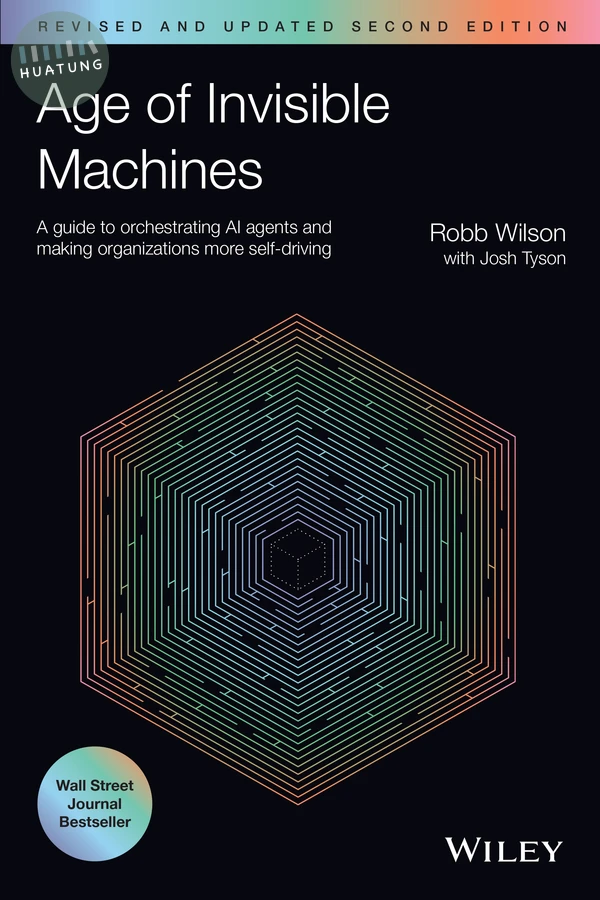
Age of Invisible Machines
$757元 定價: $841 9折 可訂購
簡介
USA Today Bestseller
The Book That Saw 2027—In 2022. Now Sharpened for the Road Ahead.
Age of Invisible Machines quickly earned a reputation as a prophetic guide for technology and business leaders, offering a clear vision of what was coming just before it arrived. When the first edition launched in late 2022, few had seen the tidal wave of generative AI coming. But Robb Wilson and Josh Tyson had. Their predictions—including the pivotal role of large language models and conversational interfaces—soon became reality, helping thousands of readers understand, prepare for, and act on the AI shift already reshaping the world.
Now, the newly revised second edition pushes that vision forward—offering a 2027-level roadmap for software architects, enterprise architects, developers, product owners, and future-focused executives who are ready to build what's next.
This expanded edition introduces timely, practical guidance on:
Harnessing generative AI in the software development lifecycle
Building composable, agentic systems that scale
Orchestrating intelligent agents across knowledge, process, and interface layers
Designed for architects of all kinds—enterprise, system, solution, and experience—this book distills decades of R&D, implementation, and design into a playbook for AI-native transformation.
You’ll also find insights drawn from exclusive conversations on the Invisible Machines podcast with pioneers including:
Cassie Kozyrkov (Google’s first Chief Decision Scientist)
Jaron Lanier (Microsoft OCTOPUS)
Tom Gruber & Adam Cheyer (Siri co-creators)
Cathy Pearl (UX Lead, Google Gemini)
Jonathan Frankle (Chief AI Scientist, Databricks/Mosaic ML), Kara Swisher, Jim Webber (Chief Scientist, Neo4j), and more
With AI accelerating faster than most enterprises can adapt, this book provides both the urgency and the operational clarity leaders need to move from exploration to execution. It’s an indispensable resource for those shaping the future of platforms, systems, teams, and entire organizations.
If the first edition helped readers see the future of AI in 2023—this one will help you navigate 2027 and beyond.
目錄
Preface by Josh Tyson vii
Acknowledgments ix
Introduction xi
Part I Imagining an Ecosystem of Orchestrated AI Agents 1
Chapter 1: Organizational Artificial General Intelligence Is Already Upon Us 3
Chapter 2: What Agentic AI Is— and Isn’t 21
Chapter 3: Competing in the Age of OAGI 37
Chapter 4: The Ethics of Experiential AI 53
Chapter 5: How Organizational AGI Can Change the World 65
Chapter 6: This Journey Has Been Personal 95
Chapter 7: Learning the Terms 103
Part II Planning An Ecosystem for Orchestrated Ai Agents 115
Chapter 8: The Dream vs. Reality 119
Chapter 9: Ecosystem Evolution Explained 125
Chapter 10: Teams and the Co-Creation Mindset 137
Chapter 11: How to Architect Tools Like LLMs, Agents, and Generative AI 149
Chapter 12: Organizational AGI Demands an Extensible Cognitive Architecture 165
Chapter 13: Digital Twins in SPACE 187
Part III Building an Ecosystem for Orchestrated AI Agents 197
Chapter 14: Orchestrating AI Agents to Become Organizational Operating Systems 199
Chapter 15: Design Strategy for Organizational AGI 223
Chapter 16: Production Design for Organizational AGI 249
Chapter 17: Best Practices in Conversational Design 259
Part IV Conclusion 277
Chapter 18: Where Do We Go from Here? 279
Notes 293
About the Authors 301
Index 303