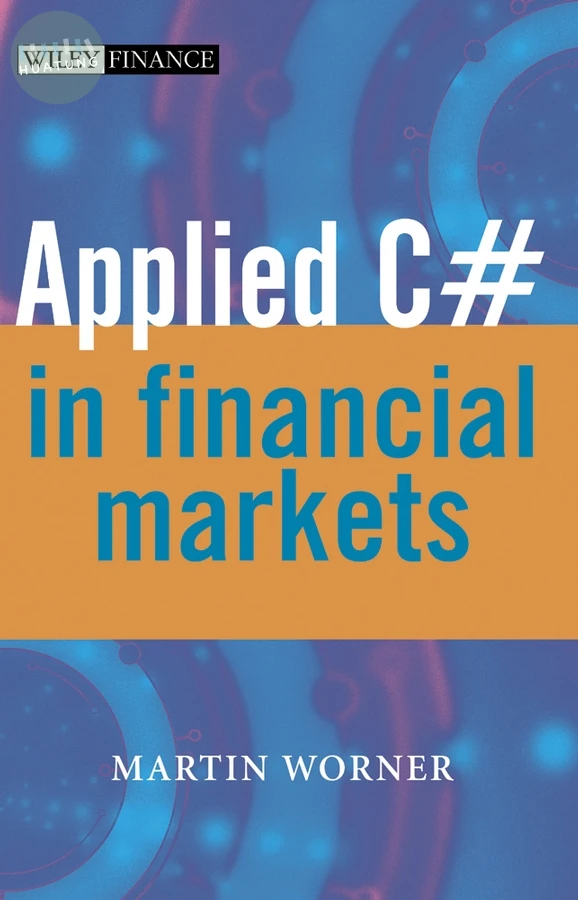

Applied C# in Financial Markets
$3174元 定價: $3527 9折 可訂購
簡介
Applied C# in Financial Markets covers all the aspects of C# relevant to practitioners working in financial sector. It contains a practical workshop which builds on the material in the book, guiding you through all the stages of building a multiple model options calculator. An accompanying website features examples, illustrations and solutions to the workshops and a downloadable application to complement the book. Features examples and illustrations taken from a sample trading application, making the book relevant to those working in the financial markets.
Provides a quick start to C# for financial professionals to hit the ground running in building financial applications.
Workshops illustrate building an options calculator, exploring the various elements in C# as they progress.
目錄
List of Examples. List of Figures.
List of Tables.
Preface.
1 What is .NET and how does C# fit in?
1.1 .NET framework and the common language runtime.
2 The Basics of C#.
2.1 Assignment, mathematic, logical and conditional operators.
2.1.1 Assignment operator.
2.1.2 Mathematical operators.
2.1.3 Calculate and re-assign operators += −=*= /=.
2.1.4 Logical operators.
2.1.5 Operator precedence.
2.2 Data structures.
2.2.1 Built-in types.
2.2.2 Casting and type converting.
2.2.3 Strings.
2.2.4 StringBuilder.
2.2.5 Regex.
2.2.6 Arrays.
2.2.7 Collections.
2.3 Control structures.
2.3.1 if/else.
2.3.2 switch.
2.3.3 while.
2.3.4 do/while.
2.3.5 for loop.
2.3.6 foreach loop.
2.4 Summary.
3 Object Oriented Programming.
3.1 Introduction to classes.
3.1.1 Exception handling.
3.1.2 User defined exception class.
3.1.3 Workshop: Exercise one.
3.2 Inheritance and polymorphism.
3.2.1 Applying inheritance and polymorphism to finance.
3.2.2 Interfaces.
3.2.3 Multiple threading or asynchronous programming.
3.2.4 Workshop: Exercise two.
3.3 Summary.
4 Databases.
4.1 ADO.NET object model.
4.2 Connecting to the database.
4.3 Connection pools.
4.4 Database handler.
4.5 Working with data.
4.6 Transactions.
4.7 Workshop: Exercise three.
4.8 Summary.
5 Input & Output.
5.1 Streams.
5.2 Serialisation.
5.3 Workshop: Exercise four.
5.4 Summary.
6 XML.
6.1 Schema validation.
6.2 XML and ADO.NET.
6.3 Workshop: Exercise five.
6.4 Summary.
7 Building Windows Applications.
7.1 Creating a new project in visual studio.NET.
7.2 Managing projects with the Solution explorer and class view.
7.3 Working with components on forms.
7.3.1 Model view control.
7.4 Workshop Exercise six.
7.5 Summary.
8 Deployment.
8.1 Assemblies.
8.1.1 Metadata.
8.1.2 Shared assemblies.
8.2 Summary.
Bibliography.
Appendices.
Appendix A: Specification for an options calculator.
Appendix B: System design.
Appendix C: Calculation models.
Index.