
簡介
EPISTEMOLOGY “This is a superb companion to Epistemology: An Anthology. It consists of sixty commentaries, one for each of the sixty entries in that anthology. Turri is an extremely lucid writer, with a wonderful knack for finding and laying out argumentative structure, and for explaining crucial concepts. His commentary will greatly aid student comprehension and enhance class discussion.”
Ernest Sosa, Rutgers University “Turri’s discussions are engaging and lucid. They are written for beginning students and will serve that purpose beautifully, but they are so well done that even veteran epistemologists will find them helpful.”
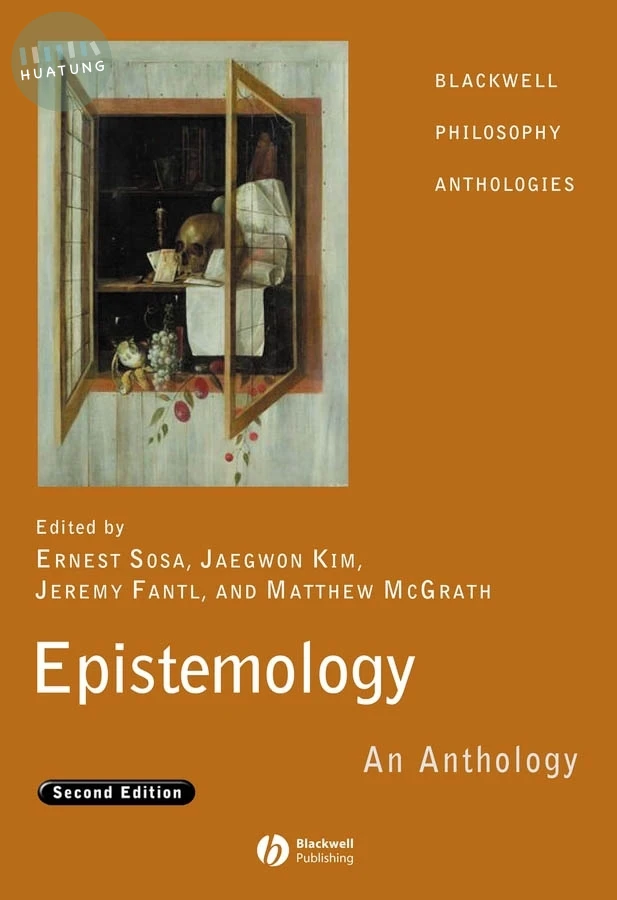
John Greco, Saint Louis University Epistemology: A Guide is a straightforward and accessible introduction to contemporary epistemology for those studying the topic for the first time. It introduces and explains the main arguments of the most influential publications in the field from the last 50 years. Balancing simplicity of argument with accuracy and detail, this guide covers the central topics of theory of knowledge, including skepticism, epistemic justification, epistemic closure, virtue epistemology, and naturalized epistemology. Instead of artificially treating themes in isolation, it provides a clear context for key topics and concepts. Designed to stand alone or to accompany the second edition of Epistemology: An Anthology (Wiley Blackwell, 2008), this is a deft and concise introduction to a foundational topic in philosophy.
目錄
Preface xi Acknowledgments xiii
1 The best case for skepticism about the external world?
(Stroud, “The Problem of the External World”) 1
2 Proving the external world exists
(Or: Let’s all give Moore a hand!) (Moore, “Proof of an External World”) 6
3 Some ways of resisting skepticism
(Moore, “Four Forms of Scepticism”) 10
4 Plausibility and possibilities
(Moore, “Certainty”) 15
5 Skeptic on skeptic
(Klein, “How a Pyrrhonian Skeptic Might Respond to Academic Skepticism”) 19
6 Realism in epistemology
(Williams, “Epistemological Realism”) 24
7 Socratic questions and the foundation of empirical knowledge
(Chisholm, “The Myth of the Given”) 31
8–9 The foundation of empirical knowledge?
(Sellars, “Does Empirical Knowledge Have a Foundation?” and “Epistemic Principles”) 36
10 It’s not a given that empirical knowledge has a foundation
(BonJour, “Can Empirical Knowledge Have a Foundation?”) 44
11 Interpretation, meaning and skepticism
(Davidson, “A Coherence Theory of Truth and Knowledge”) 49
12 Blending foundationalism and coherentism
(Haack, “A Foundherentist Theory of Epistemic Justification”) 54
13 Foundationalism, coherentism and supervenience
(Sosa, “The Raft and the Pyramid”) 60
14 Infinitism
(Klein, “Human Knowledge and the Infinite Regress of Reasons”) 67
15 The Gettier problem
(Gettier, “Is Justified True Belief Knowledge?”) 73
16 Some principles concerning knowledge and inference
(Harman, Thought, Selections) 77
17 The essence of the Gettier problem
(Zagzebski, “The Inescapability of Gettier Problems”) 83
18 Knowledge is an unanalyzable mental state
(Williamson, “A State of Mind”) 85
19 Closure, contrast and semi-skepticism
(Dretske, “Epistemic Operators”) 92
20 Closure, contrast and anti-skepticism
(Stine, “Skepticism, Relevant Alternatives, and Deductive Closure”) 99
21 Keeping close track of knowledge
(Nozick, “Knowledge and Skepticism”) 103
22 Moore wins
(Sosa, “How to Defeat Opposition to Moore”) 111
23 The closure principle: dangers and defense
(Vogel, “Are There Counter examples to the Closure Principle?”) 116
24 Evidentialist epistemology
(Feldman and Conee, “Evidentialism”) 123
25 Non-defensive epistemology
(Foley, “Skepticism and Rationality”) 129
26 Reliabilism about justification
(Goldman, “What Is Justified Belief?”) 135
27 Reliabilism: a level assessment
(Vogel, “Reliabilism Leveled”) 141
28 Against externalism
(BonJour, “Externalist Theories of Empirical Knowledge”) 146
29 Against internalism
(Goldman, “Internalism Exposed”) 151
30 A skeptical take on externalism
(Fumerton, “Externalism and Skepticism”) 156
31 A friendly take on internalism
(Feldman and Conee, “Internalism Defended”) 159
32 Warrant
(Plantinga, “Warrant: A First Approximation”) 164
33 Intellectual virtues
(Zagzebski, Virtues of the Mind) 169
34 Virtue epistemology
(Greco, “Virtues and Vices of Virtue Epistemology”) 172
35 Knowledge, luck and virtue
(Pritchard, “Cognitive Responsibility and the Epistemic Virtues”) 176
36 Epistemic value and cognitive achievement
(Sosa, “The Place of Truth in Epistemology”) 181
37 Giving up on knowledge
(Kvanvig, “Why Should Inquiring Minds Want to Know?”) 187
38 Giving up on (exact) truth
(Elgin, “True Enough”) 192
39 Naturalized epistemology advertised
(Quine, “Epistemology Naturalized”) 196
40 Naturalized epistemology criticized
(Kim, “What is ‘Naturalized Epistemology’?”) 203
41 Naturalized epistemology radicalized
(Antony, “Quine as Feminist”) 207
42 A apriori justification and unrevisability
(Putnam, “There is at Least One A Priori Truth”) 211
43 A priori justification and revisability
(Casullo, “Revisability, Reliabilism, and A Priori Knowledge”) 215
44 Philosophical method and empirical science
(Bealer, “A Priori Knowledge and the Scope of Philosophy”) 219
45 Experimental epistemology
(Weinberg, Nichols and Stich, “Normativity and Epistemic Intuitions”) 226
46 Natural kinds, intuitions and method in epistemology
(Kornblith, “Investigating Knowledge Itself”) 230
47 Contextualism and skeptical puzzles
(DeRose, “Solving the Skeptical Problem”) 235
48 Contextualism and infallibilist intuitions
(Lewis, “Elusive Knowledge”) 240
49 Contextualism and intuitional instability
(Cohen, “Contextualist Solutions to Epistemological Problems”) 244
50 Knowledge and action
(Stanley, “Knowledge and Practical Interests, Selections”) 247
51 Rationality and action
(Fantl and McGrath, “Evidence, Pragmatics, and Justification”) 252
52 One invariantist’s scorecard
(Hawthorne, “Sensitive Moderate Invariantism”) 258
53 A relativist theory of knowledge attributions
(MacFarlane, “The Assessment Sensitivity of Knowledge Attributions”) 264
54 Rationality and trust
(Baker, “Trust and Rationality”) 270
55 Testimony and gullibility
(Fricker, “Against Gullibility”) 273
56 Some reflections on how epistemic sources work
(Burge, “Content Preservation”) 277
57 Testimony and knowledge
(Lackey, “Testimonial Knowledge and Transmission”) 282
58 Memory and knowledge
(Huemer, “The Problem of Memory Knowledge”) 286
59 Perception and knowledge
(McDowell, “Criteria, Defeasibility, and Knowledge”) 291
60 Skills and knowledge
(Reynolds, “Knowing How to Believe with Justification”) 295
Index 299