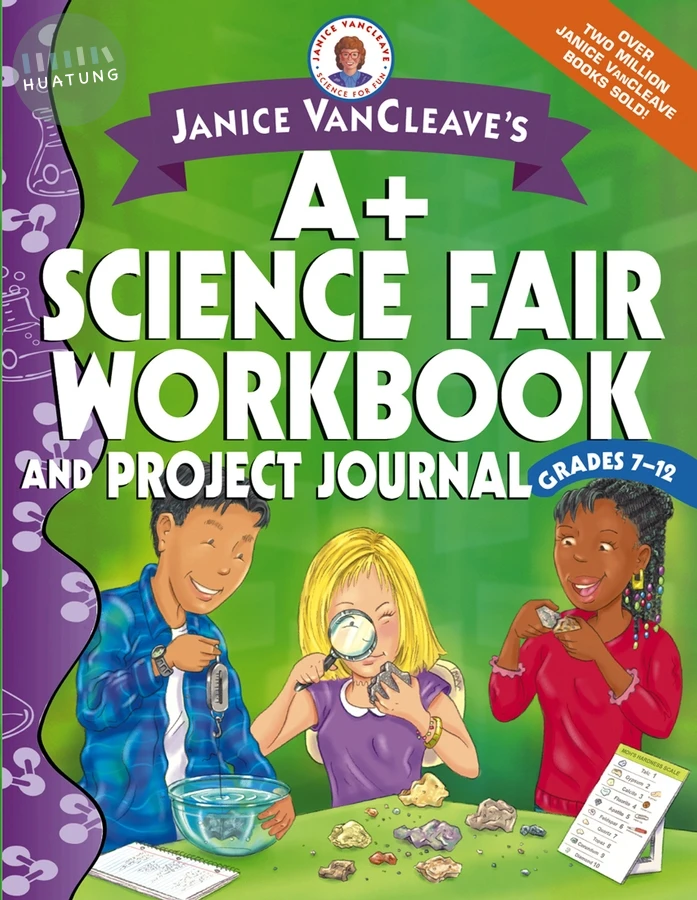

Janice VanCleave's A+ Science Fair Projects
$436元 定價: $484 9折 可訂購
簡介
A fabulous collection of science projects, explorations,techniques, and ideas!
Looking to wow the judges at the science fair this year? Everyone'sfavorite science teacher is here to help. Janice VanCleave's A+Science Fair Projects has everything you need to put together awinning entry, with detailed advice on properly planning yourproject, from choosing a topic and collecting your facts todesigning experiments and presenting your findings.
Featuring all-new experiments as well as time-tested projectscollected from Janice VanCleave's A+ series, this easy-to-followguide gives you an informative introduction to the science fairprocess. You get thirty-five complete starter projects on varioustopics in astronomy, biology, chemistry, earth science, andphysics, including explorations of:
* The angular distance between celestial bodies
* The breathing rate of goldfish
* Interactions in an ecosystem
* Nutrient differences in soils
* Heat transfer in the atmosphere
* Magnetism from electricity
* And much more!
You'll also find lots of helpful tips on how to develop your ownideas into unique projects. Janice VanCleave's A+ Science FairProjects is the ideal guide for any middle or high school studentwho wants to develop a stellar science fair entry.
目錄
How to Use This Book.
I. A GUIDE TO SCIENCE FAIR PROJECTS.
1. The Scientific Method.
2. Topic Research.
3. Categories.
4. Project Research.
5. Project Overview.
6. Experimental Data.
7. Project Summaries.
8. The Display.
9. Presentation and Evaluation.
II. 35 A+ SCIENCE FAIR PROJECT IDEAS.
Astronomy.
1. Solar System Scale: Miniature Model (Planetology).
2. Angular Separation: Angular Distance between Celestial Bodies(Astronometry).
3. Orbital Period: Time of Revolution (Celestial Mechanics).
4. Artificial Satellites: Man-made Orbiters (Astronautics).
5. Apparent Magnitude: Apparent Star Brightness(Astrophysics).
6. Sunspots: Cooler Surface Regions (Heliology).
7. Galilean Satellites: Jupiter's Largest Moons (PlanetarySatellite Science).
8. Meteors: Streaks of Light in the Sky (Meteoritics).
Biology.
9. Meristematic Region: Growth Zone(Botany--Morphology).
10. Seed Parts: Exterior and Interior(Botany--Anatomy).
11. Autotrophs: Food Builders (Botany--Physiology).
12. Aquatic Respiration: Breathing Rate of Goldfish(Zoology--Anatomy).
13. Operant Conditioning: The "Aha!" Response(Zoology--Behaviorism).
14. Ecosystem: Interactions (Ecology).
15. Preservatives: Food Additives (Microbiology).
Chemistry.
16. The Best Plant Food: Nutrient Differences in Soils(Agricultural Chemistry).
17. Acid-Base Indicators: Color Changers (InorganicChemistry).
18. Enzymes: Chemical Controllers (Biochemistry).
19. Triglycerides: Saturated and Unsaturated (OrganicChemistry).
20. Vitamin C Content: Analysis of Food by Titration (AnalyticalChemistry).
21. Viscosity: A Difference in Stickiness (PhysicalChemistry).
Earth Science.
22. The Hydrologic Cycle: The Movement of Water from Place toPlace (Physical Geology--Hydrology).
23. Minerals: Distinguishing Physical Characteristics ofMinerals (Physical Geology--Mineralogy).
24. The Rock Cycle: Processes That Change One Rock Type intoAnother (Physical Geology--Petrology).
25. Soil Texture: Effects of Regolith Size (PhysicalGeology--Soil Science).
26. Topography: Highs and Lows of the Earth's Surface(Physical Geography--Topography).
27. The Greenhouse Effect: Heat Transfer in the Atmosphere(Meteorology).
28. Soundings: Mapping a Profile of the Ocean Floor(Oceanography).
Physics.
29. Resonance: Sympathetic Vibration (Acoustics).
30. Thermal Conduction: Transfer of Vibrational Energy(Thermodynamics).
31. Static Electricity: Stationary Charges (Elementary ParticlePhysics).
32. Electromagnetism: Magnetism from Electricity(Electrodynamics).
33. Static Fluids: Fluids at Rest (Fluid Dynamics).
34. Newton's Third Law of Motion: Action-Reaction(Mechanics).
35. Polarization: Vibrations in One Direction (Optics).
Appendix 1: Random Error of Measurement.
Appendix 2: Relative Error: Percentage Error.
Appendix 3: Planet Facts and Figures.
Appendix 4: Random Sampling in an Open Ecosystem.
Appendix 5: Cross-Staff.
Appendix 6: Preparing Test Solutions.
Appendix 7: Manometer.
Appendix 8: Science Project and Experiment Books.
Appendix 9: Sources of Scientific Supplies.
Glossary.
Index.