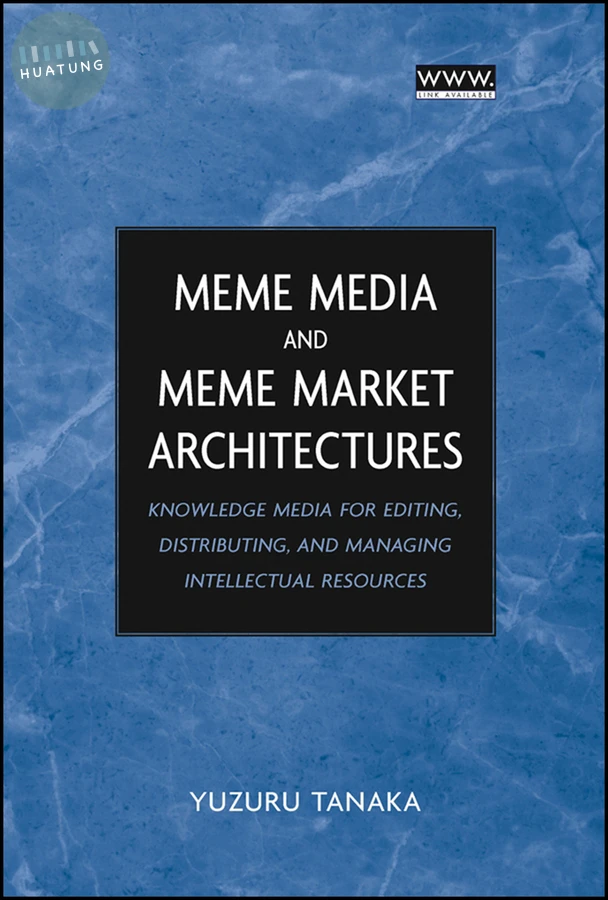
Meme Media and Meme Market Architectures
$6047元 定價: $6719 9折 可訂購
簡介
This book provides an integrated view of the five kinds of enabling technologies in terms of knowledge media architectures: multimedia and hypermedia, object-oriented GUI and visual programming, reusable component software and component integration, network publishing and electronic commerce, and object-oriented and multimedia databases. Among many books on multimedia and hypermedia, few address knowledge. Of those that do, none focus on media for the editing, distribution, and management of knowledge the way this book does. It is written based on the hypothesis that knowledge media work as genes, with their network publishing repository, working as a gene pool to accelerate the evolution of knowledge shared in our societies.
目錄
Preface xvii
1 Overview and Introduction 1
1.1 Why Meme Media? 1
1.2 How Do Meme Media Change the Reuse of Web Contens? 3
1.3 How Do Meme Media Work? 7
1.4 Frequently Asked Questions and Limitations 8
1.5 Organization of this Book 9
2 Knowledge Media and Meme Media 11
2.1 Introduction to Knowledge Media and Meme Media 11
2.2 From Information Technologies to Media Technologies 27
2.3 Summary 34
3 Augmentation Media Architectures and Technologies— 35
3.1 History and Evolution of Augmentation Media 36
3.2 History and Evolution of Knowledge-Media Architectures 45
3.3 Meme Media and their Applications 48
3.4 Web Technologies and Meme Media 55
3.5 Summary 59
4 An Outline of IntelligentPad and Its Development History 67
4.1 Brief Introduction to IntelligentPad 67
4.2 IntelligentPad Architecture 70
4.3 Worldwide Marketplace Architectures for Pads 80
4.4 End-User Computing and Media Toolkit System 81
4.5 Open Cross-Platform Reusability 85
4.6 Reediting and Redistribution by End-Users 86
4.7 Extension toward 3D Representation Media 88
4.8 Summary 89
5 Object Orientation and MVC 92
5.1 Object-Oriented System Architecture—A Technical Introduction 93
5.2 Class Refinement and Prototyping 94
5.3 Model, View, Controller 95
5.4 Window Systems and Event Dispatching 99
5.5 Summary 103
6 Component Integration 106
6.1 Object Reusability 107
6.2 Components and Application Linkage 107
6.3 Compound Documents and Object Embedding/Linking 113
6.4 Generic Components 114
6.5 What to Reuse—Components or Sample Compositions? 115
6.6 Reuses and Maintenance 116
6.7 Integration of Legacy Software 118
6.8 Distributed Component Integration and Web Technologies 119
6.9 Summary 125
7 Meme Media Architecture 128
7.1 Current Megatrends in Computer Systems 128
7.2 Primitive Media Objects 129
7.3 Composition through Slot Connections 134
7.4 Compound-Document Architecture 136
7.5 Standard Messages between Pads 137
7.6 Physical and Logical Events and their Dispatching 140
7.7 Save and Exchange Format 146
7.8 Copy and Shared Copy 147
7.9 Global Variable Pads 149
7.10 Summary 149
8 Utilities for Meme Media 152
8.1 Generic Utility Functions as Pads 152
8.2 FieldPad for the Event Sharing 153
8.3 StagePad for Programming User Operations 166
8.4 Geometrical Management of Pads 181
8.5 Proxy Pads to Assimilate External Objects 181
8.6 Legacy Software Migration 185
8.7 Special Effect Techniques 186
8.8 Expression Pad 188
8.9 Transformation Pads 188
8.10 Summary 189
9 Multimedia Application Framework 191
9.1 Component Pads for Multimedia Application Frameworks 191
9.2 Articulation of Objects 195
9.3 Hypermedia Framework 199
9.4 Summary 204
10 IntelligentPad and Databases 205
10.1 Relational Databases, Object-Oriented Databases, and Instance Bases 205
10.2 Form Bases 208
10.3 Pads as Attribute Values 215
10.4 Multimedia Database 219
10.5 Hypermedia Database 224
10.6 Geographical Information Databases 228
10.7 Content-Based Search and Context-Based Search 232
10.8 Management and Retrieval of Pads 234
10.9 Summary 239
11 Meme Pool Architectures 242
11.1 Pad Publication Repository and the WWW 242
11.2 Pad Publication and Pad Migration 244
11.3 Web Pages as Pad Catalog 245
11.4 URL-Anchor Pads 248
11.5 HTMLViewerPad with Embedded Arbitrary Composite Pads 250
11.6 New Publication Media 253
11.7 Annotation on Web Pages 258
11.8 Piazza as a Meme Pool 260
11.9 Reediting and Redistributing Web Content as Meme Media Objects 263
11.10 Redistribution and Publication of Meme Media Objects as Web Content 285
11.11 Summary 288
12 Electronic Commerce for Pads 291
12.1 Electronic Commerce 291
12.2 From Pay-per-Copy to Pay-per-Use 293
12.3 Digital Accounting, Billing, and Payment 294
12.4 Ecology of Pads in the Market 295
12.5 Superdistribution of Pads 297
12.6 Pad Integration and Package Business 301
12.7 Summary 303
13 Spatiotemporal Editing of Pads 305
13.1 Geometrical Arrangement of Pads 305
13.2 Time-Based Arrangement of Pads 311
13.3 Spatiotemporal Editing of Pads 315
13.4 Information Visualization 320
13.5 Summary 323
14 Dynamic Interoperability of Pads and Workflow Modeling 325
14.1 Dynamic Interoperability of Pads Distributed across Networks 325
14.2 Extended Form-Flow System 331
14.3 Pad-Flow Systems 337
14.4 Dynamic Interoperability across Networks 338
14.5 Workflow and Concurrent Engineering 339
14.6 Summary 345
15 Agent Media 347
15.1 Three Different Meanings of Agents 347
15.2 Collaborative-and-Reactive Agents and Pads 348
15.3 Mobile Agents and Pads 351
15.4 Pad Migration and Script Languages 354
15.5 Summary 355
16 Software Engineering with IntelligentPad 357
16.1 IntelligentPad as Middleware 357
16.2 Concurrent Engineering in Software Development 359
16.3 Components and Their Integration 361
16.4 Patterns and Frameworks in IntelligentPad 363
16.5 From Specifications to a Composite Pad 366
16.6 Pattern Specifications and the Reuse of Pads 373
16.7 IntelligentPad as a Software Development Framework 384
16.8 Summary 384
17 Other Applications of IntelligentPad 386
17.1 Capabilities Brought by the Implementation in IntelligentPad 387
17.2 Tool Integration Environments and Personal Information Management 387
17.3 Educational Applications 389
17.4 Web Page Authoring 400
17.5 Other Applications 401
17.6 Summary 406
18 3D Meme Media 407
18.1 3D Meme Media IntelligentBox 407
18.2 3D Application Systems 408
18.3 IntelligentBox Architecture 409
18.4 Example Boxes and Utility Boxes 410
18.5 Animation with IntelligentBox 412
18.6 Information Visualization with IntelligentBox 419
18.7 Component-Based Framework for Database Reification 437
18.8 Virtual Scientific Laboratory Framework 445
18.9 3D Meme Media and a Worldwide Repository of Boxes as a Meme Pool 451
18.10 Summary 452
19 Organization and Access of Meme Media Objects 457
19.1 Organization and Access of Intellectual Resources 457
19.2 Topica Framework 459
19.3 The Application Horizon of the Topica Framework 462
19.4 Queries over the Web of Topica Documents 465
19.5 Related Research 468
19.6 Summary 471
References 472
20 IntelligentPad Consortium and Available Software 474
20.1 IntelligentPad Consortium 474
20.2 Available Software 475
20.3 Concluding Remarks 476
Author Index 477
Subject Index 479
About the Author 497


