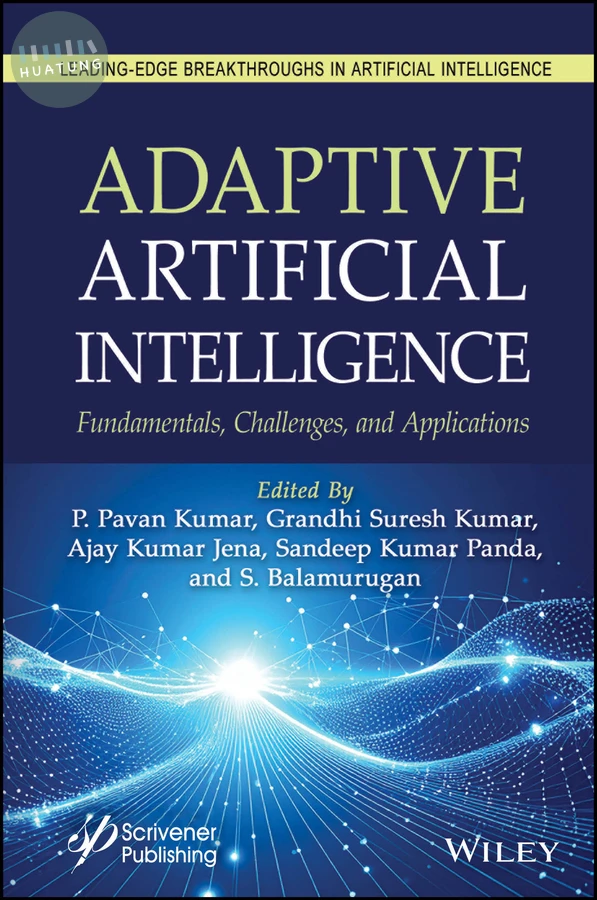
Adaptive Artificial Intelligence
$6796元 定價: $7551 9折 可訂購
簡介
Master the next frontier of technology with this book, which provides an in-depth guide to adaptive artificial intelligence and its ability to create flexible, self-governed systems in dynamic industries. Adaptive artificial intelligence represents a significant advancement in the development of AI systems, particularly within various industries that require robust, flexible, and responsive technologies. Unlike traditional AI, which operates based on pre-defined models and static data, adaptive AI is designed to learn and evolve in real time, making it particularly valuable in dynamic and unpredictable environments. This capability is increasingly important in disciplines such as autonomous systems, healthcare, finance, and industrial automation, where the ability to adapt to new information and changing conditions is crucial. In industry development, adaptive AI drives innovation by enabling systems that can continuously improve their performance and decision-making processes without the need for constant human intervention. This leads to more efficient operations, reduced downtime, and enhanced outcomes across sectors. As industries increasingly rely on AI for critical functions, the adaptive capability of these systems becomes a cornerstone for achieving higher levels of automation, reliability, and intelligence in technological solutions. Readers will find the book: Introduces the emerging concept of adaptive artificial intelligence;
Explores the many applications of adaptive artificial intelligence across various industries;
Provides comprehensive coverage of reinforcement learning for different domains.
Audience Research scholars, IT professionals, engineering students, network administrators, artificial intelligence and deep learning experts, and government research agencies looking to innovate with the power of artificial intelligence.
目錄
Series Preface xxi
Preface xxiii
Acknowledgements xxvii
Part 1: Adaptive Artificial Intelligence: Fundamentals 1
1 From Data to Diagnosis—Integrating Adaptive AI in Reshaping Healthcare 3
Kumar Saurabh and Raghuraj Singh Suryavanshi
1.1 Introduction 3
1.2 Literature Review 5
1.3 Benefits of Adaptive AI in Health Diagnostic 9
1.3.1 Personalized Treatment Plans Based on Individual Patient Data 9
1.3.2 Automated Health Monitoring Systems for Early Disease Identification 9
1.3.3 Reduction in Medical Errors and Misdiagnoses 9
1.4 Challenges and Limitations of Adaptive AI in Health Diagnostic 11
1.4.1 Privacy Concerns Related to Patient Data Usage 11
1.4.2 Lack of Standardized Regulations for AI in Healthcare 11
1.4.3 Potential Bias in AI Algorithms Leading to Inaccurate Diagnoses 12
1.5 Current Applications of Adaptive AI in Health Diagnostic 12
1.5.1 Disease Prediction and Risk Assessment 12
1.5.2 Image Recognition for Medical Imaging Analysis 12
1.5.3 Drug Discovery and Personalized Medicine 13
1.5.4 Automation of Administrative Tasks 14
1.6 Future Prospects of Adaptive AI in Health Diagnostic 15
1.7 Conclusion 15
References 16
2 Transfer Learning in Adaptive AI 19
Pradumn Kumar and Praveen Kumar Shukla
2.1 Introduction: The Evolution of Adaptive Intelligence 20
2.2 Theoretical Foundations of Transfer Learning 21
2.2.1 Categorization of Transfer Learning Approaches: An In-Depth Exploration 22
2.3 Adaptive AI: Concepts and Challenges 28
2.3.1 What is Adaptive AI 28
2.3.2 Core Characteristics 30
2.3.2.1 Continual Learning 30
2.3.2.2 Generalization 31
2.3.2.3 Efficiency 32
2.3.3 Challenges 32
2.3.3.1 Catastrophic Forgetting 32
2.3.3.2 Data Scarcity 34
2.3.3.3 Domain Shift 36
2.4 Transfer Learning Techniques for Adaptive AI 38
2.4.1 Pre-Trained Models and Fine-Tuning 38
2.4.2 Domain Adaptation 38
2.4.3 Meta-Learning 39
2.4.4 Continual Learning 39
2.4.5 Multi-Task Learning 39
2.5 Applications of Transfer Learning in Adaptive AI 40
2.5.1 Natural Language Processing (NLP) 40
2.5.2 Computer Vision 40
2.5.3 Robotics 40
2.5.4 Healthcare 41
2.5.5 Tesla Autopilot 41
2.6 Conclusion 42
References 42
3 Beyond Prediction: Adaptive AI as a Catalyst for Climate Change Mitigation and Understanding 45
Deepak Gupta and Satyasundara Mahapatra
3.1 Introduction 46
3.1.1 The Escalating Climate Crisis: A Data-Driven Perspective 46
3.1.2 The Evolution of Climate Modeling: From Traditional Methods to AI 47
3.1.3 Beyond AI: The Rise of Adaptive AI in Climate Science 47
3.1.4 Objectives and Significance of This Chapter 48
3.2 Foundations of Adaptive AI in Climate Science 48
3.2.1 Understanding Adaptive AI: A Paradigm Shift in Machine Learning 48
3.2.2 Core Mechanisms Enabling Adaptability 50
3.2.2.1 Reinforcement Learning for Dynamic Decision-Making 50
3.2.2.2 Continual Learning for Real-Time Model Updates 50
3.2.2.3 Meta-Learning 51
3.2.2.4 Evolutionary Algorithms and Neuroevolutionary 52
3.2.2.5 Transfer Learning to Leverage Knowledge Across Climate Domains 52
3.2.3 The Necessity of Adaptability in Climate Change Modeling 52
3.2.3.1 Coping with Evolving Climate Variables 52
3.2.3.2 Reducing Uncertainty in Long-Term Predictions 52
3.2.3.3 Enhancing Precision in Real-Time Climate Monitoring 53
3.2.4 Importance of Adaptation in Climate Models 53
3.2.4.1 Real-Time Learning and Parameter Updates 53
3.2.4.2 Handling Non-Stationary Climate Patterns 53
3.2.4.3 Reducing Uncertainties in Projections 53
3.3 Adaptive AI Frameworks for Climate Change Modeling 54
3.3.1 Dynamic Climate Forecasting Models 54
3.3.2 Adaptive AI for Extreme Weather Prediction 55
3.3.3 AI-Augmented Numerical and Physics-Based Climate Models 55
3.3.4 Hybrid Approaches: Integrating Big Data, IoT, and AI in Climate Prediction 56
3.3.5 Case Study: Adaptive AI in Global Climate Risk Assessment 56
3.4 Real-World Applications of Adaptive AI in Climate Resilience 57
3.4.1 Predicting and Mitigating Natural Disasters: Wildfire Prediction and Mitigation with Adaptive AI 58
3.4.2 Dynamic AI Models for Sustainable Agriculture and Food Security 58
3.4.3 Intelligent Water Management for Drought and Flood Prevention 59
3.4.4 Smart Energy Grids Optimized by Adaptive AI for Carbon Reduction 60
3.4.5 Monitoring and Protecting Marine and Terrestrial Ecosystems 60
3.5 Challenges and Limitations in Adaptive AI for Climate Science 61
3.5.1 Data Complexity and Computational Constraints 61
3.5.1.1 High-Dimensional, Spatiotemporal Datasets 62
3.5.1.2 Handling Incomplete and Uncertain Climate Data 62
3.5.2 Balancing Adaptability and Model Stability 62
3.5.3 Ethical Implications: Bias, Transparency, and AI Accountability 63
3.5.3.1 Algorithmic Bias in Climate Predictions 63
3.5.3.2 Ensuring Transparency in Adaptive Decision-Making 63
3.5.4 Policy and Regulatory Challenges in AI-Governed Climate Actions 64
3.5.4.1 Regulatory Frameworks for Adaptive AI in Environmental Monitoring 64
3.5.4.2 Collaboration Between Governments, AI Researchers, and Climate Scientists 64
3.6 The Future of Adaptive AI in Climate Change Mitigation 65
3.6.1 Quantum AI for Enhanced Climate Modeling 65
3.6.2 Federated Learning for Global Collaborative Climate Research 66
3.6.3 AI-Driven Policy Recommendations for Climate Adaptation 66
3.6.4 Towards a Unified Adaptive AI Framework for Climate Resilience 67
3.7 Conclusion 68
References 70
4 Adaptive AI: Transforming Natural Language Processing and Industry Applications 73
Meena Kumari P., Ramakrishna Reddy K. and Manikandakumar M.
4.1 Introduction 74
4.1.1 Benefits of NLP 74
4.1.2 Technologies Related to Natural Language Processing 75
4.1.3 Applications of Natural Language Processing (NLP) 76
4.2 Adaptive AI 78
4.2.1 What is Adaptive AI? 79
4.2.1.1 Key Characteristics of Adaptive AI 79
4.2.1.2 Traditional vs. Adaptive AI 81
4.2.2 How Does Adaptive AI Work? 81
4.3 Adaptive AI Use Cases with NLP 84
4.3.1 Chatbots and Virtual Assistants 84
4.3.2 Healthcare Industry 86
4.3.3 Personalized Education 88
4.4 Adaptive AI Use Cases in Other Industry 90
4.4.1 Healthcare 91
4.4.2 Finance 93
4.4.3 Transportation 94
4.4.4 Manufacturing 95
4.4.5 Environmental Sustainability 96
4.5 Ethical Considerations and Challenges 96
4.6 Conclusion 97
References 98
5 Optimizing Networking Systems with Machine Learning Approach 101
Cherukuri Gaurav Sushant, Tanishq Kumar, Lakshmi Ajay Veeramraju, Yuvraj Singh and Sandeep Kumar Panda
5.1 Introduction 102
5.2 Networks 102
5.3 Computer Networks 102
5.4 Networking Software’s 103
5.4.1 Common Protocols 103
5.4.2 Network Topologies 103
5.4.3 OSI Model 104
5.4.4 Routing Algorithms 105
5.4.5 Internet Protocol (IP) 105
5.5 Hardware Devices 105
5.5.1 Network Interface Card (NIC) 105
5.5.2 Switch 105
5.5.3 Access Point 106
5.5.4 Router 106
5.5.5 Firewall 106
5.5.6 Gateway 106
5.5.7 Transmission Medium 106
5.6 Software-Defined Networks (SDN) 107
5.6.1 Management Plane 107
5.6.2 Control Plane 107
5.6.3 Data Plane 107
5.6.4 Definition 107
5.6.5 How Different is SDN from Traditional Systems 108
5.7 Machine Learning 108
5.7.1 Data Collection 109
5.7.2 Dimensionality Reduction 111
5.7.3 Performance Score 111
5.7.4 Regression 112
5.7.5 Classification in Machine Learning 113
5.8 Deep Learning 117
5.8.1 Long Short-Term Memory (LSTM) 117
5.8.2 Autoencoders 119
5.9 Applications of Machine Learning 121
5.9.1 QOS – Quality of Service 121
5.9.2 Machine Learning in Fault Management 121
5.9.3 Machine Learning in Performance Prediction 122
5.9.4 Machine Learning in Infrastructure Cost 122
5.9.5 Load Balancing Using Machine Learning 122
5.10 Traditional Load Balancing Techniques 123
5.10.1 Machine Learning and Load Balancing 123
5.11 SDN Decision Making 124
5.11.1 Methods and Types of Decision Making in SDN 124
5.11.2 Machine Learning in SDN Decision Making 125
5.12 Conclusion 126
References 126
Part 2: Adaptive Artificial Intelligence: Applications 135
6 Assessment of the Recurrent RBF Long-Range Forecasting Model for Estimating Net Asset Value 137
Minakhi Rout, Anjishnu Saw, Ajay Kumar Jena and Ajaya Kumar Parida
6.1 Introduction 137
6.2 Design of a Forecasting Model Using the Recurrent Radial Basis Function (RRBF) Neural Network 140
6.3 Extraction of Features and Construction of Input Data 143
6.4 Simulation Based Experiments 144
6.5 Conclusion 154
References 154
7 Reinforcement Learning in Network Optimization 157
M. Sandhya, L. Lakshmi and L. Anjaneyulu
7.1 Introduction 158
7.2 Related Works 160
7.3 Key Concepts of Network Optimization 161
7.3.1 Traffic Routing 161
7.3.2 Resource Allocation 162
7.3.3 Load Balancing 162
7.3.4 Quality of Service (QoS) 162
7.4 Key Concepts of RL 163
7.4.1 Fundamental Principles of RL 163
7.4.1.1 States 164
7.4.1.2 Actions 164
7.4.1.3 Rewards 164
7.4.1.4 Policies 165
7.4.1.5 Value Functions 165
7.4.2 Types of RL Algorithms 165
7.4.2.1 Q-Learning 166
7.4.2.2 Deep Q-Networks (DQN) 167
7.4.2.3 Policy Gradient Methods 168
7.4.2.4 Actor-Critic Method 169
7.4.2.5 Deep Deterministic Policy Gradient (DDPG) 170
7.4.2.6 Multi-Agent Reinforcement Learning 171
7.4.2.7 Hierarchical Reinforcement Learning 173
7.5 Importance of RL in Network Optimization 175
7.5.1 Adaptability 177
7.5.2 Expansion Capability 177
7.5.3 Autonomous Operation 178
7.5.4 Instantaneous Optimization 178
7.6 Performance Evaluation and Benchmarking 179
7.6.1 General Metrics 179
7.6.2 Deep Q-Networks (DQN) 180
7.6.3 Action-Critic Methods 180
7.6.4 Multi-Agent Approaches 180
7.6.5 DDPG (Deep Deterministic Policy Gradient) 181
7.6.6 Hierarchical Reinforcement Learning (HRL) 181
7.7 Challenges and Future Directions in RL for Network Optimization 181
7.7.1 Challenges in RL for Network Optimization 182
7.7.1.1 Scalability 182
7.7.1.2 Real-Time Decision Making 182
7.7.1.3 Data Availability and Quality 182
7.7.1.4 Robustness and Reliability 182
7.7.1.5 Integration with Existing Systems 182
7.7.2 Future Directions in RL for Network Optimization 183
7.7.2.1 Advanced RL Algorithms 183
7.7.2.2 Efficient Training Techniques 183
7.7.2.3 Real-Time and Low-Latency Solutions 183
7.7.2.4 Robust and Adaptive RL Models 183
7.7.2.5 Enhanced Simulation Environments 184
7.7.2.6 Standardization and Benchmarking 184
7.8 Conclusions 184
References 185
8 A Study on AI Adoption Methods in Industry 189
E. Sudarshan, K.S.R.K. Sarma and Karra Kishore
8.1 Types of Adaptive AI Techniques for Industrial Automation 190
8.2 Study: Predictive Maintenance in Industrial Automation 193
8.3 Study: Process Optimization in Industrial Automation 197
8.4 Study: Robotics and Autonomous Systems in Industrial Automation 201
8.5 Study: Quality Control and Inspection Systems in Industrial Automation 205
8.6 Study: Supply Chain Optimization in Industrial Automation 210
8.7 Study: Energy Management System (EMS) in Industrial Automation 215
8.8 Study: Human-Machine Collaboration System in Industrial Automation 220
8.9 Study: Fault Detection and Recovery System in Industrial Automation 224
8.10 Study: Intelligent Scheduling System in Industrial Automation 230
8.11 Study: Safety Systems in Industrial Automation 236
8.12 Study: Customisation and Flexibility in Industrial Automation 242
8.13 Study: Real-Time Monitoring and Analytics in Industrial Automation 249
References 256
9 Role of Artificial Intelligence for Real‐Time Systems and Smart Solutions 261
Gundala Jhansi Rani, Naresh Kumar Sripada, Sirikonda Shwetha and Erukala Sudarshan
9.1 Introduction 262
9.1.1 Objectives of the Book Chapter 262
9.1.2 Real-Time Systems and Smart Solution 262
9.2 AI Techniques for Real-Time Systems 265
9.2.1 Machine Learning for Real-Time Analytics 266
9.2.1.1 Supervised Learning 266
9.2.1.2 Reinforcement Learning 267
9.2.2 Neural Networks and Deep Learning 267
9.2.2.1 CNNs for Image Recognition 267
9.2.2.2 LSTMs for Sequential Data 268
9.2.3 Edge Computing and Federated Learning 268
9.2.4 Natural Language Processing for Smart Interfaces 268
9.3 Applications of AI in Real-Time Systems 268
9.3.1 Autonomous Vehicles (AV) 269
9.3.2 Smart Cities 271
9.3.3 Healthcare 273
9.3.4 Industrial Automation 276
9.4 Challenges in AI for Real-Time Systems 278
9.5 Future Research Directions 278
9.6 Conclusion 279
References 280
10 Behavioral Analysis for Operational Efficiency in Coal Mines 285
Arunima Asthana and Tanmoy Kumar Banerjee
10.1 Introduction 285
10.1.1 Background of Behavioral Analysis 287
10.1.2 Importance of Behavioral Analysis 288
10.1.3 Research Motivation 288
10.2 Methodology 289
10.3 Rationale 292
10.4 Analysis and Future Research 301
10.5 Conclusion 302
References 303
Part 3: Adaptive Artificial Intelligence: Novel Practices 307
11 Society 5.0 – Study of Modern Smart Cities 309
Akash Raghuvanshi and Ravi Krishan Pandey
11.1 Introduction 310
11.1.1 Knowledge-Intensive Society 311
11.1.2 Data, Information, and Knowledge 311
11.1.3 What is a Data-Driven Society? 312
11.1.4 From the Information Society to the Data-Driven Society 314
11.1.5 Comparative Aims of Industrie 4.0 and Society 5.0 315
11.2 Methods 317
11.2.1 Data Source and Data Collection 317
11.2.2 Classical Content Analysis 317
11.3 What Exactly is the Smart City? 317
11.3.1 Demonstrating the Word Smart City 317
11.3.2 Smart City and Common Urban Infrastructure 318
11.3.3 Integrating Information Technologies to Urban Infrastructure to Smart Cities 319
11.4 Energy Management System in Smart Cities 319
11.4.1 Smart Energy Supply System 319
11.4.2 Smart-Grid 320
11.4.3 Micro-Grid 320
11.4.4 Smart-House 320
11.4.5 The Smart City Concept in Large Urban Development Projects 320
11.5 Citizen-Led Smart City to Society 5.0 322
11.5.1 New York, US 322
11.5.2 Boston, US 323
11.5.3 San Jose, Northern California 324
11.5.4 Smart City: Barcelona 324
11.5.5 The Sensing City, Chicago 325
11.6 Discussion: Risks and Challenges in Society 5.0 326
11.6.1 Cyber Security 326
11.6.2 Data Elite 326
11.6.3 Digital Divide 327
11.7 Conclusion 327
Acknowledgment and Author Contributions 327
References 328
12 Artificial Intelligence Applications in Healthcare 329
Dileep Kumar Murala, Sandeep Kumar Panda, V.A. Sankar Ponnapalli and Pradosh Kumar Gantayat
12.1 Introduction 330
12.1.1 Types of AI Relevance to Healthcare 330
12.2 Literature Review 333
12.2.1 Robotic Process Automation (RPA) 333
12.2.2 AI-Based Medical Imaging 335
12.2.3 Artificial Intelligence and Big Data in Precision Oncology 337
12.2.4 Artificial Intelligence in Digital Pathology and Drug Discovery 338
12.2.5 AI will Figure Out the Molecular Signaling Chain and How Cancer Works 339
12.2.6 AI in Surgery 340
12.3 Role of AI in Healthcare 341
12.4 Examples and Applications of AI in Healthcare 346
12.5 Challenges, Advantages, & Feature Directions of AI in Healthcare 349
12.5.1 Challenges 349
12.5.2 Advantages of AI in the Health Care Sector 350
12.5.3 The Future Directions of AI in Healthcare 351
Conclusion 352
References 353
13 Cloud Manufacturing and Focus on Future Trends and Directions in Health Care Applications 359
Ravi Prasad Thati and Pranathi Kakaraparthi
13.1 Introduction 359
13.1.1 Operational Quality Simplifying the Process 360
13.1.2 Reduce Costs 360
13.1.3 Personalized Medicine Customized Treatment 361
13.1.4 Customized Medical Equipment 362
13.1.5 Patient-Centered Care Enhance Patient Engagement 362
13.1.6 Scalability 363
13.1.7 Flexibility 363
13.1.8 Conclusion 364
13.2 Challenges and Considerations in Cloud Manufacturing for Healthcare 364
13.2.1 Data Breaches and Cyber Security Threats 365
13.2.2 Data Privacy and Patient Consent 365
13.2.3 Health Care Product Regulatory Standards 366
13.2.4 Global Regulatory Changes 367
13.2.5 Integrate with Existing Systems 368
13.2.6 Data Standardization and Interoperability 368
13.2.7 Supplier Lock-In and Flexibility 368
13.3 Future Trends and Directions in Cloud Manufacturing for Healthcare 369
13.3.1 Artificial Intelligence (AI) and Machine Learning 369
13.3.2 Block Chain Technology 370
13.3.3 Internet of Things (IoT) 371
13.3.4 Personalized Medicine and Customized Treatment 372
13.3.5 Advanced Telemedicine and Telemedicine 372
13.3.6 Regenerative Medicine and Bio Printing 372
13.3.7 Accessibility and Coverage 373
13.3.8 Innovation and Collaboration 374
13.4 Conclusion 375
13.4.1 Overview of Medical Cloud Manufacturing 375
13.4.2 Technical Basis 375
13.4.3 Healthcare Provider 376
13.4.4 Final Thoughts 377
References 378
14 GAN Based Encryption to Secure Electronic Health Record 381
Alakananda Tripathy and Alok Ranjan Tripathy
14.1 Introduction 382
14.2 Background Study 383
14.3 Materials and Method 384
14.3.1 Dataset 384
14.3.2 Different Stages of the Model 384
14.4 Result Analysis 389
14.5 Conclusion 393
References 394
15 Innovative AI-Driven Data Annotation Techniques 397
G. Viswanath, G. Kiran Kumar Reddy, K. Srinivasa Rao and C. Rambabu
15.1 Introduction 398
15.2 Machine Learning (ML): The Skeleton of AI-Driven Analytics 399
15.2.1 Supervised Learning 399
15.2.2 Unsupervised Learning 399
15.2.3 Reinforcement Learning 400
15.3 Knowledge-Based and Reasoning Methods 400
15.3.1 Expert Systems 400
15.3.2 Ontologies 400
15.4 Decision-Making Algorithms 401
15.4.1 Fuzzy Logic 401
15.4.2 Game Theory 401
15.4.3 Multi-Agent Systems (MAS) 401
15.5 Search and Optimization Theory 401
15.5.1 Genetic Algorithms 402
15.5.2 Swarm Intelligence 402
15.5.3 Sentiment Analysis 402
15.5.4 Named Entity Recognition (NER) 402
15.5.5 Part-of-Speech (POS) Tagging 402
15.5.6 Intent Recognition 402
15.5.7 Spam Detection 403
15.6 Challenges in Text Annotation for Big Data 403
15.7 Related Work Comparison 404
15.8 Graph Descriptions 406
15.9 Conclusion 408
References 408
16 Empowering Sustainable Finance Through Education and Awareness: Fostering Responsible AI and Quantum Computing Usage for Enhanced ESG Analysis 411
Geetha N., Byreddy Sumanth Reddy, Valluri Hari Hara Teja, Keshav Khemka and U. M. Gopal Krishna
16.1 Introduction 412
16.2 Literature Review 416
16.3 Research Methodology 423
16.4 Interpretation and Analysis of Data 424
16.4.1 Validity of Measurement 425
16.4.1.1 Root-Mean-Square Residual (RMR) and Goodness-of-Fit (GFI) 426
16.4.1.2 Root Mean Square Error of Approximation 427
16.5 Conclusion 428
16.6 Limitation 428
16.7 Future Research 429
References 429
Index 433