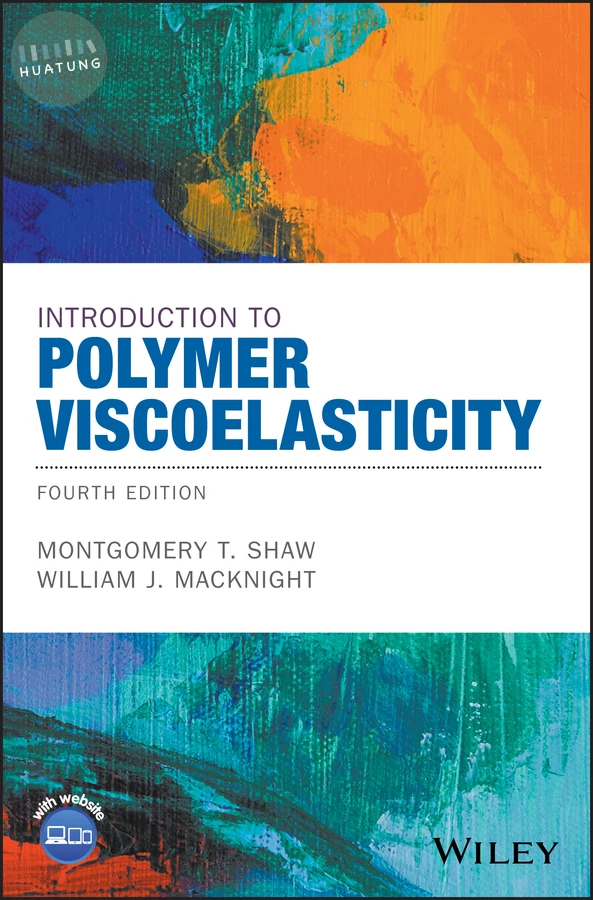

Introduction to Polymer Viscoelasticity
$5439元可訂購
簡介
Completely revised and updated, the fourth edition of this classic text continues to offer the reader a thorough understanding of viscoelastic behavior, essential for the proper utilization of polymers.
Explains principles, corresponding equations, and experimental methods with supporting real-life applications
Adds coverage of measurement techniques (nano-indentation, atomic force microscopy (AFM), and diffusing wave spectroscopy (DWS)), biopolymer viscoelasticity, and the relationship between mechanical polymer properties and viscoelastic functions
Has two new ections to address modern areas of viscoelastic measurement: large amplitude oscillatory shear (LAOS) and microrheology
Includes problems in the text and an Instructor’s Manual (including solutions) available for adopting professors
Prior edition reviews: "The book is clear written and…[is] appropriate for students in introductory undergraduate courses and for others wanting introduction to the fundamentals of the subject." (CHOICE, December 2005); "This book is invariably well written, logically organized and easy to follow...I highly recommend this book to anyone studying polymer viscoelasticity." (Polymer News, December 2005)
目錄
Preface to the Fourth Edition xiii
Preface to the Third Edition xv
Preface to the Second Edition xviii
Preface to the First Edition xx
1. Introduction 1
PROBLEMS, 6
GENERAL REFERENCE TEXTS, 7
REFERENCES, 8
2. Phenomenological Treatment of Viscoelasticity 9
A. ELASTIC MODULUS, 9
B. TRANSIENT EXPERIMENTS, 21
C. DYNAMIC EXPERIMENTS, 25
1. Low-Strain Measurements, 25
2. Large Amplitude Oscillatory Shear (LAOS), 30
3. Microrheology, 34
D. BOLTZMANN SUPERPOSITION PRINCIPLE, 38
E. RELATIONSHIP BETWEEN THE CREEP COMPLIANCE AND THE STRESS RELAXATION MODULUS, 43
F. RELATIONSHIP BETWEEN STATIC AND DYNAMIC PROPERTIES, 44
APPENDIX 2-1. Connecting Creep Compliance and Stress Relaxation Modulus Using Laplace Transforms, 45
APPENDIX 2-2. Borel’s Theorem, 48
APPENDIX 2-3. Geometries for the Measurement of Viscoelastic Functions, 49
1. Linear Motion Geometries, 49
2. Rotational Motion Geometries, 53
PROBLEMS, 57
REFERENCES, 64
3. Viscoelastic Models 66
A. MECHANICAL ELEMENTS, 66
1. Maxwell Model, 68
2. Voigt Model, 74
3. Generalized Maxwell Model, 76
4. Voigt–Kelvin model, 79
B. DISTRIBUTIONS OF RELAXATION AND RETARDATION TIMES, 81
C. MOLECULAR THEORIES—THE ROUSE MODEL, 84
D. APPLICATION OF FLEXIBLE-CHAIN MODELS TO SOLUTIONS, 93
E. THE ZIMM MODIFICATION, 94
F. EXTENSION TO BULK POLYMER, 96
G. REPTATION, 108
APPENDIX 3-1: MANIPULATION OF THE ROUSE MATRIX, 112
PROBLEMS, 117
REFERENCES, 123
4. Time–Temperature Correspondence 125
A. FOUR REGIONS OF VISCOELASTIC BEHAVIOR, 125
B. TIME–TEMPERATURE SUPERPOSITION, 133
C. MASTER CURVES, 136
D. THE WLF EQUATION, 136
E. MOLECULAR INTERPRETATION OF VISCOELASTIC RESPONSE, 143
PROBLEMS, 144
REFERENCES, 149
5. Transitions and Relaxation in Amorphous Polymers 150
A. PHENOMENOLOGY OF THE GLASS TRANSITION, 150
B. THEORIES OF THE GLASS TRANSITION, 155
1. Free-Volume Theory, 155
2. Thermodynamic Theory, 158
3. Kinetic Theories, 164
C. STRUCTURAL PARAMETERS AFFECTING THE GLASS TRANSITION, 166
D. RELAXATIONS IN THE GLASSY STATE, 172
E. RELAXATION PROCESSES IN NETWORKS, 176
1. Physical Relaxation, 176
2. Chemical Processes, 177
F. BIOPOLYMER VISCOELASTICITY, 180
1. Biopolymer Sources, 180
2. Humidity Control, 181
3. Examples of Biopolymer Viscoelastic Response, 183
PROBLEMS, 189
REFERENCES, 196
6. Elasticity of Rubbery Networks 198
A. THERMODYNAMIC TREATMENT, 199
B. STATISTICAL TREATMENT, 205
1. Derivation, 205
2. Energy Contribution, 216
C. PHENOMENOLOGICAL TREATMENT, 220
D. FACTORS AFFECTING RUBBER ELASTICITY, 224
1. Effect of Degree of Crosslinking, 224
2. Effect of Swelling, 226
3. Effect of Fillers, 229
4. Effect of Strain-Induced Crystallization, 232
APPENDIX 6-1. Statistics of a Polymer Chain, 234
APPENDIX 6-2. Equation of State for a Polymer Chain, 240
PROBLEMS, 242
REFERENCES, 246
7. Dielectric and NMR Methods 249
A. DIELECTRIC METHODS, 249
1. Phenomenology, 250
2. Molecular Interpretation of Dielectric Constant, 257
3. Interfacial Polarization, 264
4. Application to Polymers, 265
5. Experimental Methods, 268
6. Application of Dielectric Relaxation to Poly(methyl methacrylate), 272
7. Comparisons between Mechanical and Dielectric Relaxation for Polymers, 273
B. NUCLEAR MAGNETIC RESONANCE METHODS, 274
PROBLEMS, 280
REFERENCES, 282
Answers to Selected Problems 284
CHAPTER 2, 284
CHAPTER 3, 296
CHAPTER 4, 304
CHAPTER 5, 308
CHAPTER 6, 312
CHAPTER 7, 320
List of Major Symbols 324
List of Files on the Website 331
Author Index 334
Subject Index 339