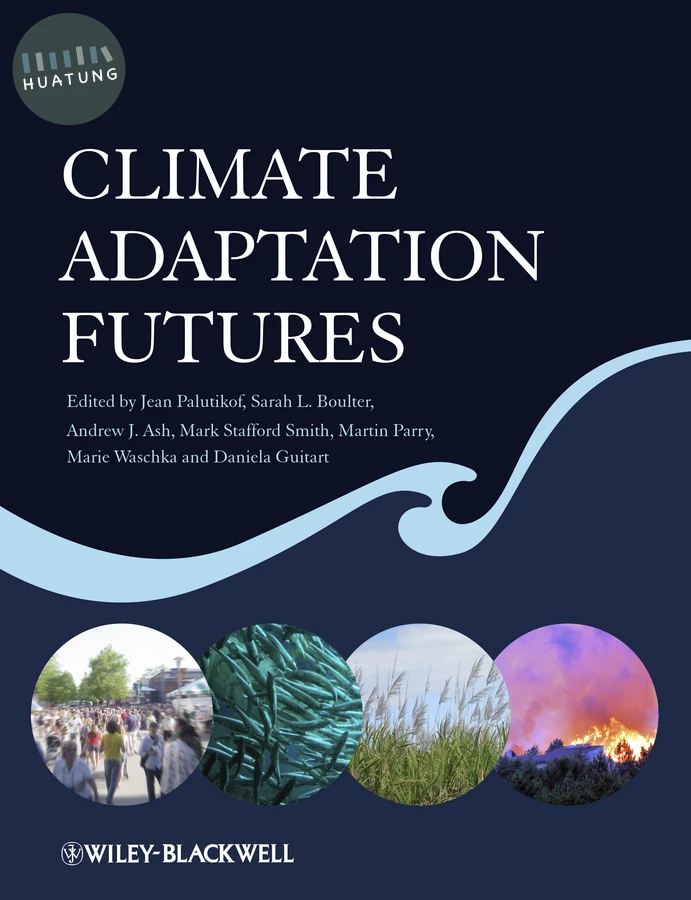

Climate Adaptation Futures
$5066元 定價: $5629 9折 可訂購
簡介
Adaptation is the poor cousin of the climate change challenge - the glamour of international debate is around global mitigation agreements, while the bottom-up activities of adaptation, carried out in community halls and local government offices, are often overlooked. Yet, as international forums fail to deliver reductions in greenhouse gas emissions, the world is realising that effective adaptation will be essential across all sectors to deal with the unavoidable impacts of climate change. The need to understand how to adapt effectively, and to develop appropriate adaptation options and actions, is becoming increasingly urgent.
This book reports the current state of knowledge on climate change adaptation, and seeks to expose and debate key issues in adaptation research and practice. It is framed around a number of critical areas of adaptation theory and practice, including:
Advances in adaptation thinking,
Enabling frameworks and policy for adaptation,
Engaging and communicating with practitioners,
Key challenges in adaptation and development,
Management of natural systems and agriculture under climate change,
Ensuring water security under a changing climate,
Urban infrastructure and livelihoods, and
The nexus between extremes, disaster management and adaptation.
It includes contributions from many of the leading thinkers and practitioners in adaptation today. The book is based on key contributions from the First International Conference on Climate Change Adaptation ‘Climate Adaptation Futures’, held on the Gold Coast, Australia, in June 2010. That three-day meeting of over 1000 researchers and practitioners in adaptation from 50 countries was the first of its kind.
Readership: The book is essential reading for a wide range of individuals involved in climate change adaptation, including:
Researchers,
Communication specialists,
Decision-makers and policy makers (e.g. government staff, local council staff),
On-ground adaptation practitioners (e.g. aid agencies, government workers, NGOs),
Postgraduate and graduate students, and
Consultants.
目錄
List of Contributors, viii
Preface, xii
Section 1 Introduction, 1
1 The past, present and future of adaptation: setting the context and naming the challenges, 3
Jean Palutikof, Martin Parry, Mark Stafford Smith, Andrew J. Ash, Sarah L. Boulter and Marie Waschka
2 Uncertainty/limits to adaptation/adapting to +4 °C, 31
Stephen H. Schneider
Section 2 Advances in adaptation thinking, 47
3 Adaptation research: community, science or discipline?, 49
Andrew J. Ash and Mark Stafford Smith
4 Food security under a changing climate: frontiers of science or adaptation frontiers?, 56
Mark Howden, Rohan A. Nelson and Steven Crimp
5 Emerging dimensions of fair process for adaptation decision-making, 69
W. Neil Adger
6 Conversations on adaptation effectiveness, 75
Robert Kay, Andy Haines, Cynthia Rosenzweig, Will Steffen and Bruce Thom
7 Minimising the risk of maladaptation: a framework for analysis, 87
Jon Barnett and Saffron J. O’Neill
Section 3 Enabling frameworks and policy for adaptation, 95
8 How much adaptation: are existing policy and institutions enough?, 97
Stephen Dovers
9 Bridging the science–policy interface: informing climate governance in the USA, 103
Diana M. Liverman
10 Wise adaptation to climate change: the view from Japan, 111
Nobuo Mimura
11 Scenarios for picturing a future adapted to +4 °C, 119
Mark Stafford Smith
12 Creating legislative frameworks for adaptation, 126
Jan McDonald
13 Natural hazards and insurance, 133
Sandra Schuster
Section 4 Engaging with stakeholders, 141
14 Communication of information for adaptation, 143
Marie Waschka and Simon Torok
Case Study 1 Designer guidance: climate change information for New Zealand decision-makers, 149
Julie Knauf
Case Study 2 Evidence based media: a communication approach for effective climate adaptation, 155
Sabrina McCormick
Case Study 3 Indigenous people and climate change adaptation: engagement through tailored communication, research and monitoring, 158
Emma L. Woodward
15 Fostering community acceptance of managed retreat in New Zealand, 161
Anna Vandenbeld and Janet MacDonald
16 Community engagement to resolve climate adaptation conflicts: utilising consensus-building, joint fact-finding strategies and cognitive frames analysis, 167
Julian Prior
17 Shared learning on adapting to climate change in south-east British Columbia, Canada, 177
Stewart Cohen, Michelle Laurie, Ingrid Liepa, Trevor Murdock, Cindy Pearce, Ellen Pond, Olaf Schroth and Jeff Zukiwsky
18 Cultural dimensions of climate change adaptation: Indigenous knowledge and future adaptive management in East Kimberley, Australia, 190
Sonia Leonard and Meg Parsons
Section 5 Key challenges in adaptation and development, 201
19 Adaptation, development and the community, 203
Jessica Ayers and Saleemul Huq
20 Climate change and sustainable development in Botswana: towards a framework for adaptation, 215
Opha Pauline Dube
21 The challenge of adaptation that meets the needs of low-income urban dwellers, 227
David Dodman
22 Migration doesn’t have to be a failure to adapt: an escape from environmental determinism, 235
François Gemenne
23 Climate change adaptation pathways: insights from case studies in South Africa, Canada and the Pacific Islands, 242
Florence Crick, Johanna Wandel, Nic Maclellan and Katharine Vincent
Section 6 Natural systems and agricultural production, 255
24 Ecosystem impacts and adaptation, 257
Alistair J. Hobday and Guy F. Midgley
25 Nature’s technology: an ecosystem-based approach to adaptation, 267
Caroline Cowan
Case Study 4 Adaptation strategies of coffee producers in Coatepec, Veracruz, Mexico to climate variability and change, 275
Cecilia Conde, Alejandro Monterroso, Guillermo Rosales and María Pérez Martín
26 Adaptation measures to climate change in the Mongolian livestock sector, 279
Batimaa Punsalmaa, Bolormaa Buyndalai and Batnasan Nyamsuren
Section 7 Water security, 285
27 Addressing water security in China: screening for climate impacts and adaptation responses, 287
Jun Xia, Thomas Tanner and Ian Holman
28 Drought proofing rural economies in semi-arid regions: lessons from north-east Brazil, 294
Antonio Rocha Magalhães
29 Changing monsoon pattern and its impact on water resources in Himalaya: responses and adaptation, 301
Prakash Chandra Tiwari and Bhagwati Joshi
Section 8 Urban infrastructure and livelihoods, 309
30 Adapting to climate change in cities, 311
Shagun Mehrotra, Joann Carmin, Adam Fenech, Hartmut Fünfgeld, Yadh Labane, Jun Li, Rob Roggema, Frank Thomalla and Cynthia Rosenzweig
31 A Bayesian network approach to investigating climate change and commodity price change impacts on human well-being: a case study of employment from Queensland, Australia, 322
Tim Lynam, Jenny Langridge, Art Langston and Yiheyis Maru
Case Study 5 Adaptation responses to agricultural change and increasing salinisation in the Mekong Delta, Việt Nam, 332
Olivia Dun
Case Study 6 Adaptation to climate change impacts on buildings and infrastructure: electricity infrastructure, 338
Jenny Riesz and Joel Gilmore
Case Study 7 Adaptation to climate change impacts on buildings and infrastructure: building energy efficiency and mitigation effectiveness, 346
Xiaoming Wang, Dong Chen and Zhengen Ren
Section 9 Extremes, disaster management and adaptation, 351
32 Extreme event risk and climate change adaptation: improving the knowledge base and building capacity, 353
Martine Woolf, John Schneider and Martyn Hazelwood
33 Linking disaster risk reduction and climate change adaptation: a good practice project in Jakarta, Indonesia, 362
Febi Dwirahmadi, Shannon Rutherford, Wayne Ulrich and Cordia Chu
Index, 371
Colour plates section between page 180 and 181