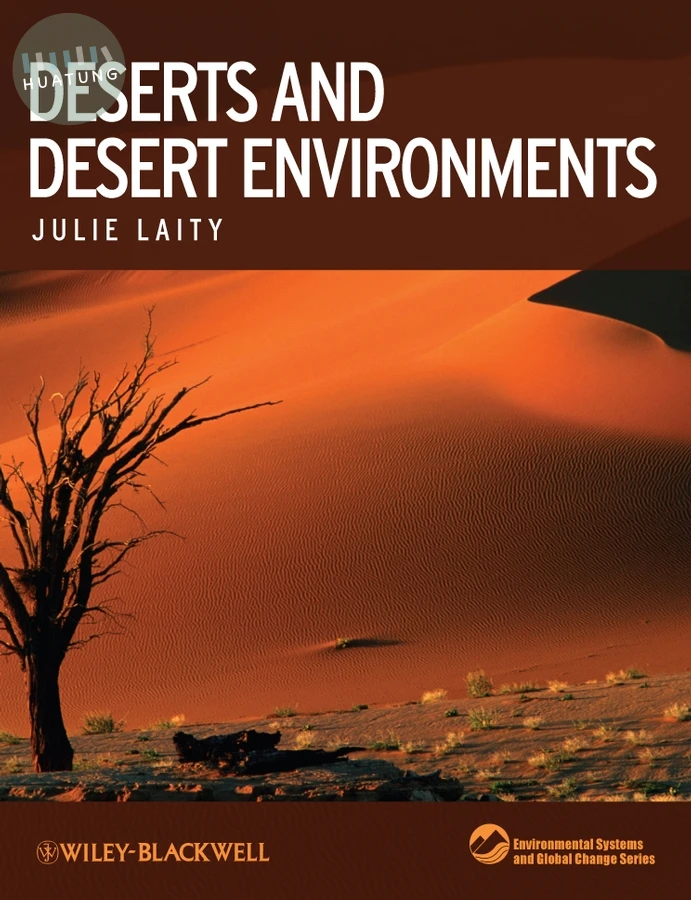

Deserts and Desert Environments
$2300元 定價: $2555 9折 可訂購
簡介
Taking a global perspective, this book provides a concise overview of drylands, including their physical, biological, temporal, and human components.
Examines the physical systems occurring in desert environments, including climate, hydrology, past and present lakes, weathering, hillslopes, geomorphic surfaces, water as a geomorphic agent, and aeolian processes
Offers an accessible introduction to the physical, biological, temporal, and human components of drylands
Investigates the nature, environmental requirements, and essential geomorphic roles of plants and animals in this stressful biological environment
Highlights the impact of human population growth on climate, desertification, water resources, and dust storm activity
Includes an examination of surface/atmosphere interactions and the impact of ENSO events.
目錄
Preface xii
1 Introduction: defining the desert system 1
1.1 Defining the desert system 1
1.2 Evolution of deserts 2
1.3 Indices of aridity 6
1.4 Desert surfaces 8
1.5 Tectonically stable and unstable deserts 8
1.6 Deserts of the past 9
1.7 Changing human perspectives on deserts 12
2 Deserts of the world 14
2.1 Introduction: the extent of global aridity 14
2.2 Global deserts 14
3 The climatic framework 48
3.1 Introduction: classification of deserts by temperature 48
3.2 Weather data 48
3.3 Atmospheric controls: surface boundary layer 50
3.4 Temporal and spatial variability of climatic influences 64
4 The hydrologic framework 71
4.1 Introduction 71
4.2 The water balance in deserts 71
4.3 Water budgets 73
4.4 Surface runoff and floods 84
4.5 The chemical quality of surface and soil water 89
4.6 Water resources 90
4.7 Case study: the waters of the Tigris-Euphrates Basin and the impact of modern water management 94
5 Lake systems: past and present 98
5.1 Introduction to desert lakes 98
5.2 Types of lake 98
5.3 Lakes of the global arid environment 106
6 Weathering processes and hillslope systems 122
6.1 Introduction 122
6.2 Weathering 122
6.3 Weathering forms 126
6.4 Duricrusts 128
6.5 Desert varnish 134
6.6 Hillslope processes 136
6.7. Composite surfaces (pediments) 145
7 Desert soils and geomorphic surfaces 148
7.1 Introduction 148
7.2 The nature of soils in arid and semiarid regions 148
7.3 Soil description and classification 149
7.4 Soil characteristics of arid regions 150
7.5 Inorganic and biological soil crusts 152
7.6 Spatial heterogeneity in soil properties and the ecohydrology of patterned vegetation zones 156
7.7 Surface volume changes 158
7.8 Surface types: hamada and stone pavements 159
8 Water as a geomorphic agent 168
8.1 Introduction 168
8.2 Groundwater sapping in slope and valley development 168
8.3 Piping processes in channel and slope evolution 171
8.4 Fluvial processes 172
8.5 Fluvial landforms 179
9 Aeolian processes 186
9.1 Introduction 186
9.2 Near-surface flow 187
9.3 Wind processes 191
9.4 Landforms of accumulation: sand sheets, zibar, and sand stringers 195
9.5 Landforms of accumulation: dunes 197
9.6 Ripples 213
10 Landforms of aeolian erosion and desert dust 216
10.1 Introduction 216
10.2 Deflation features: desert depressions and pans 216
10.3 Ventifacts 218
10.4 Yardangs and ridge and swale systems 221
10.5 Desert dust 225
11 Plant communities and their geomorphic impacts 237
11.1 Introduction: characteristics of desert ecosystems 237
11.2 Adaptations to desert conditions 238
11.3 Plant communities and ecotones 245
11.4 Succession in desert plant communities 251
11.5 Dune communities 252
11.6 Vegetation type and density and relationship to geomorphic processes 253
12 Animal communities 259
12.1 Introduction: environmental requirements 259
12.2 Effects on geomorphic processes 264
12.3 Hydrologic impacts 265
12.4 Effects of the geomorphic activity of animals on plant communities 266
13 Desertification and the human dimension 267
13.1 Desertification: introduction and terminology 267
13.2 Climate change and desertification 268
13.3 Anthropogenic causes of desertification 269
13.4 Water resources: a rural and urban problem 275
13.5 Case study: the Aral Sea 280
13.6 Discussion 283
References 285
Index 320