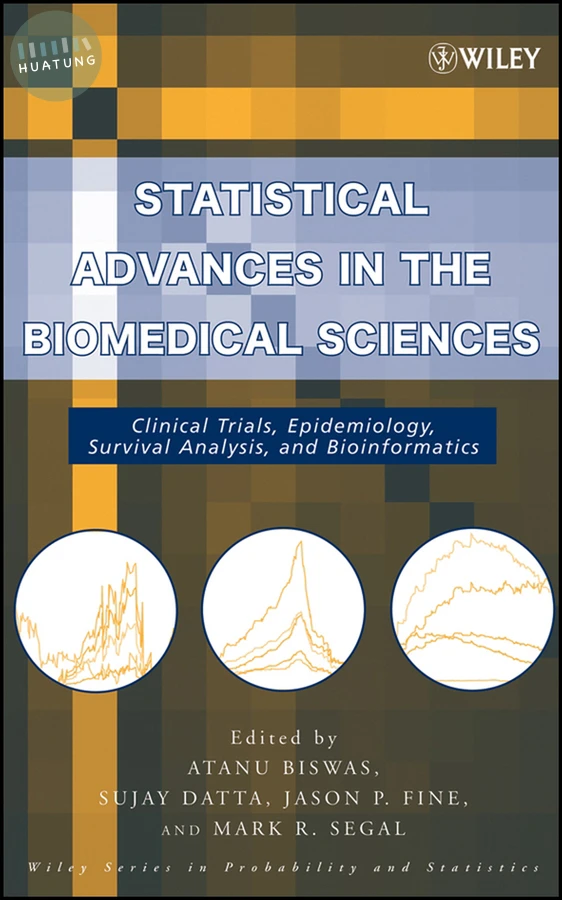

Statistical Advances in the Biomedical Sciences
$6143元 定價: $6826 9折 可訂購
簡介
The Most Comprehensive and Cutting-Edge Guide to Statistical Applications in Biomedical Research With the increasing use of biotechnology in medical research and the sophisticated advances in computing, it has become essential for practitioners in the biomedical sciences to be fully educated on the role statistics plays in ensuring the accurate analysis of research findings. Statistical Advances in the Biomedical Sciences explores the growing value of statistical knowledge in the management and comprehension of medical research and, more specifically, provides an accessible introduction to the contemporary methodologies used to understand complex problems in the four major areas of modern-day biomedical science: clinical trials, epidemiology, survival analysis, and bioinformatics.
Composed of contributions from eminent researchers in the field, this volume discusses the application of statistical techniques to various aspects of modern medical research and illustrates how these methods ultimately prove to be an indispensable part of proper data collection and analysis. A structural uniformity is maintained across all chapters, each beginning with an introduction that discusses general concepts and the biomedical problem under focus and is followed by specific details on the associated methods, algorithms, and applications. In addition, each chapter provides a summary of the main ideas and offers a concluding remarks section that presents novel ideas, approaches, and challenges for future research.
Complete with detailed references and insight on the future directions of biomedical research, Statistical Advances in the Biomedical Sciences provides vital statistical guidance to practitioners in the biomedical sciences while also introducing statisticians to new, multidisciplinary frontiers of application. This text is an excellent reference for graduate- and PhD-level courses in various areas of biostatistics and the medical sciences and also serves as a valuable tool for medical researchers, statisticians, public health professionals, and biostatisticians.
目錄
Preface xxi
Acknowledgments xxv
Contributors xxvii
Part I Clinical Trials 1
1. Phase I Clinical Trials 3
Anastasis Ivanova and Nancy Flournoy
1.1 Introduction, 3
1.2 Phase I Trials in Healthy Volunteers, 3
1.3 Phase I Trials with Toxic Outcomes Enrolling Patients, 5
1.4 Other Design Problems in Dose Finding, 11
1.5 Concluding Remarks, 12
2. Phase II Clinical Trials 15
Nigel Stallard
2.1 Introduction, 15
2.2 Frequentist Methods in Phase II Clinical Trials, 18
2.3 Bayesian Methods in Phase II Clinical Trials, 22
2.4 Decision-Theoretic Methods in Phase II Clinical Trials, 25
2.5 Analysis of Multiple Endpoints in Phase II Clinical Trials, 26
2.6 Outstanding Issues in Phase II Clinical Trials, 27
3. Response-Adaptive Designs in Phase III Clinical Trials 33
Atanu Biswas, Uttam Bandyopadhyay, and Rahul Bhattacharya
3.1 Introduction, 33
3.2 Adaptive Designs for Binary Treatment Responses, 34
3.3 Adaptive Designs for Binary Treatment Responses Incorporating Covariates, 40
3.4 Adaptive Designs for Categorical Responses, 41
3.5 Adaptive Designs for Continuous Responses, 42
3.6 Optimal Adaptive Designs, 43
3.7 Delayed Responses in Adaptive Designs, 44
3.8 Biased Coin Designs, 45
3.9 Real Adaptive Clinical Trials, 45
3.10 Data Study for Different Adaptive Schemes, 46
3.11 Concluding Remarks, 49
4. Inverse Sampling for Clinical Trials: A Brief Review of Theory and Practice 55
Atanu Biswas and Uttam Bandyopadhyay
4.1 Introduction, 55
4.2 Two-Sample Randomized Inverse Sampling for Clinical Trials, 59
4.3 An Example of Inverse Sampling: Boston ECMO, 62
4.4 Inverse Sampling in Adaptive Designs, 62
4.5 Concluding Remarks, 63
5. The Design and Analysis Aspects of Cluster Randomized Trials 67
Hrishikesh Chakraborty
5.1 Introduction: Cluster Randomized Trials, 67
5.2 Intracluster Correlation Coefficient and Confidence Interval, 69
5.3 Sample Size Calculation for Cluster Randomized Trials, 71
5.4 Analysis of Cluster Randomized Trial Data, 73
5.5 Concluding Remarks, 75
Part II Epidemiology 81
6. HIV Dynamics Modeling and Prediction of Clinical Outcomes in AIDS Clinical Research 83
Yangxin Huang and Hulin Wu
6.1 Introduction, 83
6.2 HIV Dynamic Model and Treatment Effect Models, 84
6.3 Statistical Methods for Predictions of Clinical Outcomes, 87
6.4 Simulation Study, 90
6.5 Clinical Data Analysis, 91
6.6 Concluding remarks, 92
7. Spatial Epidemiology 97
Lance A. Waller
7.1 Space and Disease, 97
7.2 Basic Spatial Questions and Related Data, 98
7.3 Quantifying Pattern in Point Data, 99
7.4 Predicting Spatial Observations, 107
7.5 Concluding Remarks, 118
8. Modeling Disease Dynamics: Cholera as a Case Study 123
Edward L. Ionides, Carles Bretó, and Aaron A. King
8.1 Introduction, 123
8.2 Data Analysis via Population Models, 124
8.3 Sequential Monte Carlo, 126
8.4 Modeling Cholera, 130
8.5 Concluding Remarks, 136
9. Misclassification and Measurement Error Models in Epidemiologic Studies 141
Surupa Roy and Tathagata Banerjee
9.1 Introduction, 141
9.2 A Few Examples, 143
9.3 Binary Regression Models with Two Types of Error, 144
9.4 Bivariate Binary Regression Models with Two Types of Error, 146
9.5 Models for Analyzing Mixed Misclassified Binary and Continuous Responses, 149
9.6 Atom Bomb Data Analysis, 151
9.7 Concluding Remarks, 152
Part III Survival Analysis 157
10. Semiparametric Maximum-Likelihood Inference in Survival Analysis 159
Michael R. Kosorok
10.1 Introduction, 159
10.2 Examples of Survival Models, 160
10.3 Basic Estimation and Limit Theory, 162
10.4 The Bootstrap, 163
10.5 The Profile Sampler, 166
10.6 The Piggyback Bootstrap, 168
10.7 Other Approaches, 170
10.8 Concluding Remarks, 171
11. An Overview of the Semi–Competing Risks Problem 177
Limin Peng, Hongyu Jiang, Rick J. Chappell, and Jason P. Fine
11.1 Introduction, 177
11.2 Nonparametric Inferences, 179
11.3 Semiparametric One-Sample Inference, 181
11.4 Semiparametric Regression Method, 184
11.5 Concluding Remarks, 189
12. Tests for Time-Varying Covariate Effects within Aalen’s Additive Hazards Model 193
Torben Martinussen and Thomas H. Scheike
12.1 Introduction, 193
12.2 Model Specification and Inferential Procedures, 194
12.3 Numerical Results, 199
12.4 Concluding Remarks, 204
12.5 Summary, 204
Appendix 12A, 205
13. Analysis of Outcomes Subject to Induced Dependent Censoring: A Marked Point Process Perspective 209
Yijian Huang
13.1 Introduction, 209
13.2 Induced Dependent Censoring and Associated Identifiability Issues, 210
13.3 Marked Point Process, 212
13.4 Modeling Strategy for Testing and Regression, 215
13.5 Concluding Remarks, 218
14. Analysis of Dependence in Multivariate Failure-Time Data 221
li Hsu and Zoe Moodie
14.1 Introduction, 221
14.2 Nonparametric Bivariate Survivor Function Estimation, 223
14.3 Non- and Semiparametric Estimation of Dependence Measures, 230
14.4 Concluding Remarks, 239
15. Robust Estimation for Analyzing Recurrent-Event Data in the Presence of Terminal Events 245
Rajeshwari Sundaram
15.1 Introduction, 245
15.2 Inference Procedures, 247
15.3 Large-Sample Properties, 249
15.4 Numerical Results, 252
15.5 Concluding Remarks, 259
Appendix 15A, 260
16. Tree-Based Methods for Survival Data 265
Mousumi Banerjee and Anne-Michelle Noone
16.1 Introduction, 265
16.2 Review of CART, 266
16.3 Trees for Survival Data, 268
16.4 Simulations for Comparison of Different Splitting Methods, 272
16.5 Example: Breast Cancer Prognostic Study, 274
16.6 Random Forest for Survival Data, 278
16.7 Concluding Remarks, 281
17. Bayesian Estimation of the Hazard Function with Randomly Right-Censored Data 287
Jean-François Angers and Brenda MacGibbon
17.1 Introduction, 287
17.2 Bayesian Functional Model Using Monotone Wavelet Approximation, 292
17.3 Estimation of the Subdensity F*, 295
17.4 Simulations, 296
17.5 Examples, 298
17.6 Concluding Remarks, 300
Appendix 17A, 301
Part IV Bioinformatics 307
18. The Effects of Intergene Associations on Statistical Inferences from Microarray Data 309
Kerby Shedden
18.1 Introduction, 309
18.2 Intergene Correlation, 310
18.3 Differential Expression, 314
18.4 Timecourse Experiments, 315
18.5 Meta-Analysis, 319
18.6 Concluding Remarks, 321
19. A Comparison of Methods for Meta-Analysis of Gene Expression Data 325
Hyungwon Choi and Debashis Ghosh
19.1 Introduction, 325
19.2 Background, 326
19.3 Example, 328
19.4 Cross-Comparison of Gene Signatures, 329
19.5 Best Common Mean Difference Method, 329
19.6 Effect Size Method, 331
19.7 POE Assimilation Method, 332
19.8 Comparison of Three Methods, 334
19.9 Conclusions, 336
20. Statistical Methods for Identifying Differentially Expressed Genes in Replicated Microarray Experiments: A Review 341
Lynn kuo, Fang Yu, and Yifang Zhao
20.1 Introduction, 341
20.2 Normalization, 344
20.3 Methods for Selecting Differentially Expressed Genes, 349
20.4 Simulation Study, 357
20.5 Concluding Remarks, 360
21. Clustering of Microarray Data via Mixture Models 365
Geoffrey J. McLachlan, Richard W. Bean, and Angus Ng
21.1 Introduction, 365
21.2 Clustering of Microarray Data, 367
21.3 Notation, 367
21.4 Clustering of Tissue Samples, 369
21.5 The EMMIX-GENE Clustering Procedure, 370
21.6 Clustering of Gene Profiles, 372
21.7 Emmix-wire, 373
21.8 Maximum-Likelihood Estimation via the EM Algorithm, 374
21.9 Model Selection, 376
21.10 Example: Clustering of Timecourse Data, 377
21.11 Concluding Remarks, 379
22. Censored Data Regression in High-Dimensional and Low-Sample-Size Settings for Genomic Applications 385
Hongzhe li
22.1 Introduction, 385
22.2 Censored Data Regression Models, 386
22.3 Regularized Estimation for Censored Data Regression Models, 388
22.4 Survival Ensemble Methods, 394
22.5 Nonparametric-Pathway-Based Regression Models, 395
22.6 Dimension-Reduction-Based Methods and Bayesian Variable Selection Methods, 396
22.7 Criteria for Evaluating Different Procedures, 397
22.8 Application to a Real Dataset and Comparisons, 397
22.9 Discussion and Future Research Topics, 398
22.10 Concluding Remarks, 400
23. Analysis of Case–Control Studies in Genetic Epidemiology 405
Nilanjan Chatterjee
23.1 Introduction, 405
23.2 Maximum-Likelihood Analysis of Case–Control Data with Complete Information, 406
23.3 Haplotype-based Genetic Analysis with Missing Phase Information, 410
23.4 Concluding Remarks, 415
24. Assessing Network Structure in the Presence of Measurement Error 419
Denise Scholtens, Raji Balasubramanian, and Robert Gentleman
24.1 Introduction, 419
24.2 Graphs of Biological Data, 420
24.3 Statistics on Graphs, 421
24.4 Graph-Theoretic Models, 422
24.5 Types of Measurement Error, 425
24.6 Exploratory Data Analysis, 426
24.7 Influence of Measurement Error on Graph Statistics, 429
24.8 Biological Implications, 436
24.9 Conclusions, 439
25. Prediction of RNA Splicing Signals 443
Mark R. Segal
25.1 Introduction, 443
25.2 Existing Approaches to Splice Site Identification, 445
25.3 Splice Site Recognition via Contemporary Classifiers, 450
25.4 Results, 455
25.5 Concluding Remarks, 459
26. Statistical Methods for Biomarker Discovery Using Mass Spectrometry 465
Bradley M. Broom and Kim-Anh Do
26.1. Introduction, 465
26.2 Biomarker Discovery, 470
26.3 Statistical Methods for Preprocessing, 470
26.4 Statistical Methods for Multiple Testing, Classification, and Applications, 473
26.5 Potential Statistical Developments, 481
26.6 Concluding Remarks, 483
27. Genetic Mapping of Quantitative Traits: Model-Free Sib-Pair Linkage Approaches 487
Saurabh Ghosh and Partha P. Majumder
27.1 Introduction, 487
27.2 The Basic QTL Framework For Sib-Pairs, 488
27.3 The Haseman–Elston Regression Framework, 489
27.4 Nonparametric Alternatives, 489
27.5 The Modified Nonparametric Regression, 490
27.6 Comparison With Linear Regression Methods, 492
27.7 Significance Levels and Empirical Power, 493
27.8 An Application to Real Data, 495
27.9 Concluding Remarks, 496
Part V Miscellaneous Topics 499
28. Robustness Issues in Biomedical Studies 501
Ayanendranath Basu
28.1 Introduction: The Need for Robust Procedures, 501
28.2 Standard Tools for Robustness, 502
28.3 The Robustness Question in Biomedical Studies, 506
28.4 Robust Estimation in the Logistic Regression Model, 508
28.5 Robust Estimation for Censored Survival Data, 513
28.6 Adaptive Robust Methods in Clinical Trials, 518
28.7 Concluding Remarks, 521
29. Recent Advances in the Analysis of Episodic Hormone Data 527
Timothy D. Johnson and Yuedong Wang
29.1 Introduction, 527
29.2 A General Biophysical Model, 530
29.3 Bayesian deconvolution model (BDM), 531
29.4 Nonlinear Mixed-Effects Partial-Splines Models, 537
29.5 Concluding Remarks, 542
30. Models for Carcinogenesis 547
Anup Dewanji
30.1 Introduction, 547
30.2 Statistical Models, 549
30.3 Multistage Models, 552
30.4 Two-Stage Clonal Expansion Model, 555
30.5 Physiologically Based Pharmacokinetic Models, 560
30.6 Statistical Methods, 562
30.7 Concluding Remarks, 564
Index 569