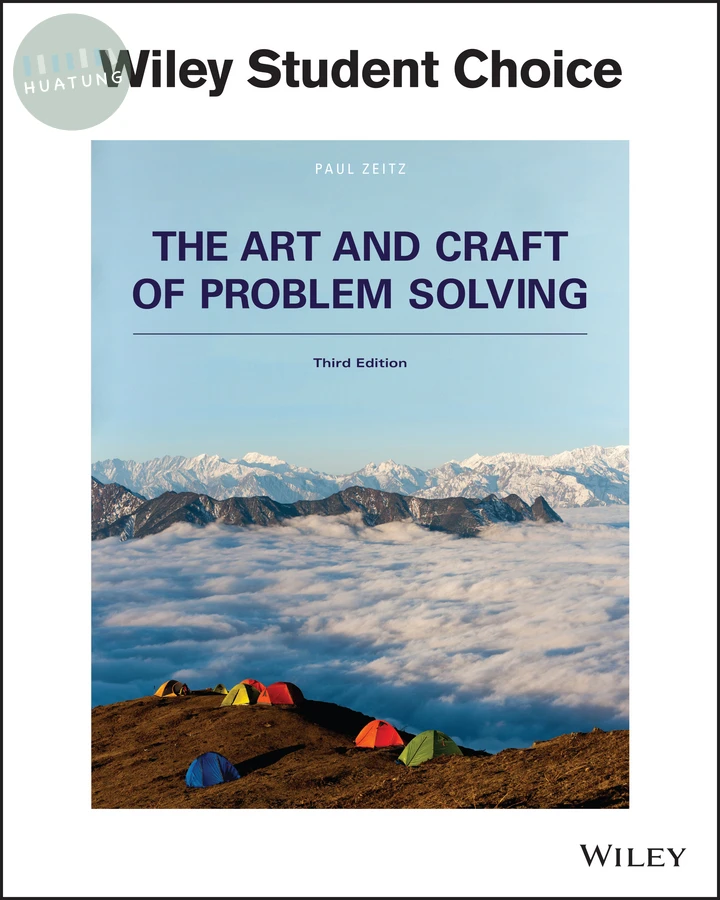

The Art and Craft of Problem Solving
$4799元可訂購
簡介
Appealing to everyone from college-level majors to independent learners, The Art and Craft of Problem Solving, 3rd Edition introduces a problem-solving approach to mathematics, as opposed to the traditional exercises approach. The goal of The Art and Craft of Problem Solving is to develop strong problem solving skills, which it achieves by encouraging students to do math rather than just study it. Paul Zeitz draws upon his experience as a coach for the international mathematics Olympiad to give students an enhanced sense of mathematics and the ability to investigate and solve problems.
目錄
1 What This Book Is About and How to Read It 1
1.1 “Exercises” vs. “Problems” 1
1.2 The Three Levels of Problem Solving 3
1.3 A Problem Sampler 6
1.4 How to Read This Book 9
2 Strategies for Investigating Problems 12
2.1 Psychological Strategies 12
Mental Toughness: Learn from Pólya’s Mouse 13
Creativity 15
2.2 Strategies for Getting Started 23
The First Step: Orientation 23
I’m Oriented. Now What? 24
2.3 Methods of Argument 37
Common Abbreviations and Stylistic Conventions 37
Deduction and Symbolic Logic 38
Argument by Contradiction 39
Mathematical Induction 42
2.4 Other Important Strategies 49
Draw a Picture! 49
Pictures Don’t Help? Recast the Problem in Other Ways! 51
Change Your Point of View 55
3 Tactics for Solving Problems 58
3.1 Symmetry 59
Geometric Symmetry 60
Algebraic Symmetry 64
3.2 The Extreme Principle 70
3.3 The Pigeonhole Principle 80
Basic Pigeonhole 80
Intermediate Pigeonhole 82
Advanced Pigeonhole 83
3.4 Invariants 88
Parity 90
Modular Arithmetic and Coloring 95
Monovariants 97
4 Three Important Crossover Tactics 105
4.1 Graph Theory 105
Connectivity and Cycles 107
Eulerian and Hamiltonian Walks 108
The Two Men of Tibet 111
4.2 Complex Numbers 116
Basic Operations 116
Roots of Unity 122
Some Applications 123
4.3 Generating Functions 128
Introductory Examples 129
Recurrence Relations 130
Partitions 132
4.4 Interlude: A few Mathematical Games 138
5 Algebra 143
5.1 Sets, Numbers, and Functions 143
Sets 143
Functions 145
5.2 Algebraic Manipulation Revisited 147
The Factor Tactic 148
Manipulating Squares 149
Substitutions and Simplifications 150
5.3 Sums and Products 157
Notation 157
Arithmetic Series 158
Geometric Series and the Telescope Tool 158
Infinite Series 161
5.4 Polynomials 164
Polynomial Operations 165
The Zeros of a Polynomial 165
5.5 Inequalities 174
Fundamental Ideas 174
The AM-GM Inequality 177
Massage, Cauchy-Schwarz, and Chebyshev 181
6 Combinatorics 189
6.1 Introduction to Counting 189
Permutations and Combinations 189
Combinatorial Arguments 192
Pascal’s Triangle and the Binomial Theorem 193
Strategies and Tactics of Counting 195
6.2 Partitions and Bijections 197
Counting Subsets 197
Information Management 200
Balls in Urns and Other Classic Encodings 203
6.3 The Principle of Inclusion-Exclusion 207
Count the Complement 207
PIE with Sets 208
PIE with Indicator Functions 212
6.4 Recurrence 215
Tiling and the Fibonacci Recurrence 215
The Catalan Recurrence 217
7 Number Theory 224
7.1 Primes and Divisibility 224
The Fundamental Theorem of Arithmetic 224
GCD, LCM, and the Division Algorithm 226
7.2 Congruence 232
What’s So Good About Primes? 233
Fermat’s Little Theorem 234
7.3 Number Theoretic Functions 236
Divisor Sums 237
Phi and Mu 238
7.4 Diophantine Equations 242
General Strategy and Tactics 242
7.5 Miscellaneous Instructive Examples 249
Can a Polynomial Always Output Primes? 249
If You Can Count It, It’s an Integer 250
A Combinatorial Proof of Fermat’s Little Theorem 250
Sums of Two Squares 251
8 Geometry for Americans 258
8.1 Three “Easy” Problems 258
8.2 Survival Geometry I 259
Points, Lines, Angles, and Triangles 260
Parallel Lines 262
Circles and Angles 265
Circles and Triangles 267
8.3 Survival Geometry II 271
Area 271
Similar Triangles 275
Solutions to the Three “Easy” Problems 277
8.4 The Power of Elementary Geometry 283
Concyclic Points 284
Area, Cevians, and Concurrent Lines 287
Similar Triangles and Collinear Points 290
Phantom Points and Concurrent Lines 293
8.5 Transformations 297
Symmetry Revisited 297
Rigid Motions and Vectors 299
Homothety 306
Inversion 308
9 Calculus 316
9.1 The Fundamental Theorem of Calculus 316
9.2 Convergence and Continuity 318
Convergence 319
Continuity 324
Uniform Continuity 325
9.3 Differentiation and Integration 329
Approximation and Curve Sketching 329
The Mean Value Theorem 332
A Useful Tool 335
Integration 336
Symmetry and Transformations 338
9.4 Power Series and Eulerian Mathematics 342
Don’t Worry! 342
Taylor Series with Remainder 344
Eulerian Mathematics 347
Beauty, Simplicity, and Symmetry: The Quest for a Moving Curtain 350
References 355
Index 357