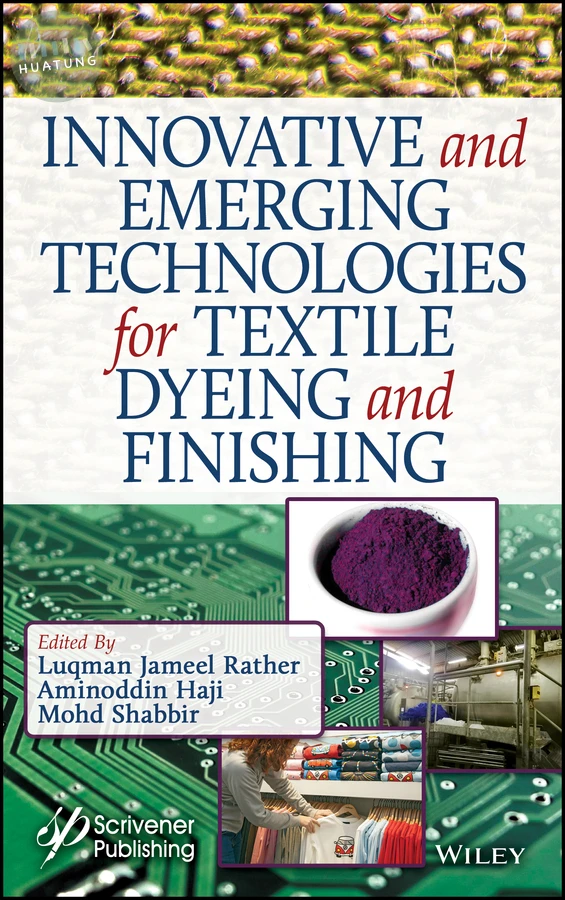
Innovative and Emerging Technologies for Textile Dyeing and Finishing
$7105元 定價: $7894 9折 可訂購
簡介
Innovative and Emerging Technologies for Textile Dyeing and Finishing
With the public enhanced awareness towards eco-preservation, eco-safety and health concerns, environmentally benign, nontoxic and sustainable bioresource materials produced mainly from non-food crops have revolutionized all industrial sectors particularly textile industry. In recent years, textile industries in developed countries are getting increasing interest in global interest due to the varied and changing world market conditions in terms of price, durability and fiber mixtures as well as design, colors, weight, ease of handling and product safety. The increasing environmental and health concerns owing to the use of large quantities of water and hazardous chemicals in conventional textile finishing processes lead to the design and development of new dyeing strategies and technologies. Effluents produced from these textiles wet processing industries are very diverse in chemical composition, ranging from inorganic finishing agents, surfactants, chlorine compounds, salts, total phosphate to polymers and organic products.
This aspect forced western countries to exploit their high technical skills in the advancements of textile materials for high quality technical performances, and development of cleaner production technologies for cost effective and value-added textile materials. Therefore, vast and effective research investigations have been undertaken all over the world to minimize the negative environmental impact of synthetic chemical agents through the sustainable harvest of eco-friendly bioresource materials.
The book will discuss following research developments in academic and industry:
Improvement in dye extraction and its applications
Impact of textile dyeing on environment
Textile finishing by natural and ecofriendly means
Natural dyes as environmental-friendly bioresource products
Textile effluent remediation via physical, chemical and biological processes.
目錄
Preface xv
1 Eco-Friendly Stimuli and Their Impact on the Tinctorial Capacity of Textile Materials 1
Vasilica Popescu and Luminita Ciobanu
1.1 Introduction 2
1.2 Characterization of Ultrasound Physical Stimuli 2
1.3 Microwave as Stimulus for the Textile Wet Processes 26
1.4 Conclusions 38
2 Skincare Finishes to Textiles 45
Angela Danila and Laura Chirila
2.1 Introduction 45
2.2 Types of Skincare Textiles 48
2.3 Techniques for Skincare Compounds Embedding 74
2.4 Techniques for Microparticles Applying on Textile Supports 76
2.5 Conclusion 79
3 Recent Advances in Synthetic Dyes 91
Suhail Ayoub Khan, Daud Hussain and Tabrez Alam Khan
3.1 Introduction 91
3.2 Synthetic Dyes in Textile Coloration 92
3.3 Synthetic Dyes in Dye-Sensitized Solar Cells 99
3.4 Synthetic Dyes in Liquid Crystal Display 102
3.5 Synthetic Dyes in Fluorescent Sensors 105
3.6 Synthetic Dyes in the Detection of G-Quadruplex DNA 106
3.7 Conclusion 107
4 Natural Dye Extraction and Dyeing of Different Fibers: A Review 113
Bota, Sanda and Indrie, Liliana
4.1 Introduction 114
4.2 Classification of Natural Dyes 116
4.3 Color-Based Classification 122
4.4 Dyeing With Natural Color From Calendula offcinalis 124
4.5 Extraction of Natural Dyes 125
4.6 Dyeing Methods 127
4.7 Conclusions 131
5 Airflow, Foam, and Supercritical Carbon Dioxide Dyeing Technologies 137
Molla Tadesse Abate and Melkie Getnet Tadesse
5.1 Introduction 137
5.2 Airflow Dyeing Technology 138
5.3 Foam Dyeing Technology 145
5.4 Supercritical Carbon Dioxide Dyeing Technology 152
5.5 Conclusion 159
6 Colored Nanofiber Production: A Literature Review and Case Study 165
Derman Vatansever Bayramol, Rýza Atav, Ahmet Özgür Aðýrgan and Aylin Yýldýz
6.1 Introduction 166
6.2 Electrospinning 170
6.3 Colored Nanofiber Production 175
6.4 A Case Study: Silver Cyclohexane Mono Carboxylate: β-Cyclodextrine Inclusion Complex Doped Colored Functional Poly(Vinyl Alcohol) Nanoweb Production 177
6.5 Conclusion 184
7 The Effect of Plasma Treatment on Dyeing of Natural Fibers 191
Maryam Naebe, Abu Naser Md Ahsanul Haque and Aminoddin Haji
7.1 Introduction 191
7.2 Types of Plasma 192
7.3 Plasma Application on Natural Fibers 194
7.4 Environmental Impact 206
7.5 Conclusions 207
8 The Effect of Plasma Treatment on Dyeing of Synthetic Fibers 213
Aminoddin Haji, Abu Naser Md Ahsanul Haque and Maryam Naebe
8.1 Introduction 213
8.2 Mechanism of Plasma Interaction With the Substrate 215
8.3 Achievable Functionalities by Plasma Application 217
8.4 Application on Synthetic Fibers 219
8.5 The Current Standpoint of Plasma Application 227
8.6 Conclusions 228
9 Ozone-Based Finishing of Textile Materials 235
M. Ýbrahim Bahtiyari and Ayþegül Körlü
9.1 Introduction 235
9.2 Application of Ozone in Textile Finishing 239
9.3 Conclusion with Future Expectation 257
10 Ultrasound-Based Wet Processes in Textile Industry 265
Ayþegül Körlü and M. Ýbrahim Bahtiyari
10.1 Introduction 265
10.2 Application of Ultrasound in Textile Finishing 267
10.3 Conclusion With Future Expectation 289
11 Synthetic and Natural UV Protective Agents for Textile Finishing 301
Anuradha Sankaran, Arpana Kamboj, Lata Samant and Seiko Jose
11.1 Introduction 302
11.2 Role of Textiles in Protective Clothing 303
11.3 Factors Influencing Ultraviolet Radiation 305
11.4 Susceptibility of Various Textiles on UV Radiations 307
11.5 Method of Analysis and Standard 308
11.6 Synthetic Organic Compounds for UV Protection of Textiles 310
11.7 Ultraviolet Protection of Textiles From Natural Dyes 314
11.8 Nanotechnological Interventions in UV Protective Textiles 315
11.9 Graphene as UV Blocker for Textiles 317
11.10 Conclusion 319
12 Hydrophobic and Oleophobic Finishes for Textiles 325
Laura Chirila and Angela Danila
12.1 Introduction 326
12.2 Textiles With Special Wettability Properties 328
12.3 Liquid Repellent Treatments of Textile Materials 332
12.4 Characterization Methods of Repellency Degree 361
12.5 Properties Desired of Liquid-Repellent Coatings 363
12.6 Environmental Impact 363
12.7 Conclusions 365
13 Flame Retardant Finish for Textile Fibers 373
Nur-Us-Shafa Mazumder and Mohammad Tajul Islam
13.1 Introduction 373
13.2 Importance of Flame Retardant Finish 374
13.3 Factors Affecting the Flammability of Textiles 375
13.4 Mechanism of Combustion of Textile Fibers 377
13.5 Flame Retardants 378
13.6 Flame Retardant Finish for Different Polymers 386
13.7 Different Flame Retardant Techniques 394
13.8 Assessment of Flame Retardancy 396
13.9 Application of Flame Retardant Textiles 396
13.10 Environmental Issues and Sustainable Flame Retardants 400
References 401
Index 407