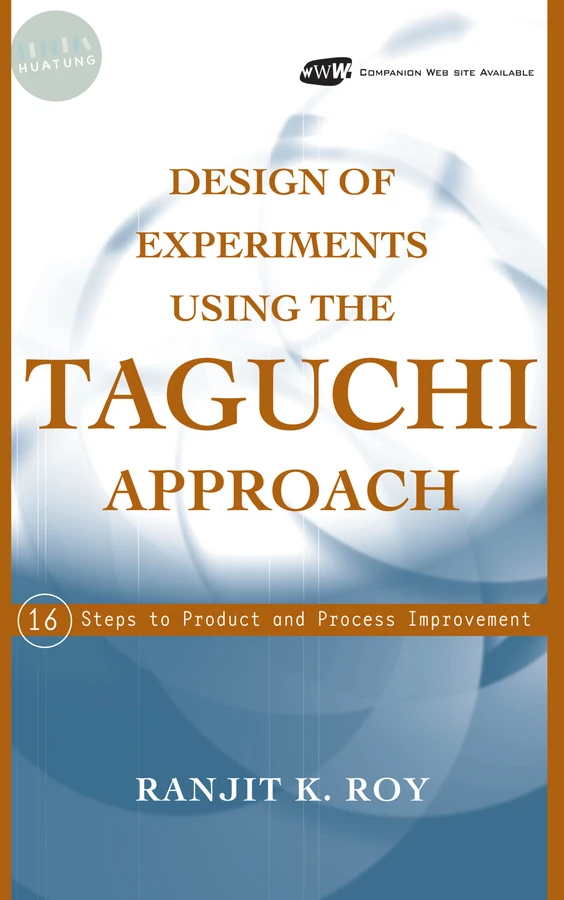

Design of Experiments Using The Taguchi Approach
$5736元 定價: $6373 9折 可訂購
簡介
Fulfill the practical potential of DOE-with a powerful, 16-step approach for applying the Taguchi method
Over the past decade, Design of Experiments (DOE) has undergone great advances through the work of the Japanese management guru Genechi Taguchi. Yet, until now, books on the Taguchi method have been steeped in theory and complicated statistical analysis. Now this trailblazing work translates the Taguchi method into an easy-to-implement 16-step system.
Based on Ranjit Roy's successful Taguchi training course, this extensively illustrated book/CD-ROM package gives readers the knowledge and skills necessary to understand and apply the Taguchi method to engineering projects-from theory and applications to hands-on analysis of the data. It is suitable for managers and technicians without a college-level engineering or statistical background, and its self-study pace-with exercises included in each chapter-helps readers start using Taguchi DOE tools on the job quickly. Special features include:
* An accompanying CD-ROM of Qualitek-4 software, which performs calculations and features all example experiments described in the book
* Problem-solving exercises relevant to actual engineering situations, with solutions included at the end of the text
* Coverage of two-, three-, and four-level factors, analysis of variance, robust designs, combination designs, and more
Engineers and technical personnel working in process and product design-as well as other professionals interested in the Taguchi method-will find this book/CD-ROM a tremendously important and useful asset for making the most of DOE in their work.
目錄
Preface.
Acknowledgments.
Symbols and Abbreviations.
Introduction.
Design of Experiments and the Taguchi Approach.
Definition and Measurement of Quality.
Common Experiments and Methods of Analysis.
Experimental Design Using Orthogonal Arrays.
Experimental Design with Two-Level Factors Only.
Experimental Design With Three- and Four-Level Factors.
Analysis of Variance.
Experimental Design for Studying Factors Interaction.
Experimental Design with Mixed-Level Factors.
Combination Designs.
Strategies for Robust Design.
Analysis Using Signal-to-Noise Ratios.
Results Comprising Multiple Criteria of Evaluations.
Quantification of Variation Reduction and Performance Improvement.
Effective Experiment Preparation and Planning.
Case Studies.
Appendix.
What's on the Disk.
Index.
List of Symbols.