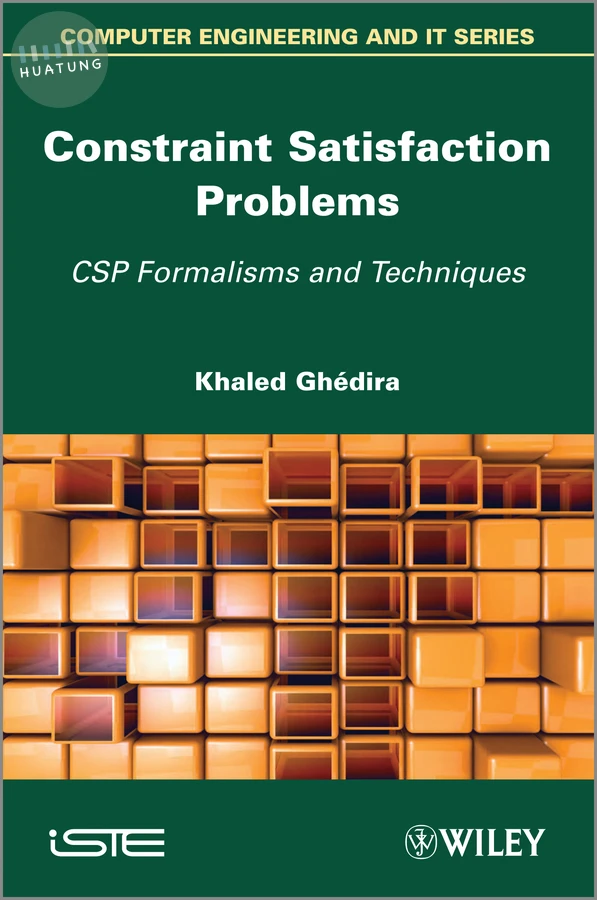
Constraint Satisfaction Problems
$5126元 定價: $5695 9折 可訂購
簡介
A Constraint Satisfaction Problem (CSP) consists of a set of variables, a domain of values for each variable and a set of constraints. The objective is to assign a value for each variable such that all constraints are satisfied. CSPs continue to receive increased attention because of both their high complexity and their omnipresence in academic, industrial and even real-life problems. This is why they are the subject of intense research in both artificial intelligence and operations research. This book introduces the classic CSP and details several extensions/improvements of both formalisms and techniques in order to tackle a large variety of problems. Consistency, flexible, dynamic, distributed and learning aspects are discussed and illustrated using simple examples such as the n-queen problem.
目錄
Preface ix
Introduction xi
Chapter 1 Foundations of CSP 1
1.1.Basicconcepts 1
1.2.CSPframework 3
1.2.1.Formalism 4
1.2.2.Areasofapplication 6
1.2.3.Extensions 17
1.3.Bibliography 22
Chapter 2 Consistency Reinforcement Techniques 29
2.1.Basicnotions 29
2.1.1.Equivalence 29
2.1.2.K-consistency 30
2.2.Arcconsistencyreinforcementalgorithms 32
2.2.1.ac-1 33
2.2.2.ac-2 36
2.2.3.ac-3 38
2.2.4.ac-4 41
2.2.5.ac-5 44
2.2.6.ac-6 50
2.2.7.ac-7 54
2.2.8 Ac2000 61
2.2.9 Ac2001 65
2.3.Bibliography 69
Chapter 3 CSP Solving Algorithms 73
3.1.Completeresolutionmethods 73
3.1.1.Thebacktrackingalgorithm 74
3.1.2.Look-backalgorithms 76
3.1.3.Look-aheadalgorithms 86
3.2.Experimentalvalidation 92
3.2.1.Randomgenerationofproblems 92
3.2.2.Phasetransition 94
3.3.Bibliography 96
Chapter 4 Search Heuristics 99
4.1.Organizationofthesearchspace 99
4.1.1.Parallelapproaches 99
4.1.2.Distributedapproaches 100
4.1.3 Collaborative approaches 102
4.2 Ordering heuristics 102
4.2.1 Illustrative example 102
4.2.2 Variable ordering 109
4.2.3 Value ordering 115
4.2.4 Constraints-based ordering 116
4.3 Bibliography 117
Chapter 5 Learning Techniques 121
5.1.The“nogood”concept 122
5.1.1.Exampleofunionandprojection 123
5.1.2.Useofnogoods 125
5.1.3.Nogoodhandling 125
5.2.Nogood-recordingalgorithm 126
5.3.Thenogood-recording-forward-checkingalgorithm 129
5.4.Theweak-commitment-nogood-recordingalgorithm 132
5.5.Bibliography 133
Table of Contents vii
Chapter 6. Maximal Constraint Satisfaction Problems 135
6.1 Branch and bound algorithm 136
6.2.PartialForward-Checkingalgorithm 138
6.3.Weak-commitmentsearch 142
6.4.GENETmethod 144
6.5.Distributedsimulatedannealing 146
6.6.Distributedandguidedgeneticalgorithm 147
6.6.1.Basicprinciples 148
6.6.2.Themulti-agentmodel 150
6.6.3.Geneticprocess 152
6.6.4.Extensions 158
6.7 Bibliography 162
Chapter 7 Constraint Satisfaction and Optimization Problems 165
7.1.Formalism 166
7.2 Resolution methods 166
7.2.1 Branch-and-bound algorithm 167
7.2.2 Tunneling algorithm 170
7.3 Bibliography 178
Chapter 8 Distributed Constraint Satisfaction Problems 181
8.1.DisCSPframework 183
8.1.1.Formalism 183
8.1.2.Distributionmodes 185
8.1.3.Communicationmodels 191
8.1.4.Convergenceproperties 193
8.2.Distributedconsistencyreinforcement 195
8.2.1.TheDisAC-4algorithm 196
8.2.2.TheDisAC-6algorithm 197
8.2.3.TheDisAC-9algorithm 198
8.2.4.TheDRACalgorithm 199
8.3 Distributed resolution 200
8.3.1.Asynchronousbacktrackingalgorithm 201
8.3.2.Asynchronousweak-commitmentsearch 204
8.3.3 Asynchronous aggregation search 205
8.3.4.Approachesbasedoncanonicaldistribution 207
8.3.5.DOCapproach 208
8.3.6 Generalization of DisCSP algorithms to several variables 214
8.4.Bibliography 215
Index 221