
Deep Learning in Quantitative Finance
$2679元 定價: $2977 9折 可訂購
簡介
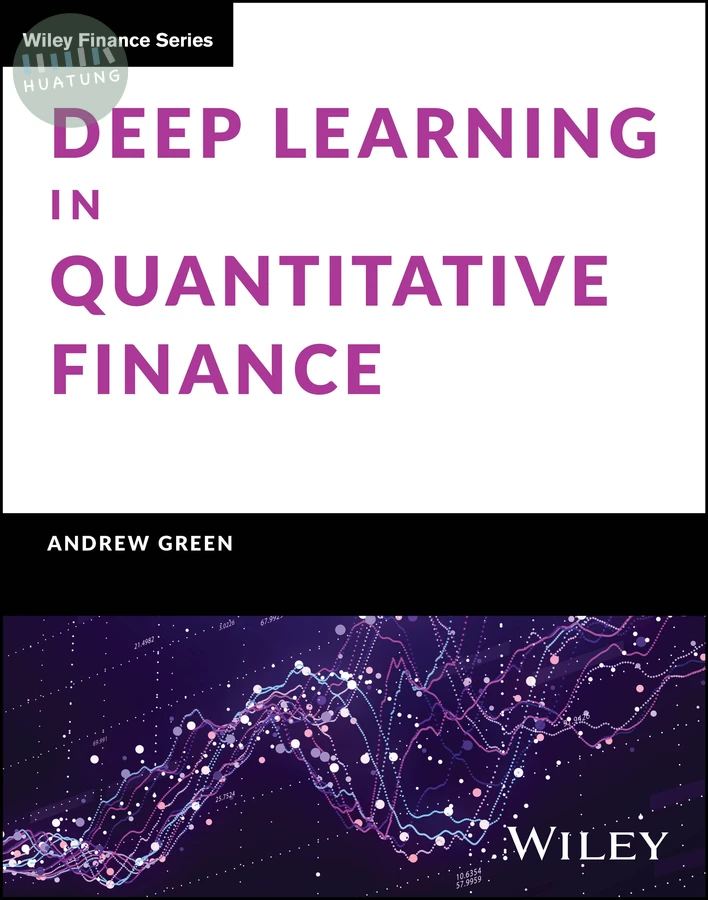
The complete and practical guide to one of the hottest topics in quantitative finance Deep learning, that is, the use of deep neural networks, is now one of the hottest topics amongst quantitative analysts. Deep Learning in Quantitative Finance provides a comprehensive treatment of deep learning and describes a wide range of applications in mainstream quantitative finance. Inside, you’ll find over ten chapters which apply deep learning to multiple use cases across quantitative finance. You’ll also gain access to a companion site containing a set of Jupyter notebooks, developed by the author, that use Python to illustrate the examples in the text. Readers will be able to work through these examples directly. This book is a complete resource on how deep learning is used in quantitative finance applications. It introduces the basics of neural networks, including feedforward networks, optimization, and training, before proceeding to cover more advanced topics. You’ll also learn about the most important software frameworks. The book then proceeds to cover the very latest deep learning research in quantitative finance, including approximating derivative values, volatility models, credit curve mapping, generating realistic market data, and hedging. The book concludes with a look at the potential for quantum deep learning and the broader implications deep learning has for quantitative finance and quantitative analysts. Covers the basics of deep learning and neural networks, including feedforward networks, optimization and training, and regularization techniques
Offers an understanding of more advanced topics like CNNs, RNNs, autoencoders, generative models including GANs and VAEs, and deep reinforcement learning
Demonstrates deep learning application in quantitative finance through case studies and hands-on applications via the companion website
Introduces the most important software frameworks for applying deep learning within finance
This book is perfect for anyone engaged with quantitative finance who wants to get involved in a subject that is clearly going to be hugely influential for the future of finance.
目錄
Acknowledgments xix
1 Introduction 3
1.1 What this book is about 3
1.2 The Rise of AI 5
1.3 The Promise of AI in Quantitative Finance 7
1.4 Practicalities 7
1.5 Reading this book 10
2 Feed Forward Neural Networks 13
2.1 Introducing Neural Networks 13
2.2 Regression and Classification 18
2.3 Activation Functions 27
2.4 The Universal Function Approximation Theorem 45
2.5 Conclusions 48
3 Training Neural Networks 49
3.1 Backpropagation and Adjoint Algorithmic Differentiation 50
3.2 Data Preparation and Scaling 53
3.3 Weight Initialization 57
3.4 The Choice of Loss Function 68
3.5 Optimization Algorithms 82
3.6 Common Training Problems 97
3.7 Batch Normalization 104
3.8 Evaluation and Validation 110
3.9 Sobolev Training Using Function Derivatives 124
3.10 Conclusions 131
4 Regularisation 133
4.1 Introduction Regularisation and Generalisation 133
4.2 Weight Decay 134
4.3 Early Stopping 137
4.4 Ensemble Methods and Dropout 138
4.5 Data Augmentation 146
4.6 Other Regularisation Methods 147
4.7 Conclusions Regularisation Strategy 149
5 Hyperparameter Optimization 151
5.1 Introduction 151
5.2 Manual 155
5.3 Grid Search 155
5.4 Random Search 158
5.5 Bayesian Optimization 159
5.6 Bandit-based 165
5.7 Population Based Training (PBT) 181
5.8 Conclusions 184
6 Convolutional Neural Networks 187
6.1 Introduction 187
6.2 Convolutions 188
6.3 Downsampling 203
6.4 Data Augmentation 206
6.5 Transfer Learning Using Pre-trained Networks 211
6.6 Visualising Features 213
6.7 Famous CNNs 223
6.8 Conclusions on CNNs 252
7 Sequence Models 255
7.1 Introducing Sequence Models 255
7.2 Recurrent Neural Networks 257
7.3 Neural Natural Language Processing 276
7.4 Conclusions on Sequence Models 322
8 Autoencoders 323
8.1 Introduction 323
8.2 Autoencoders and Singular-Valued Decomposition 325
8.3 Shallow and Deep Autoencoders 332
8.4 Regularized and Sparse Autoencoders 336
8.5 Denoising Autoencoders 339
8.6 Autoencoders and Generative Models 341
8.7 Conclusion 342
9 Generative Models 343
9.1 Introduction 343
9.2 Evaluating Generative Model Performance 345
9.3 Energy-based Models (EBMs) 348
9.4 Variational Autoencoders (VAEs) 383
9.5 Generative Adversarial Networks (GANs) 396
9.6 Latent Diffusion Models (LDMs) 491
9.7 Conclusions on Generative Models 493
10 Deep Reinforcement Learning 495
10.1 Introduction 495
10.2 Key Concepts in Reinforcement Learning 496
10.3 Markov Decision Processes (MDPs) and the Bellman Equations 506
10.4 Dynamic Programming and Policy Search 509
10.5 Monte Carlo Methods for RL 516
10.6 TD Learning 535
10.7 Deep Q Networks (DQNs) 546
10.8 Policy Gradient 561
10.9 Actor-Critic Methods 567
10.10 Conclusions 568
11 Derivative Valuation using Neural Networks 571
11.1 Introduction 571
11.2 Derivative Valuation using Neural Networks trained as Non-parametric Models 572
11.3 Derivative Valuation Function Approximation 584
12 High Dimensional PDE and BSDE Solvers 603
12.1 Introduction 603
12.2 Deep Galerkin Method (DGM) 604
12.3 Deep BSDE Solvers 619
12.4 Projection and Martingale Solvers 641
12.5 Deep Path Dependent PDEs (DPPDE) 642
12.6 Physics Informed Neural Networks (PINNs) 644
12.7 Deep Backward Dynamic Programming (DBDP) 646
12.8 Deep Splitting (DS) 647
12.9 Conclusions 649
13 Deep Monte Carlo and Optimal Stopping 651
13.1 Introduction 651
13.2 Deep Monte Carlo 653
13.3 Deep Optimal Stopping and Applications 685
13.4 Conclusion Deep Monte Carlo 703
14 Static Replication using Neural Networks 705
14.1 (Semi) Static Replication 705
14.2 Neural Static Replication 708
14.3 Conclusions on Neural Static Replication 716
15 Volatility Surfaces 717
15.1 Introduction 717
15.2 Volatility Surface Models 718
15.3 Deep Learning Volatility Surfaces 722
15.4 Deep Local Volatility 736
15.5 Conclusions 750
16 Model Calibration 751
16.1 Introduction 751
16.2 Model Calibration 752
16.3 Conclusion on Deep Calibration 767
17 XVA 769
17.1 Introduction 769
17.2 Credit Curve Mapping 771
17.3 Exposure Calculation using Neural Networks 784
17.4 Conclusions on Deep XVA 791
18 Generating Realistic Market Data 793
18.1 Introduction and Classical Methods 793
18.2 Motivation and Applications of Synthetic Financial Market Data 796
18.3 Time Series Generation 798
18.4 Generating Higher Dimensional Market Data Structures 864
18.5 Completing Market Data - imputing missing values 886
18.6 Conclusions Synthetic Market Data 888
19 Deep Hedging 893
19.1 Introduction 893
19.2 Approaches to Deep Hedging 894
19.3 Deep Hedging Examples 935
19.4 Conclusion 942
20 The Future Quant 957
20.1 Conclusion on Deep Learning 957
20.2 The Future of Quantitative Analytics 959
20.3 The Future Quant 960
20.4 A Final Word 960