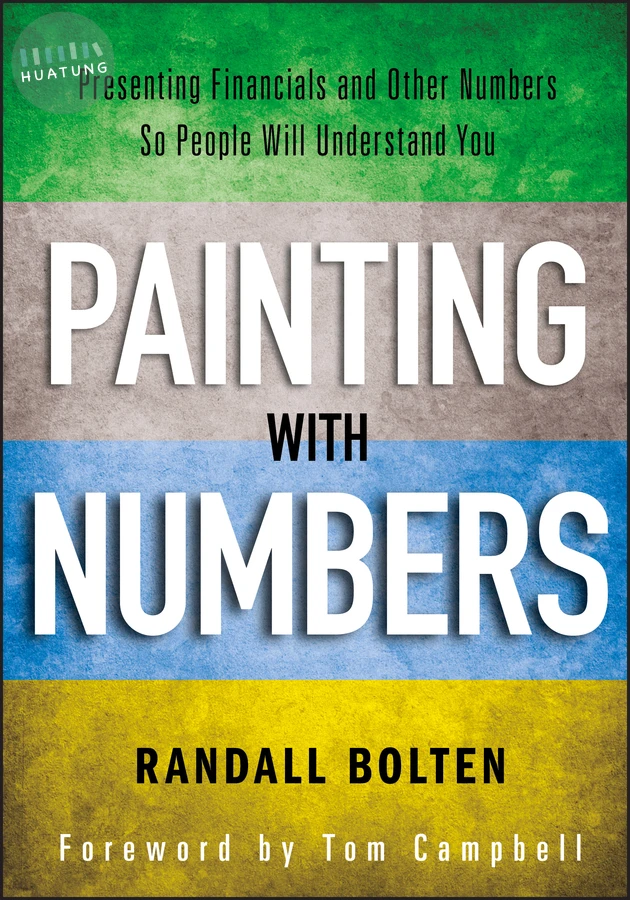

Painting with Numbers
$1151元 定價: $1279 9折 可訂購
簡介
Learn how to communicate better with numbers Whether you are distributing a report or giving a presentation, you have a lot of numbers to present and only a few minutes to get your point across. Your audience is busy and has a short attention span. Don't let an amateur presentation bog you down, confuse your audience, and damage your credibility. Instead, learn how to present numerical information effectively—in the same way you learned how to speak or write. With Painting with Numbers, you'll discover how to present numbers clearly and effectively so your ideas and your presentation shine.
Use the Arabic numeral system to your advantage master the use of layout and visual effects to communicate powerfully
Understand how audiences process your information and how that affects your "personal brand image"
Learn how to be perceived as a professional who truly understands the business concepts and issues underlying your numbers
Use software tools, including Excel, PowerPoint, and graphs, efficiently and to drive home your point
Author Randall Bolten shares his decades of experience as a senior finance executive distilling complicated information into clear presentations, to help you make your numerical information more comprehensible, meaningful, and accessible. Painting with Numbers is brimming with hands-on advice, techniques, tools, rules, and guidelines for producing clear, attractive, and effective quantation (the word the author has coined for the skill of presenting numbers).
目錄
Foreword xiii Preface xv
Acknowledgments xvii
introdUCtion This book Is Not About Numbers—Honest! 1
Being “Literate” 2
It’s What They Think That Matters 2
What You Were Never Taught 3
The Ultimate Goal 5
Some Notes about Reading This Book 5
Part I the rules 11
Chapter 1 Numerals Matter 13
Lining Up the Numbers 14
The Units of Measure 16
Precision 17
Negative Numbers: What Do They Mean? 20
Chapter 2 Looks Matter 25
The Tabula Rasa Decision 26
The “Where’s Waldo?” Effect 27
White Space Is Your Friend 29
But White Space Is Not Always Your Friend 30
Time and Other Dimensions: Across or Down? 33
Borders, Shading, and Other Visual Effects 35
Comments and Artwork 41
The “Ransom Note” Effect 43
Two Truly Helpful Hints 44
Chapter 3 Words Matter 47
Mean What You Say and Say What You Mean 48
Choosing between Precision and Presentability 52
Treating Words Like Numbers 55
Remember the Title. Please 57
Chapter 4 Your Audience Matters 61
The Right Amount of Data 62
Appropriate Emphasis on Critical Information 64
Consistency 67
Meaningful and Relevant Numbers 69
Respect for Your Audience’s Time 73
Wrap-Up for Part I: The Rules 77
Part II The Tools 81
Chapter 5 You Can Pay Me Now 83
The Instant Payoff Tips 85
Instant Payoff Tip #1: Set Up Templates and Styles 85
Instant Payoff Tip #2: Customize Your Toolbar 86
Instant Payoff Tip #3: Learn Some Shortcut Keys 87
Instant Payoff Tip #4: Use Consistent Formats 89
Instant Payoff Tip #5: Learn to Use Excel as a Database 90
Instant Payoff Tip #6: Learn to Use the Lookup & Reference Functions 94
Instant Payoff Tip #7: Organize Data for Easy Computation 95
Instant Payoff Tip #8: Learn to Use Automated Help 98
Instant Payoff Tip #9: Don’t Learn Too Many Ways to Do the Same Thing 99
Chapter 6 . . . Or Pay Me Later 103
The Long-Term Payoff Tips 104
Long-Term Payoff Tip #1: Use Sensible, Intelligent Filenames and Folder Organization 104
Long-Term Payoff Tip #2: Use Consistent Formats 106
Long-Term Payoff Tip #3: Design Intelligent, Intelligible Formulas 106
Long-Term Payoff Tip #4: Use Named Ranges 110
Long-Term Payoff Tip #5: Use Named Formulas or Macros 112
Long-Term Payoff Tip #6: Links: A Force That Can Be Used for Good or Evil 117
Long-Term Payoff Tip #7: Make Different Types of Cells Visually Distinguishable and Physically Separate 118
Long-Term Payoff Tip #8: Document Your Work! 120
Long-Term Payoff Tip #9: Check Your Work! 121
Long-Term Payoff Tip #10: Avoid Cool New Features 122
Chapter 7 Graphs: The “Cartoons” of Numbers 125
Why Do People Use Graphs? 126
Help Your Audience 127
First, Do No Harm 138
Chapter 8 The Pitfalls of Presentations and PowerPoint
153Why Do People Make Fun of Business Presentations? 154
Real Estate Is a Scarce and Precious Commodity 154
Help Your Audience 156
First, Do No Harm 161
Some Basic Truths That Go Double for Quantation 162
Wrap-Up for Part II: The Tools 166
Part III Real Mastery 169
Chapter 9 It’s Clear, but Is It Meaningful? 171
The War of the Adjectives 171
A Quantation Professional 173
Relating to Your Audience in a Constructive Way 174
Chapter 10 53 . . . Uh, Is That a Lot? 179
What Is a Key Indicator? 180
What Makes a Good Key Indicator? 183
A Simple Example 185
How Do You Present Key Indicators Effectively? 185
A Note on Precision 190
A Note on Dashboards 191
Chapter 11 The One Report Every Organization Needs 197
A Sample Natural P&L, and What Makes It a Good One 199
1. One Page! 200
2. Decision-Focused Line Items 200
3. Appropriate Dollar Amounts, neither Too Big nor Too Small 204
4. Intuitive Organization of the Line Items 205
5. Understandable Categories, Meaningful to All Users 208
6. Plain-English Terminology 208
7. Consistent Look-and-Feel 209
8. Key Results Equal to the Corresponding Numbers in the Accounting System (or an Explanation Why Not) 209
Mapping the Chart of Accounts 211
Generate a Natural P&L from a Spreadsheet, or from the Accounting System? 212
Now Let’s Talk about the Columns 213
Appendix 11A a Sermon to the Accounting Purists 219
Chapter 12 The Gaps in GAAP 225
Rules-Based versus Principles-Based 226
Where Is All This Headed? 227
“Expensing” Stock Options 228
Software Revenue Recognition 230
Tying GAAP to Internal Management Reports 232
Appendix 12A Some Notes on GAAP 235
What Is GAAP? 235
Stock Options 236
Revenue Recognition 237
Chapter 13 Quantation: It’s Not Just for Business Anymore 239
One Taxpayer at a Time 240
All the Taxpayers at Once 243
What’s Really Going on Here? 249
Chapter 14 Quantation in Ordinary Life 255
Models 255
The Meaning of Words 260
That Quiz I Promised 263
Part IV Wrap-Up 269
Chapter 15 Speaking Truth to Power 271
My “Tell the Truth” Syllogism 272
Reason #1 for Telling the Truth: It’s the Right Thing to Do 272
Reason #2: It’s in Your Employer’s Interest 272
Reason #3: It’s in Your Interest 273
Reason #4: You Will Get Caught 273
Reason #5: It’s the “Gotcha” of This Book 275
Don’t Be So Smug, You Civil Servants and Elected Officials! 276
Your Audience Has a Role, Too 276
Chapter 16 Now, What’s the First Thing You Do? 281
My Last, Best Tip 282
It’s Just a Skill 282
Where We Have Been 283
Appendix Jazz Meets Theology 287
Revisitation 288
The Sins of Presentation 289
The Sins of Behavior 297
The Deadliest Sin of All 301
About the Author 305
Index 307