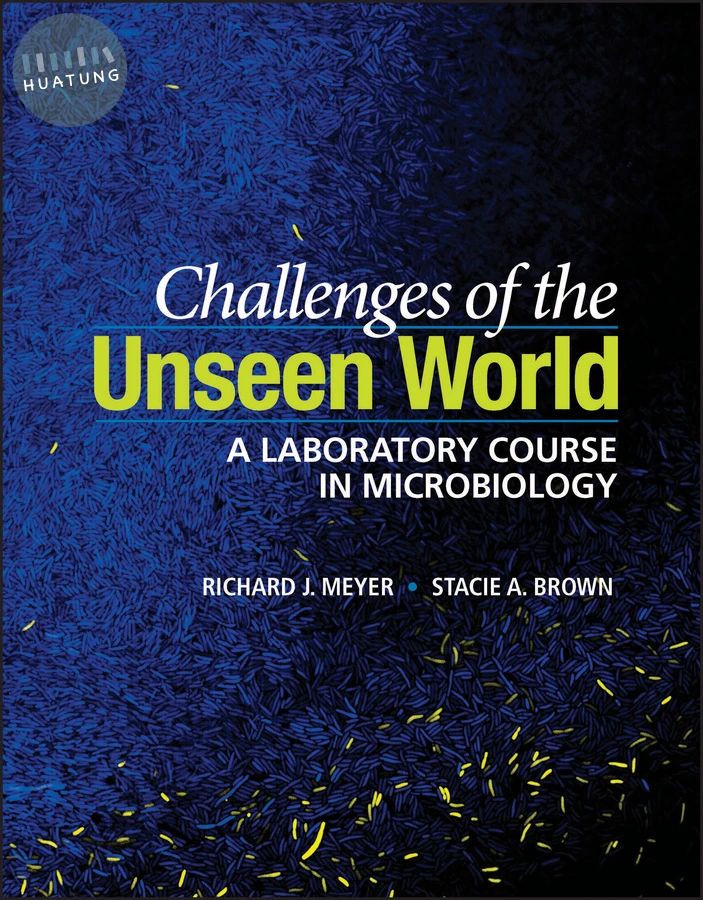
Challenges of the Unseen World
$2879元可訂購
簡介
Solving real-world health challenges in a learning environment
You are at an exciting gateway into the world of microorganisms. With nothing more than basic lab equipment such as microscopes, Petri dishes, media, and a handful of reagents, you will learn to isolate, grow, and identify bacteria that live all around us. This is no ordinary microbiology laboratory course; not only will you learn how to streak plates, use a microscope, perform a Gram stain, and prepare serial dilutions and spread plates—fundamental skills found in every microbiologist's toolkit—you will solve a series of public health–related challenges that many professional microbiologists encounter in their work.
By the end of this course, you will:
Determine the origin of a nosocomial infection. Using foundational and molecular methods, you will determine whether the infections occurring in hospitalized patients are the result of contaminated medical items.
Select the antibiotic to treat a patient with Crohn's disease. You will find minimum inhibitory concentrations of various antibiotics for a Pseudomonas strain associated with Crohn's disease.
Pinpoint the source of lettuce contaminated with E. coli. Using molecular tools you will investigate a common food safety challenge, antibiotic-resistant E. coli and the potential for spread of this resistance in the environment.
Find the farm releasing pathogens into a stream used for drinking water. Using bacteriophage load in water samples, you will locate the source of fecal contamination in the water supply of a village in an underdeveloped country.
Evaluate the potential of bacteria to cause a urinary tract infection. You will test for biofilms, quorum sensing behavior, and chemotaxis and assess which disinfectants would be most effective for sanitizing contaminated surfaces.
Microbiology educators and researchers Richard Meyer and Stacie Brown have created this hands-on, engaging introduction to the essential laboratory skills in the microbial sciences that is sure to change the way you view the world around you.
目錄
Preface
About the Authors
Introduction
The scientific method
Experimental design
Big data
Documentation
Safety
Student Laboratory Safety Contract
Appendix
Challenge One: Identifying the bacteria causing infections in hospital patients
Lab One
Background
Diversity and pure cultures
Bright field and phase contrast microscopy
Learning outcomes
Objectives
Part 1: Isolate bacteria from a mixed culture: Procedure: Streaking for isolated colonies
Part 2: Examine bacterial cells under the microscope
Procedure: Making a wet mount
Procedure: Using the microscope
Preparation for next lab
Questions
Lab Two
Background
Colony morphology and optimum temperature for growth
Cell shape and bacterial spores
The cell envelope
Learning outcomes
Part 1: Describe the colony morphology of the unknown
Part 2: Describe the characteristics of an individual cell viewed under themicroscope
Part 3: Determine the optimum temperature for growth
Part 4: Determine if the unidentified microorganism is Gram-positive or Gram-negative.
Procedure: Doing a Gram stain
Preparation for next lab
Questions
Lab Three
Background
Modes of energy generation in bacteria
Learning outcomes
Part 1: Can the unidentified microorganism grow in the presence of bile salts and ferment lactose?
Procedure: Streaking cells on MacConkey-lactose plates
Part 2: Can the unidentified microorganism ferment glucose?
Procedure: Glucose fermentation test
Part 3: Does the unidentified microorganism use cytochrome C duringrespiration (Gram-negative bacteria)?
Procedure: Oxidase test
Part 4: Does the microorganism make catalase (Gram-positive bacteria)?
Procedure: Catalase test
Part 5: Is the microorganism motile?
Procedure: Soft agar motility assay
Questions
Solving Challenge One
Preparing for Challenge Two
Questions
Bibliography
Challenge Two: Confirming the identification of a microorganism by sequencing the 16S rRNA gene
Questions before you begin the challenge
Lab One: Background
Classification of bacteria and 16S rRNA gene
Polymerase chain reaction (PCR)
Lab One: Learning outcomes
Lab One: Objective
Part 1: Obtain enough DNA for sequencing: amplify the 16S rRNA gene by PCR
Procedure:Diluting from stock solutions:
Lab One: Questions
Lab Two: Background
Agarose gel electrophoresis
Dideoxy DNA sequencing
Lab Two: Learning outcomes
Lab Two: Objectives
Part 1: Visualize the PCR product by agarose gel electrophoresis
Procedure:Making an agarose gel and carrying out gel electrophoresis
Part 2: Submit sample for DNA sequencing
Lab Two: Questions
Solving Challenge Two: Background
Solving Challenge Two: Learning outcomes
Solving Challenge Two: Objective
Identifying the unknown microorganism from the 16S rRNA gene sequence
Procedure: Preparing the sequence for analysis
Procedure: Doing a BLAST search
Questions
Bibliography
Challenge Three: Choosing an antibiotic to alleviate the symptoms of Crohn’s disease
Questions before you begin the challenge
Lab One: Background
Exponential growth
The bacterial growth curve
Pure cultures in liquid medium and the real world of bacteria
Lab One: Learning outcomes
Lab One: Objectives
Part 1: Construct a growth curve and calculate the generation time
Procedure: Recording the optical density of a growing culture
Part 2: Determine viable cell counts during exponential growth
Procedure: Serial dilution of samples
Procedure: Spreading cells on agar medium
Lab One: Questions
Lab Two: Background
Assaying for antibiotic sensitivity
Lab Two: Learning outcomes
Lab Two: Objective
Determine the MICs of different antibiotics for the Pseudomonas isolate.
Procedure: Setting up a MIC dilution assay
Lab Two: Questions
Solving Challenge Three
Bibliography
Challenge Four: Tracking down the source of an E. coli strain causing a local outbreak of disease
Questions before you begin the challenge
Lab One: Background
Genomic diversity and horizontal gene transfer
The shifting genome of many bacteria
Conjugation and other mechanisms of horizontal gene transfer
Lab One: Learning outcomes
Lab One: Objectives
Part 1: Determine if chloramphenicol resistance can be transferred byconjugation
Procedure: Doing a conjugation experiment on TSA medium
Part 2: Determine if the donor strain for conjugation contains a plasmid
Procedure: Rapid isolation of plasmid DNA
Lab One: Questions
Lab Two: Background
Strain typing
Lab Two: Learning outcomes
Lab Two: Objectives
Part 1: Determine if the plasmid DNAs from the lettuce isolate and the pathogenic strain are related
Procedure: Doing a restriction digest
Part 2: Determine if the donor strain for conjugation contains a plasmid
Procedure: Rapid isolation of plasmid DNA
Procedure: Agarose gel electrophoresis of the DNA fragments
Solving Challenge Four
Questions
Bibliography
Challenge Five: Using bacteriophage to identify the farm releasing pathogenic bacteria intoa village stream
Questions before you begin the challenge
Lab: Background
History and properties of bacteriophage
Testing water purity
Lab: Learning outcomes
Lab: Objective
Determine the load of bacteriophage at each collection site
Procedure: Filter the water samples to remove all the bacteria
Procedure: Titer the phages in the sterile filtrates
Solving Challenge Five
Lab: Questions
Bibliography
Challenge Six: Evaluating the pathogenic potential of bacteria causing urinary infections
Questions before you begin the challenge
Lab One: Background
Quorum sensing
Biofilms
Lab One: Objectives
Part 1: Determine if the hospital isolates form biofilms
Procedure: Staining biofilms with crystal violet
Part 2: Quantitatively analyze biofilm formation
Procedure: Quantifying the amount of biofilm by spectrophotometry
Part 3: Determine whether the hospital strains produce quorum sensingcompounds
Procedure: Using a reporter strain to detect quorum sensing
Lab One: Questions
Lab Two: Background
Swimming
Lab Two: Objectives
Part 1: Complete the analysis of quorum sensing
Part 2: Assay the hospital strains for chemotaxis to different compounds
Procedure: Testing for chemotaxis with the “plug-in-soft agar” test
Part 3: Determine the effectiveness of chemical cleaners
Procedure: Testing for chemical effectiveness with the Kirby-Bauer disk diffusion assay
Questions
Solving Challenge Six
Bibliography