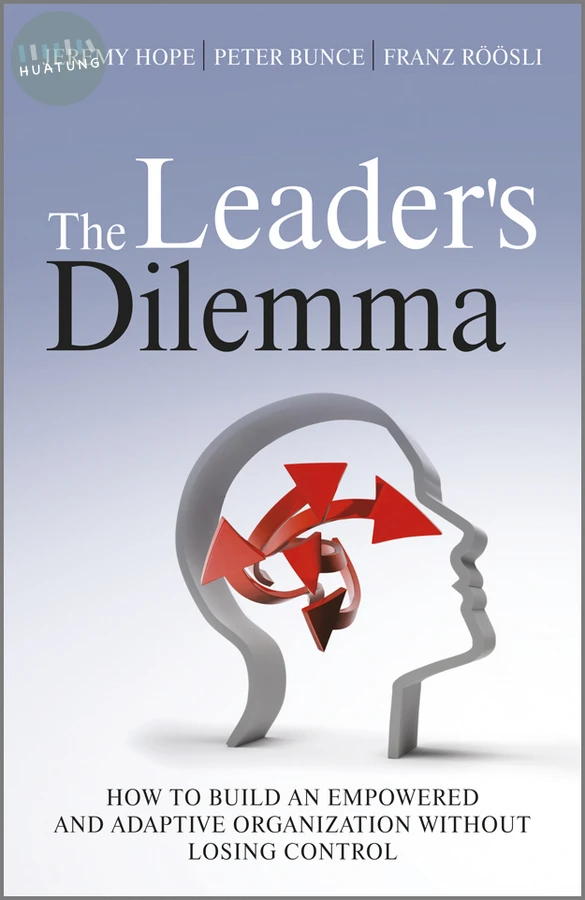
The Leader's Dilemma
$1252元 定價: $1391 9折 可訂購
簡介
Drawing on their work on performance management within the ‘beyond budgeting’ movement over the past ten years, including many interviews and case studies, Jeremy Hope, Peter Bunce and Franz Röösli set out in this book an executive guide to building a new management model based on eight key change management issues: 1. Governance: From rules and budgets to purpose and values
2. Success: From fixed targets to relative improvement
3. Organization: From centralized functions to customer-oriented teams
4. Accountability: From narrow targets to holistic success criteria
5. Trust: From central control to local autonomy
6. Transparency: From closed information to open book management
7. Rewards: From individual incentives to team-based reward
8. Risk: From complying with rules to understanding pressure points
This book is about rethinking how we manage organizations in a post-industrial, post credit crunch world where innovative management models represent the only remaining source of sustainable competitive advantage.[i] The changes suggested by the authors will enable and encourage a cultural climate change that will help organizations to attract and keep the best people as well as drive continuous innovation and growth.
Above all, The CEO's Dilemma is about learning how to change business - based on best practice and innovation drawn from leaders world-wide who have built and managed successful organizations.
目錄
Foreword v
Preface vii
Some definitions ix
Introduction
The organization as an adaptive system 1
1 Principle #1 – Values 33
Bind people to a common cause, not a central plan
2 Principle #2 – Governance 57
Govern through shared values and sound judgment, not detailed rules and regulations
3 Principle #3 – Transparency 89
Make information open and transparent; don’t restrict and control it
4 Principle #4 – Teams 105
Organize around a seamless network of accountable teams, not centralized functions
5 Principle #5 – Trust 121
Trust teams to regulate and improve their performance; don’t micro-manage them
6 Principle #6 – Accountability 139
Base accountability on holistic criteria and peer reviews, not on hierarchical relationships
7 Principle #7 – Goals 157
Set ambitious medium-term goals, not short-term fixed targets
8 Principle #8 – Rewards 179
Base rewards on relative performance, not fixed targets
9 Principle #9 – Planning 203
Make planning a continuous and inclusive process, not a top-down annual event
10 Principle #10 – Coordination 225
Coordinate interactions dynamically, not through annual budgets
11 Principle #11 – Resources 239
Make resources available just-in-time, not just-in-case
12 Principle #12 – Controls 257
Base controls on fast, frequent feedback, not on budget variances
13 Implementation insights 283
14 Make management change your legacy 305
Notes 309
Index 325