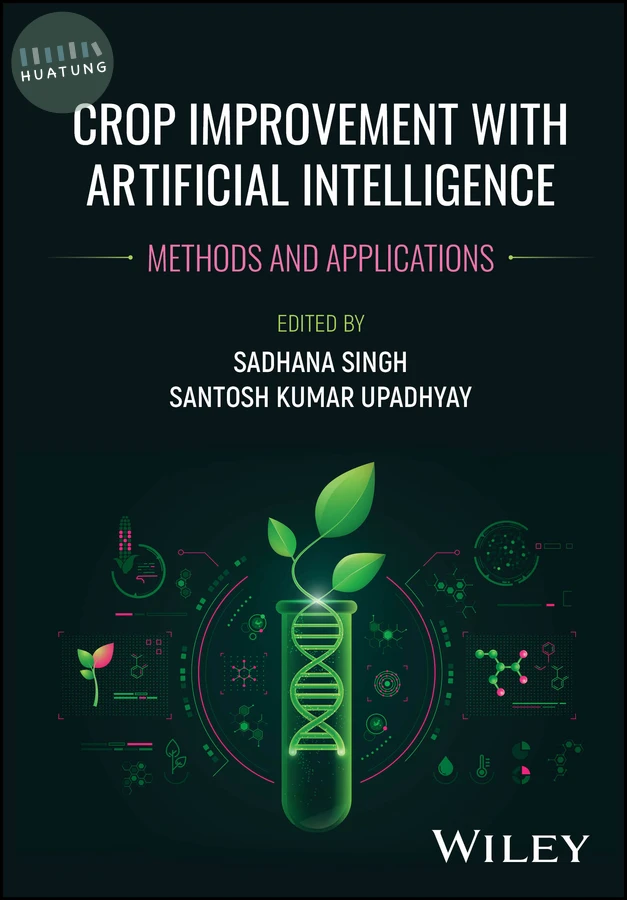
Crop Improvement with Artificial Intelligence
$6018元 定價: $6687 9折 可訂購
簡介
Guide to the application of AI for crop improvement, including deployment in plant biology and crop breeding Crop Improvement with Artificial Intelligence provides a comprehensive overview of the integration of AI into crop development and farm management, highlighting the latest advancements and applications in the field. The book offers an exhaustive review of recent progress and implementations of AI in agriculture, covering a wide range of topics crucial for understanding the innovative potential of AI in crop enhancement. Beginning with an exploration of the documented factors and potential for innovation in agriculture, the book introduces readers to the fundamental concepts of AI and its transformative impact on advanced farming methods. It delves into the various applications of AI in plant biology and breeding, from data collection and pre-processing to predictive analytics for crop yield and disease resistance. The book also addresses ethical considerations and challenges in AI-enabled crop improvement and delivers insights into the prospects of employing AI for crop enhancement, underscoring the significance of genetic diversity, resource optimization, and ethical considerations. Crop Improvement with Artificial Intelligence discusses topics including: Utilization of LLMs to improve analysis of agricultural data by interpreting intricate datasets and providing insights to enhance decision-making
Generative AI???s role in developing innovative solutions and predictive models for better crop management, pest control, and resource distribution
Current challenges such as data constraints, economic feasibility, and untested technologies
Integration of multi-omics data with the latest applications and technologies, including functional genomics, phenotyping, high-throughput imaging, and genomic prediction in plants, to analyze complex traits and advance plant transcriptomics
Crop Improvement with Artificial Intelligence is an essential resource for scholars, researchers, academics, agronomists, policymakers, and all other readers interested in capitalizing AI to address the hurdles of worldwide food security and encourage sustainable agricultural implementation.
目錄
About the Editors xxiii
List of Contributors xxv
Preface xxxi
1 Introduction to Artificial Intelligence for Crop Improvement 1
Madeeha Gul, Nikhil Raghuwanshi, and Noopur Singh
1.1 Introduction 1
1.2 AI-Driven Multi-Omics Data Integration 3
1.3 Genomic Selection and Breeding 4
1.4 High-Throughput Phenotyping and Imaging 6
1.5 Generative AI in Plant Breeding 8
1.6 Advanced Pest and Disease Management 9
1.7 Climate-Smart Agriculture Using AI 11
1.8 AI-Powered Digital Twins for Agriculture 12
1.9 AI for Soil Microbiome Optimization 12
1.10 Ethical and Socioeconomic Aspects of AI in Agriculture 13
1.11 Challenges, Limitations, and Future Directions 14
1.12 Conclusion 15
2 Advances in Artificial Intelligence for Plant Biology and Crop Breeding: An Overview 27
Diya Kapadia, Jayshree Pawar, and Kanti Kiran
2.1 Introduction 27
2.2 Big Data: Handling and Analytics 27
2.3 Blockchain Technology to Trace and Store Huge Breeding Data 29
2.4 3D Printing in Plant Science 31
2.5 Machine Learning-Based Approaches in Modernized Plant Biology and Biotechnology 32
2.6 Supervised and Unsupervised Learning Algorithms 32
2.7 Artificial Neural Network and Genetic Algorithm Usage in Crops 33
2.8 Predictive Analytics for Plant Biology 34
2.9 Usage of Agents and Robotics in Breeding Programs 35
2.10 Sensors and Interpretations of Networking 37
2.11 Object Image Capture and Analysis of Data Used in Plant Biology 38
2.12 Application of ANNs in Plant Science 39
2.13 Future Perspectives of AI for Crop Improvements 39
2.14 Conclusion 40
3 The Role of Artificial Intelligence in Modern Agriculture and Crop Innovation 45
Dil Khurram, Nadeem Iqbal, Muhammad Nauman, Riyazuddin Riyazuddin, and Guo Liu
3.1 Introduction 45
3.2 Crop Improvement 46
3.3 Artificial Intelligence 48
3.4 The Role of AI in Agriculture 49
3.5 Overview of AI Integration in Crop Improvement 49
3.6 Role of Crop Growth Models 50
3.7 Machine Learning (ML) Models and Algorithms 52
3.8 Deep Learning 55
3.9 Computer Vision 57
3.10 AI for Multi-Omics Data Analysis 58
3.11 Natural Language Processing 58
3.12 Symbolic AI 62
3.13 Conclusions and Future Perspectives 63
4 Advancements in Phenotyping and High-Throughput Imaging 71
Shrishti, Avani Vasudeva, and Papiya Mukherjee
4.1 Introduction 71
4.2 Crop Phenotyping 72
4.3 Phenotyping Platforms 72
4.4 Plant Traits to Be Phenotyped 77
4.5 High-Throughput Imaging Systems 78
4.6 High-Throughput Image Data Processing 84
4.7 Future Prospectives 85
4.8 Conclusion 85
5 Applications of AI in the Genomic Analysis of Crop Plants for Improved Agricultural Outcomes 93
Satwi Shah, Nancy Vora, and Manan Shah
5.1 Introduction 93
5.2 AI Methods 95
5.3 Genomic Selection Models: Implementation in Plant Breeding 98
5.4 Challenges in AI Techniques for Genomic Selection in Plants 106
5.5 Conclusions 109
6 Current Applications of Artificial Intelligence and Machine Learning in Plant Functional Genomics 113
Siddharth Singh, Sanjana Mishra, Amaan Arif, Prekshi Garg, and Prachi Srivastava
6.1 Introduction 113
6.2 Artificial Intelligence and Machine Learning in Plant Genomics 118
6.3 Applications of Artificial Intelligence and Machine Learning in Plant Genomics 123
6.4 Challenges in AI and ML Applications in Plant Genomics 128
6.5 Future Prospects 130
6.6 Conclusion 131
7 AI Models for Studying and Integrating Plant Multiple Omics 141
Maliheh Eftekhari and Mohammad Reza Naghavi
7.1 Introduction 141
7.2 Plant Multi-Omics: Data Types and Challenges 142\
7.3 AI Models for Analyzing Individual Omics 147
7.4 AI Approaches for Multi-Omics Integration 150
7.5 Applications of AI-Driven Multi-Omics in Crop Improvement 152
7.6 Challenges and Future Directions in AI-Driven Multi-Omics for Crop Science 153
7.7 Conclusion 154
8 Artificial Intelligence and Synthetic Biology for Crop Breeding 163
Arukshita Chandra, Sakshi Singh, Divya Mohanty, Charu Sharma, Shrishti, Papiya Mukherjee, and Nupur Mondal
8.1 Introduction 163
8.2 History 164
8.3 Methods, Models, and Algorithms 166
8.4 Synthetic Genomics 167
8.5 Artificial Intelligence (AI) 167
8.6 Applications 169
8.7 Global and National Progress 171
8.8 Challenges 172
8.9 Future Prospects 173
8.10 Conclusion 174
9 Hub Gene Prediction by Machine Learning for Regulating Plant Stress Responses 179
Perumalla Srikanth, Ann Maxton, and Sam A. Masih
9.1 Introduction 179
9.2 Methods of Machine Learning for Gene Regulatory Network Prediction 180
9.3 Prediction of Different Biological Systems 182
9.4 Applications of Machine Learning for Regulating Plant Stress Responses 186
9.5 Future Research and Challenges 187
9.6 Conclusion 188
10 Artificial Intelligence Models for Analysing Plant Transcriptomics 195
Amaan Arif and Prachi Srivastava
10.1 Introduction 195
10.2 Fundamentals of Transcriptomics in Plants 196
10.3 Key Challenges in Analyzing Transcriptomic Data 197
10.4 Significance of Gene Expression and Regulatory Networks in Plant Development and Stress Response 198
10.5 Introduction to AI, ML, and DL in the Context of Transcriptomics 201
10.6 Advantages of AI-Driven Approaches Over Conventional Statistical Methods 202
10.7 Key Applications of AI in Analyzing Plant Transcriptomic Data 203
10.8 Machine Learning Models in Plant Transcriptomics 204
10.9 Deep Learning Models in Plant Transcriptomics 205
10.10 Integrating AI with RNA-Seq Data 205
10.11 AI Models for Analyzing RNA-Seq Datasets 207
10.12 Applications for AI in Functional Genomics 209
10.13 Future Perspectives and Opportunities in AI-Driven Plant Transcriptomics 212
10.14 Conclusion 213
11 Integrating Artificial Intelligence Technologies with Plant Systems Biology 219
Anukriti
11.1 Introduction 219
11.2 Case Studies 226
11.3 Challenges and Opportunities 227
11.4 The Future of AI-Powered Agriculture 229
11.5 Conclusion 229
12 Disease and Pest Management Using AI Technologies 235
Acharya Balkrishna, Shalini Bhatt, Rakshit Pathak, and Vedpriya Arya
12.1 Introduction 235
12.2 AI Technologies in Disease Diagnosis 237
12.3 AI in Pest Identification and Control 247
12.4 AI for Predictive Modeling in Disease and Pest Management 251
12.5 Economic and Environmental Impacts of AI in Pest and Disease Management 251
12.6 Challenges 253
12.7 Future Directions 254
12.8 Conclusion 255
13 Climate-Resilient Crop Improvement Through AI Technologies 263
Akhouri Nishant Bhanu, Bangar Vaibhav, Mohammad Yasin, and Sadhana Singh
13.1 Introduction 263
13.2 Artificial Intelligence: Transforming the Future of Agriculture 265
13.3 Integration of Artificial Intelligence in Plant Breeding for Crop Improvement 268
13.4 Characterizing Germplasm Resources with AI to Produce Genomic Big Data 269
13.5 AI for Overcoming Phenomics Bottlenecks Through Digitalization and Phenotyping Data Collection 271
13.6 Examining AI's Potential for Genomic Predictions and Gene Function Analysis 274
13.7 Multi-Omic Big Data Integration in Plant Breeding 277
13.8 AI-Driven Integration to Bridge the Genotype–Phenotype Gap in Modern Crop Breeding 279
13.9 AI for Functional Genomics and Gene Mining 282
13.10 Using AI to Discover Exceptional Alleles and Causal Variants in Omic Data 284
13.11 AI-Enabled Genomic Selection for Practical Plant Breeding by Phenotype Prediction 286
13.12 Enhancing Gene Editing with Generative AI 288
13.13 AI Providing Access to Envirotyping Data for Crop Breeding 291
13.14 Conclusion 295
14 Integration of AI with Precision Agriculture Technologies 307
Tanisha Anand, Sumita Mishra, Sachin Kumar, Rajesh K. Tiwari, and Mala Trivedi
14.1 Introduction 307
14.2 Enabling Technologies for Precision Agriculture 309
14.3 Internet of Things (IoT) 310
14.4 Role/Applications of AI in Precision Agriculture 312
14.5 Resource Management 314
14.6 Climate Adaptation 315
14.7 Supply Chain Optimization 316
14.8 Result and Discussion 316
14.9 Conclusion 318
15 AI-Enabled IoT for Crop Improvement: A Paradigm Shift in Smart Agriculture 323
Akhouri Nishant Bhanu, Bangar Vaibhav, and Satyam Sanodiya
15.1 Introduction 323
15.2 The Role of IoT in Crop Improvement 324
15.3 IoT Technologies Used in Plant Breeding, Molecular Breeding, and Gene Editing 326
15.4 Benefits and Challenges of Integrating AI and IoT in Crop Improvement 341
15.5 Future Prospects of IoT and AI Integration in Crop Improvement 345
15.6 Conclusion 348
16 Optimizing Crop Management Practices Using AI Technologies 359
Ambrina Sardar Khan and Prateek Srivastava
16.1 Introduction 359
16.2 Traditional Breeding: The Foundation of Agricultural Advancement 360
16.3 Advancements in Molecular Breeding Techniques 361
16.4 Speed Breeding: A New Era in Agriculture 363
16.5 Traditional Meets Speed Breeding: Shaping Agricultural Progress 364
16.6 Artificial Intelligence (AI) in Plant Breeding 365
16.7 AI in Enhancing Plant Breeding Technologies 367
16.8 Studying Biochemical Phenotype Through AI 367
16.9 Integrating Phenomics with Genomics for Smart Breeding 368
16.10 AI Technologies Benefiting Crop Breeding 370
16.11 Role of Artificial Intelligence in Addressing Phenomics Challenges 370
16.12 AI in Gene Function Analysis 371
16.13 Artificial Intelligence in Genomics, Phenomics, and Envirotyping Data Accessibility 371
16.14 Next-Generation (Next-Gen) Artificial Intelligence (AI) Augmented Farm 372
16.15 Future Prospects of AI Breeding 373
16.16 Conclusion 373
17 Artificial Intelligence (AI)-Based Strategies for Plant Health andCropSafety 381
Muhammad Nauman, Nadeem Iqbal, Dil Khurram, Hafiz Muhammad Ansab Jamil, Moniba Zahid Mahmood, Kalpita Singh, and Riyazuddin Riyazuddin
17.1 Introduction to AI in Agriculture 381
17.2 Machine Learning (ML) 387
17.3 Role of Artificial Intelligence in Predictive Analytics and Real-Time Monitoring 388
17.4 Applications of Artificial Intelligence in Disease and Pest Management 389
17.5 Case Studies: DSS in Action 392
17.6 Key Technologies in Artificial Intelligence-Driven Management 393
17.7 Advantages of Internet of Things-Based Monitoring 395
17.8 Machine Learning Models 396
17.9 Conclusions and Future Perspectives 399
18 Challenges and Uncertainties Associated with AI in Agriculture 403
Vipin Bihari Mishra and Kanti Kiran
18.1 Introduction 403
18.2 Applicability of AI to Agricultural Practices 404
18.3 Scope of Improvement of AI Strategies in the Agriculture Sector 405
18.4 Recent Advancements in AI for Agriculture – Deep Learning in Agriculture 407
18.5 New Opportunities for AI-Driven Initiatives in Agriculture 410
18.6 Aspects of AI in Agriculture That are Ethical, Socioeconomic, and Environmental 412
18.7 AI in Agriculture and Cross-Disciplinary Relationships 414
18.8 Acceptance and Challenges of AI in Agriculture 414
18.9 Data Bias and Its Implications in AI Agriculture 415
18.10 Future Advancements and Plans 416
18.11 Conclusions 416
19 Ethical and Regulatory Considerations in AI-Driven Crop Improvement 421
Praveen Kumar Maddheshiya, Kapil Gupta, Shubhra Gupta, Kiran Gupta, and Ravindra Pratap Singh
19.1 Introduction 421
19.2 The Potential of AI for Agriculture 422
19.3 Ethical Issues of Using SIS in Agriculture 425
19.4 Scenario of Digital Divide in Agriculture 426
19.5 Ethical and Regulatory Considerations in AI-Driven Crop Improvement 426
19.6 Ethical Framework for Assessment of Artificial Intelligence-Based Solutions in Agriculture 429
19.7 Recommendations for Agricultural Technology Providers 430
19.8 Conclusion 431
20 Challenges and Opportunities Using AI Toward Crop Improvement 437
Akhouri Nishant Bhanu, Bangar Vaibhav, and Saurav Raj
20.1 Introduction 437
20.2 Opportunities of Using AI in Crop Improvement 439
20.3 Challenges for Using AI in Crop Improvement 442
20.4 SWOT Analysis of AI Technologies in Crop Improvement 444
20.5 Future Directions for AI in Crop Improvement 446
20.6 Conclusion 447
References 447
Index 451