簡介
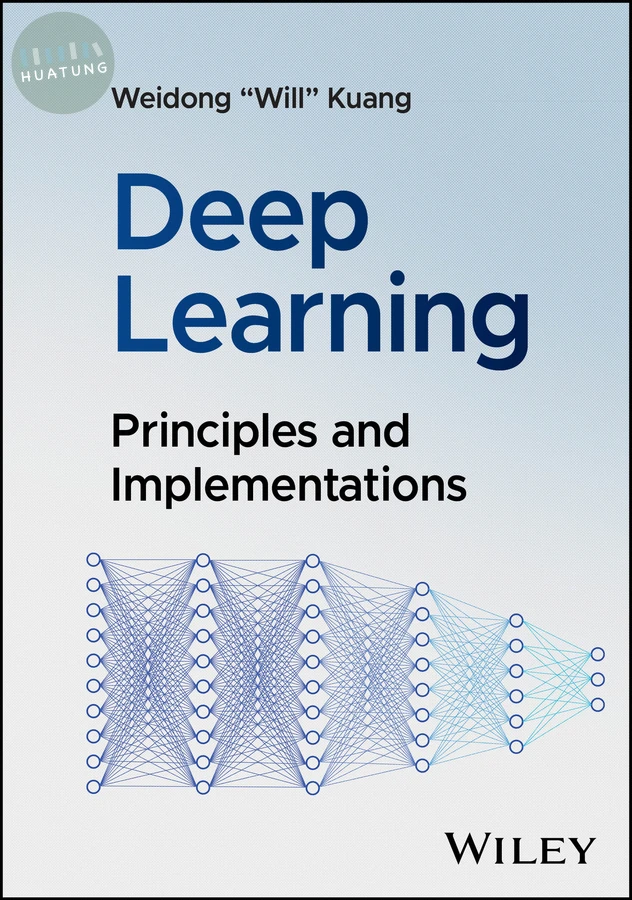
A hands-on and intuitive guide to the foundations of modern deep learning In Deep Learning: Principles and Implementations, distinguished researcher and professor Weidong “Will” Kuang delivers an up-to-date exploration of how major deep learning algorithms and architectures are formalized and developed from mathematical equations. The book bridges theory and practice and covers a wide range of fundamental topics, including linear regression, logistic regression, basic neural networks, convolution neural networks, as well as other basic and advanced subjects in the field. The author provides intuitive introductions to each subject and presents the development of algorithms and architectures from basic mathematical concepts. Along the way, he relies on straightforward math to keep the topics accessible for non-mathematicians and accompanies his explanations with tested Python sample code you can apply in your own work. You’ll also find: Thorough introductions to both linear and logistic regression, offering a solid foundation and insight into neural networks
Comprehensive explorations of neural networks, computer vision, natural language processing, generative models, and reinforcement learning
Practical exercises that students and practitioners can use to apply and develop the concepts found in the book
Balanced treatments of the mathematics, algorithms, architecture, and code that serve as the foundations of a complete understanding of deep learning
Perfect for undergraduate and graduate students with an interest in deep learning, Deep Learning: Principles and Implementations will also benefit practicing software engineers, faculty, and researchers whose work involves deep learning and related topics.
目錄
Preface xv
Mathematical Notation xxi
1 Introduction to Deep Learning 1
1.1 Introduction 1
1.2 Types of Machine Learning 2
1.3 Data Representation in Machine Learning 6
1.4 An Overview of Deep Learning 8
1.5 Resources for Deep Learning 14
2 Linear Regression 19
2.1 Linear Regression with Single Feature 19
2.2 Linear Regression with Multiple Features 25
2.3 Linear Models for Regression 28
2.4 Linear Regression – a Probabilistic Perspective View 31
2.5 An Example: House Price Prediction 35
2.6 Summary and Further Reading 41
3 Classification and Logistic Regression 45
3.1 Logistic Regression 45
3.2 Performance Metrics for Classification 52
3.3 Implementation of Logistic Regression in Python 56
3.4 Summary 61
4 Basics of Neural Networks 67
4.1 A Simplest Neural Network: A Logistic Regression Unit 67
4.2 From Regression to Neural Networks 69
4.3 Neural Network Representation: Feedforward Propagation 72
4.4 Activation Functions 73
4.5 Network Training: Backward Propagation 76
4.6 Multi-class Classification: Softmax and Cross-Entropy Loss 79
4.7 Practice in Python 82
4.8 Summary and Further Reading 100
5 Practical Considerations in Neural Networks 107
5.1 Multiple-Layer Neural Networks 108
5.2 Generalization and Model Selection 111
5.3 Regularization 115
5.4 Weight Initialization 119
5.5 Mini-batch Gradient Descent 122
5.6 Normalization 124
5.7 Adam Optimization 129
5.8 Gradient Checking 132
5.9 Examples in Python 133
5.10 Summary and Further Reading 166
6 Introduction to PyTorch 171
6.1 Why PyTorch? 171
6.2 Tensors 172
6.3 Data Representation Using Tensors 184
6.4 Linear Regression Using PyTorch 189
6.5 Neural Networks Using PyTorch 198
6.6 Summary and Further Reading 203
7 Convolutional Neural Networks 205
7.1 Architecture of Convolutional Neural Networks 205
7.2 Convolution Layer 207
7.3 Pooling Layer and Fully Connected Layer 212
7.4 Backpropagation in CNNs (Optional) 214
7.5 Batch Normalization for CNNs 222
7.6 Implement CNNs in PyTorch 223
7.7 Summary and Further Reading 234
8 Classic Architectures of CNNs 239
8.1 Datasets 239
8.2 AlexNet 243
8.3 VGG: Networks Using Blocks 246
8.4 GoogLeNet 249
8.5 ResNet 250
8.6 Pretrained Models 253
8.7 Summary and Further Reading 265
9 Object Detection – YOLO 269
9.1 Introduction 269
9.2 YOLO (v1) 270
9.3 YOLO (v2) 276
9.4 YOLO (v3) 280
9.5 Implementation of YOLO v3 Using Pre-trained Model 289
9.6 A Metric for Object Detection: mAP 310
9.7 Summary and Further Reading 314
10 Introduction to Probabilistic Generative Models 319
10.1 Generative Models with Latent Variables 320
10.2 EM Algorithm 323
10.3 Variational Auto-encoder (VAE) 333
10.4 VAE on MNIST Dataset in PyTorch 340
10.5 Summary and Further Reading 348
11 Generative Adversarial Networks 351
11.1 Mathematical Description of the Original GAN 351
11.2 Implementation of GANs 354
11.3 Practical Issues with the Original GAN 362
11.4 Conditional GAN 362
11.5 InfoGAN 364
11.6 Wasserstein GAN 367
11.7 CycleGAN 372
11.8 f-GANs 375
11.9 Example: Deep Convolutional GAN on MNIST Dataset 378
11.10 Summary and Further Reading 394
12 Diffusion Models 399
12.1 Revisit Variational Auto-Encoder 399
12.3 Score-Based Generative Modeling 409
12.4 Denoising Diffusion Implicit Models for Acceleration 417
12.5 Guidance 421
12.6 Implementation of a Simple Diffusion Model on MNIST Dataset 424
12.7 Summary and Further Reading 436
13 Word Embedding 439
13.1 Introduction to Natural Language Processing 439
13.2 Word2vec 442
13.3 Hierarchical Softmax in Word2vec 452
13.4 Negative Sampling in Word2vec 459
13.5 GloVe 463
13.6 Implementation of a Skip-Gram Model by PyTorch 464
13.7 Summary and Further Reading 472
14 Recurrent Neural Networks 475
14.1 Introduction to Sequence Models 475
14.2 Basic RNNs 476
14.3 Long Short-Term Memory 482
14.4 Practical RNN Architectures 486
14.5 Sequence-to-Sequence Learning: An Application of RNNs 490
14.6 Attention Mechanism in Encoder-Decoder Architectures 494
14.7 BLEU: A Metric of Machine Translation 496
14.8 Implementations of RNNs Using PyTorch 499
14.9 Summary and Further Reading 504
15 Transformer 509
15.1 Bahdanau Attention Mechanism 510
15.2 Attention Mechanism 512
15.3 Transformer Architecture 514
15.4 Bert 520
15.5 Generative Pre-trained Transformer (GPT) 526
15.6 Implementation of a Transformer in PyTorch 529
15.7 Summary and Further Reading 543
16 Introduction to Reinforcement Learning 547
16.1 Definition of Markov Decision Process 547
16.2 Policy, Value Function, and Bellman Equation 550
16.3 Dynamic Programming for MDPs 557
16.4 Monte Carlo Learning 560
16.5 Temporal Difference Learning 564
16.6 Implementation of Q-Learning for a Mountain Car Task 568
16.7 Summary and Further Reading 575
17 Deep Q-Learning 579
17.1 Value Function Approximation 579
17.2 Basic Deep Q-Network 582
17.3 Double Deep Q-Network 585
17.4 Implementation of DQN for Mountain Car-v 0 586
17.5 Summary and Further Reading 595
18 Policy Gradient Methods 601
18.1 Introduction to Policy-Based Methods 601
18.2 Policy Gradient Theorem 602
18.3 REINFORCE Algorithm 605
18.4 Actor-Critic Methods 609
18.5 Policy Optimization Methods 613
18.6 Deep Deterministic Policy Gradient (DDPG) 623
18.7 Soft Actor-Critic Algorithm 627
18.8 On-Policy and Off-Policy 631
18.9 Implementations of Policy Gradient Algorithms in Python 633
18.10 Summary and Further Reading 652
Exercises 653
References 656
Appendix A Mathematics in Machine Learning 657
Index 717