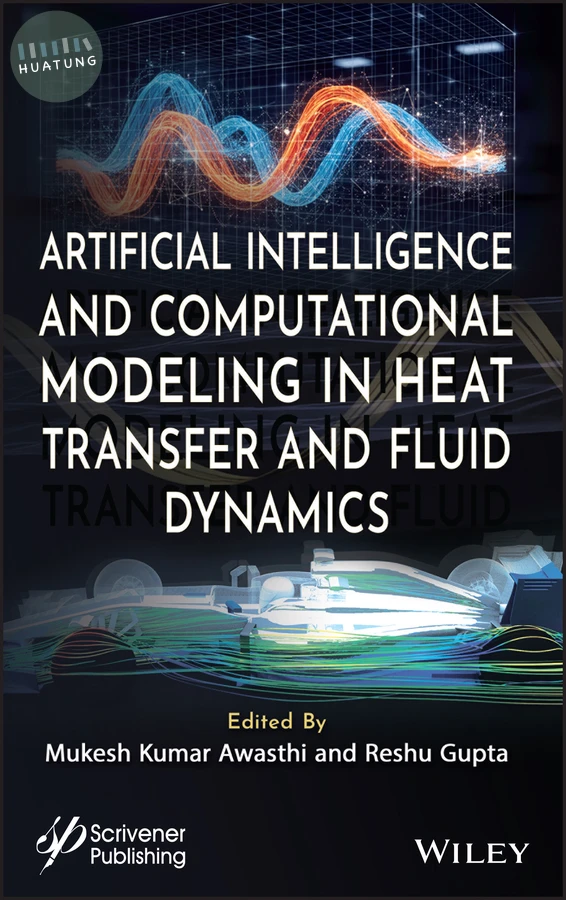
Artificial Intelligence and Computational Modeling in Heat Transfer and Fluid Dynamics
$6796元 定價: $7551 9折 可訂購
簡介
Drive innovation in thermal sciences with this essential book that leverages artificial intelligence and machine learning to transcend traditional computational methods and solve complex, real-time problems in heat transfer and fluid dynamics. Traditionally, heat transfer and fluid dynamics have relied on classical computational methods like computational fluid dynamics, which employ numerical techniques to solve governing equations for fluid flow and thermal transport. However, these methods are often computationally intensive and limited in handling complex, real-time scenarios, especially in turbulence modeling, multiphase flows, and optimization tasks. This book explores the transformative impact of artificial intelligence in the fields of heat transfer and fluid dynamics. It covers a range of topics, including AI-based optimization techniques for thermal systems, machine learning applications in fluid dynamics, and the use of neural networks for modeling thermal systems. The book delves into advanced areas such as microfluidics, predictive maintenance, and real-time flow control, highlighting how AI enhances traditional computational fluid dynamics methods. It also presents case studies that illustrate successful implementations of AI in industrial processes, offering practical insights into its applications. By fostering an understanding of both theoretical and practical aspects, equips engineers and researchers with the tools necessary to leverage AI effectively in their work, ultimately driving innovation in thermal sciences.
目錄
Preface xvii
1 Artificial Intelligence in Heat Transfer and Fluid Dynamics: Innovations, Applications, and Future Directions 1
R. Sakthikala and R. Revathi
1.1 Introduction 2
1.2 Theoretical Foundations of Heat Transfer and Fluid Dynamics 4
1.3 Artificial Intelligence in Engineering: Methods and Techniques 5
1.4 Artificial Intelligence Applications in Heat Transfer 11
1.5 Artificial Intelligence in Fluid Dynamics 13
1.6 Practical Implementations 17
1.7 Challenges and Future Directions 19
1.8 Conclusion 21
2 Machine Learning Applications in Fluid Mechanics 23
A. Ahadi, P. Hosseini Baei and M. Sheikholeslami
2.1 Introduction 24
2.2 The Basics of Machine Learning 26
2.3 Fluid Mechanics Machine Learning Influenced by Physics 30
2.4 Methods for Modeling Turbulence 36
2.5 Machine Learning in Fluid Dynamics: Obstacles and Prospects 40
2.6 Summary 41
3 Artificial Intelligence-Enhanced Developments in Computational Fluid Dynamics 51
Tushar Sagar, Sachin Kumar, Dinesh Kumar Patel, Gaurav Nandan and Vipin Kumar Sharma
3.1 Introduction 52
3.2 An Overview of Artificial Intelligence in Computational Fluid Dynamics 55
3.3 Methodology of Artificial Intelligence-Driven Enhancement in Computational Fluid Dynamics 66
3.4 Discussion 77
3.5 Case Study 80
3.6 Conclusion 81
4 Artificial Neural Network-Based Analysis of Natural Convection in Ag-TiO©ü/H©üO Hybrid Nanoliquids 93
Madhavarao Kulkarni
4.1 Introduction 94
4.2 Mathematical Modeling 96
4.3 Methods of Solution 99
4.4 Results and Discussion 104
4.5 Conclusions 113
5 Artificial Intelligence-Based Optimization of Heat Transfer in Gyrotactic-Nanofluid Flow 117
Priyanka Chandra and Raja Das
5.1 Introduction 118
5.2 Mathematical Modeling 119
5.3 Numerical Method 122
5.4 Results and Discussions 123
5.5 Conclusions 137
6 Artificial Intelligence-Based Heat Exchanger Design and Optimization 141
Sachin Mishra, Raj Kumar, Shailendra Singh Rathore, Sakshi Saxena, Pushpendra Sharma, Shubhra Khare and Kuldeep Chauhan
6.1 Introduction 142
6.2 Artificial Intelligence-Based Heat Exchanger Design and Optimization 143
6.3 Principles of Heat Exchangers 143
6.4 Two-Pipe Heat Exchangers 145
6.5 Performance and Optimization Metrics 146
6.6 Worldwide Market for Heat Exchangers 146
6.7 Basic Equation of Heat Transfer 147
6.8 Designing Heat Exchangers Thermally 151
6.9 Issue with Thermal Design of Heat Exchanger 153
6.10 The Need for Artificial Intelligence in Heat Exchanger Design and Optimization 153
6.11 Artificial Intelligence in Heat Exchanger Design 154
6.12 Benefits of Artificial Intelligence in Heat Exchanger Design and Optimization 155
6.13 Artificial Intelligence Applications in Different Types of Heat Exchangers 156
6.14 Significance of Artificial Intelligence in Heat Exchanger Design 157
6.15 Key Aspects of Artificial Intelligence in Heat Exchanger Design 157
6.16 Applications of Artificial Intelligence in Heat Exchanger Design 159
6.17 Upcoming Developments and Trends 160
6.18 Heat Exchange Design 162
6.19 Innovation in Heat Exchanger Design 166
6.20 Challenges in Artificial Intelligence-Based Heat Exchanger Design 167
6.21 Conclusion 169
7 Artificial Intelligence-Driven Energy Optimization in Heating, Ventilation, and Air Conditioning Systems 177
G. Gandhimathi, C. Chellaswamy, S. Sridevi and Mohamed M. Awad
7.1 Introduction 178
7.2 Literature Review 183
7.3 Game Theory Structure of Liquid Flow 185
7.4 Liquid Flow of Fluid-Structural System 188
7.5 Result and Discussion 193
7.6 Conclusion 209
8 Artificial Neural Network Model for Radiative Heat Transfer in a Magnetized Tapered Stenosed Artery 213
Haris Alam Zuberi, Naveen Kumar and Nurul Amira Zainal
8.1 Introduction 214
8.2 Mathematical Modeling 217
8.3 Methodology: Implementation of a Physics-Informed Neural Network Model in MATLAB 221
8.4 Results and Discussion 223
8.5 Validation of a Physics-Informed Neural Network Model 229
8.6 Conclusions 231
8.7 Medical Applications and Future Prospects 232
9 Artificial Intelligence-Driven Flow Optimization in Renewable Energy Systems 237
Sachin Kumar, Vipin Kumar Sharma, Dinesh Kumar Patel, Gaurav Nandan and Tushar Sagar
9.1 Introduction 238
9.2 Artificial Intelligence in Wind Energy Systems 241
9.3 Artificial Intelligence in Hydroelectric Power Systems 254
9.4 Artificial Intelligence in Solar Power Systems 259
9.5 Challenges and Future Directions 264
9.6 Conclusion 267
10 Artificial Intelligence-Driven Flow Optimization for Enhanced Efficiency in Renewable Energy Systems 277
Kavita Sanjay Singh, V. Shanmugapriya, Siddharth Shankar Mishra and Manvendra Singh
10.1 Introduction 278
10.2 Fundamentals of Flow Dynamics in Renewable Energy Systems 280
10.3 Artificial Intelligence Technologies in Renewable Energy 286
10.4 Artificial Intelligence Models for Flow Prediction and Optimization 291
10.5 Optimizing Hydrodynamic Processes in Hydropower 294
10.6 Artificial Intelligence-Enhanced Solar Energy Systems 296
10.7 Challenges and Future Prospects 299
10.8 Conclusion 303
11 Artificial Intelligence for Flow Optimization in Renewable Energy Systems 307
Devanshi Srivastava and Adarsh Kumar Arya
11.1 Introduction 308
11.2 Artificial Intelligence, Deep Learning, and the Sustainable Development Goals 308
11.3 Analysis of Artificial Intelligence Technologies in Sustainable Power 310
11.4 Technology for Energy Efficiency 312
11.5 Recently Developed Artificial Intelligence-Powered Optimization Methods 316
11.6 Applications of Artificial Intelligence and Deep Learning for Ecological Well-Being 320
11.7 Using Artificial Intelligence and Deep Learning for Energy Efficiency in Smart Buildings 321
11.8 Application of Artificial Intelligence in Solid Waste Management Systems and Predictive Analysis Model in Solar Synergy 322
11.9 Ethical Concerns, Limitations, and Potential Biases in AI-Driven Environmental Solutions 323
11.10 Obstacles and Prospective Pathways 324
11.11 Conclusions 325
12 Physics-Informed Neural Networks for Exothermic Reactions in Porous Media 333
Pavan Patel and Saroj R. Yadav
12.1 Introduction 334
12.2 Mathematical Model 335
12.3 The Building Block of Physics-Informed Neural Networks 336
12.4 Experiments’ Results and Discussion 337
12.5 Conclusion 340
13 Machine Learning for Magnetohydrodynamic Nanofluid Flow: Artificial Neural Networks vs. Traditional Methods 343
B.C. Rout, Bijoylakshmi Boruah, Utpal Kumar Saha, Madhusudan Senapati, Sakambari Mishra, Vikash Kumar and Bhimanand Pandurang Gajbhare
13.1 Introduction 345
13.2 Problem Description 347
13.3 Results and Discussion 350
13.4 Conclusion 362
14 Case Studies of Artificial Intelligence in Industrial Fluid and Thermal Processes 365
Abdulhalim Musa Abubakar, Kiran Batool, Muhammad Asif and Baudilio Coto
14.1 Introduction 366
14.2 Artificial Intelligence Techniques in Fluid Flow and Heat Transfer 367
14.3 Artificial Intelligence in Chemical Processing Industries 369
14.4 Artificial Intelligence in Power Generation 373
14.5 Artificial Intelligence in Manufacturing and Electronic Components 374
14.6 Challenges, Limitations, and Recommended Solutions 377
14.7 Conclusion 381
15 Artificial Intelligence in Microfluidics and Nanofluidics 395
Ashish Mathur, Souradeep Roy and Rabab Fatima
15.1 Introduction 396
15.2 Case Study 400
15.3 Predictive Modeling of Fluid Behaviour 402
15.4 Real-Time Control Systems 402
15.5 Artificial Intelligence and Edge Computing for Real-Time Applications 403
15.6 Environmental Sensors 405
15.7 Challenges and Limitations 406
15.8 Future Directions 407
15.9 Regulatory and Ethical Considerations of Artificial Intelligence in Microfluidics 409
15.10 Conclusion 410
References 411
About the Editors 415
Index 417