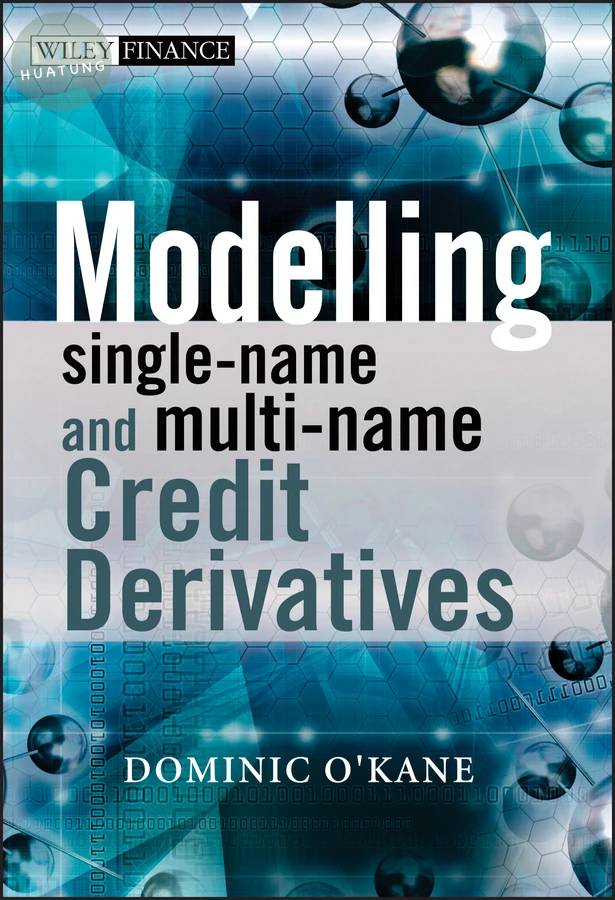

Modelling Single-name and Multi-name Credit Derivatives
$4573元 定價: $5081 9折 可訂購
簡介
Modelling Single-name and Multi-name Credit Derivatives presents an up-to-date, comprehensive, accessible and practical guide to the pricing and risk-management of credit derivatives. It is both a detailed introduction to credit derivative modelling and a reference for those who are already practitioners. This book is up-to-date as it covers many of the important developments which have occurred in the credit derivatives market in the past 4-5 years. These include the arrival of the CDS portfolio indices and all of the products based on these indices. In terms of models, this book covers the challenge of modelling single-tranche CDOs in the presence of the correlation skew, as well as the pricing and risk of more recent products such as constant maturity CDS, portfolio swaptions, CDO squareds, credit CPPI and credit CPDOs.
目錄
Acknowledgements xiii
About the Author xv
Introduction vii
Notation xix
1 The Credit Derivatives Market 1
1.1 Introduction 1
1.2 Market Growth 2
1.3 Products 4
1.4 Market Participants 6
1.5 Summary 7
2 Building the Libor Discount Curve 9
2.1 Introduction 9
2.2 The Libor Index 9
2.3 Money Market Deposits 10
2.4 Forward Rate Agreements 12
2.5 Interest Rate Futures 13
2.6 Interest Rate Swaps 16
2.7 Bootstrapping the Libor Curve 21
2.8 Summary 26
2.9 Technical Appendix 26
Part I Single-name Credit Derivatives 29
3 Single-name Credit Modelling 31
3.1 Introduction 31
3.2 Observing Default 32
3.3 Risk-neutral Pricing Framework 35
3.4 Structural Models of Default 38
3.5 Reduced Form Models 42
3.6 The Hazard Rate Model 44
3.7 Modelling Default as a Cox Process 46
3.8 A Gaussian Short Rate and Hazard Rate Model 49
3.9 Independence and Deterministic Hazard Rates 51
3.10 The Credit Triangle 54
3.11 The Credit Risk Premium 55
3.12 Summary 57
3.13 Technical Appendix 57
4 Bonds and Asset Swaps 59
4.1 Introduction 59
4.2 Fixed Rate Bonds 60
4.3 Floating Rate Notes 68
4.4 The Asset Swap 72
4.5 The Market Asset Swap 78
4.6 Summary 80
5 The Credit Default Swap 81
5.1 Introduction 81
5.2 The Mechanics of the CDS Contract 82
5.3 Mechanics of the Premium Leg 84
5.4 Mechanics of the Protection Leg 85
5.5 Bonds and the CDS Spread 90
5.6 The CDS–Cash basis 92
5.7 Loan CDS 94
5.8 Summary 95
6 A Valuation Model for Credit Default Swaps 97
6.1 Introduction 97
6.2 Unwinding a CDS Contract 97
6.3 Requirements of a CDS Pricing Model 99
6.4 Modelling a CDS Contract 100
6.5 Valuing the Premium Leg 101
6.6 Valuing the Protection Leg 105
6.7 Upfront Credit Default Swaps 108
6.8 Digital Default Swaps 110
6.9 Valuing Loan CDS 111
6.10 Summary 112
7 Calibrating the CDS Survival Curve 113
7.1 Introduction 113
7.2 Desirable Curve Properties 113
7.3 The Bootstrap 114
7.4 Interpolation Quantities 115
7.5 Bootstrapping Algorithm 117
7.6 Behaviour of the Interpolation Scheme 118
7.7 Detecting Arbitrage in the Curve 121
7.8 Example CDS Valuation 123
7.9 Summary 125
8 CDS Risk Management 127
8.1 Introduction 127
8.2 Market Risks of a CDS Position 127
8.3 Analytical CDS Sensitivities 128
8.4 Full Hedging of a CDS Contract 138
8.5 Hedging the CDS Spread Curve Risk 139
8.6 Hedging the Libor Curve Risk 145
8.7 Portfolio Level Hedging 147
8.8 Counterparty Risk 148
8.9 Summary 149
9 Forwards, Swaptions and CMDS 151
9.1 Introduction 151
9.2 Forward Starting CDS 151
9.3 The Default Swaption 156
9.4 Constant Maturity Default Swaps 169
9.5 Summary 180
Part II Multi-name Credit Derivatives 181
10 CDS Portfolio Indices 183
10.1 Introduction 183
10.2 Mechanics of the Standard Indices 184
10.3 CDS Portfolio Index Valuation 188
10.4 The Index Curve 190
10.5 Calculating the Intrinsic Spread of an Index 192
10.6 The Portfolio Swap Adjustment 195
10.7 Asset-backed and Loan CDS Indices 200
10.8 Summary 201
11 Options on CDS Portfolio Indices 203
11.1 Introduction 203
11.2 Mechanics 203
11.3 Valuation of an Index Option 207
11.4 An Arbitrage-free Pricing Model 209
11.5 Examples of Pricing 213
11.6 Risk Management 215
11.7 Black’s Model Revisited 215
11.8 Summary 217
12 An Introduction to Correlation Products 219
12.1 Introduction 219
12.2 Default Baskets 219
12.3 Leveraging the Spread Premia 227
12.4 Collateralised Debt Obligations 230
12.5 The Single-tranche Synthetic CDO 232
12.6 CDOs and Correlation 236
12.7 The Tranche Survival Curve 237
12.8 The Standard Index Tranches 240
12.9 Summary 240
13 The Gaussian Latent Variable Model 241
13.1 Introduction 241
13.2 The Model 241
13.3 The Multi-name Latent Variable Model 243
13.4 Conditional Independence 246
13.5 Simulating Multi-name Default 248
13.6 Default Induced Spread Dynamics 253
13.7 Calibrating the Correlation 257
13.8 Summary 258
14 Modelling Default Times using Copulas 261
14.1 Introduction 261
14.2 Definition and Properties of a Copula 261
14.3 Measuring Dependence 264
14.4 Rank Correlation 265
14.5 Tail Dependence 269
14.6 Some Important Copulae 270
14.7 Pricing Credit Derivatives from Default Times 278
14.8 Standard Error of the Breakeven Spread 280
14.9 Summary 281
14.10 Technical Appendix 282
15 Pricing Default Baskets 283
15.1 Introduction 283
15.2 Modelling First-to-default Baskets 283
15.3 Second-to-default and Higher Default Baskets 291
15.4 Pricing Baskets using Monte Carlo 294
15.5 Pricing Baskets using a Multi-Factor Model 296
15.6 Pricing Baskets in the Student-t Copula 298
15.7 Risk Management of Default Baskets 299
15.8 Summary 301
16 Pricing Tranches in the Gaussian Copula Model 303
16.1 Introduction 303
16.2 The LHP Model 303
16.3 Drivers of the Tranche Spread 308
16.4 Accuracy of the LHP Approximation 312
16.5 The LHP Model with Tail Dependence 313
16.6 Summary 314
16.7 Technical Appendix 314
17 Risk Management of Synthetic Tranches 317
17.1 Introduction 317
17.2 Systemic Risks 318
17.3 The LH+ Model 324
17.4 Idiosyncratic Risks 328
17.5 Hedging Tranches 334
17.6 Summary 339
17.7 Technical Appendix 339
18 Building the Full Loss Distribution 343
18.1 Introduction 343
18.2 Calculating the Tranche Survival Curve 343
18.3 Building the Conditional Loss Distribution 345
18.4 Integrating over the Market Factor 353
18.5 Approximating the Conditional Portfolio Loss Distribution 354
18.6 A Comparison of Methods 360
18.7 Perturbing the Loss Distribution 362
18.8 Summary 364
19 Implied Correlation 365
19.1 Introduction 365
19.2 Implied Correlation 365
19.3 Compound Correlation 367
19.4 Disadvantages of Compound Correlation 370
19.5 No-arbitrage Conditions 371
19.6 Summary 374
20 Base Correlation 375
20.1 Introduction 375
20.2 Base Correlation 375
20.3 Building the Base Correlation Curve 377
20.4 Base Correlation Interpolation 382
20.5 Interpolating Base Correlation using the ETL 389
20.6 A Base Correlation Surface 393
20.7 Risk Management of Index Tranches 394
20.8 Hedging the Base Correlation Skew 395
20.9 Base Correlation for Bespoke Tranches 398
20.10 Risk Management of Bespoke Tranches 405
20.11 Summary 406
21 Copula Skew Models 409
21.1 Introduction 409
21.2 The Challenge of Fitting the Skew 409
21.3 Calibration 411
21.4 Random Recovery 412
21.5 The Student-t Copula 413
21.6 The Double-t Copula 415
21.7 The Composite Basket Model 418
21.8 The Marshall–Olkin Copula 420
21.9 The Mixing Copula 421
21.10 The Random Factor Loading Model 423
21.11 The Implied Copula 427
21.12 Copula Comparison 429
21.13 Pricing Bespokes 431
21.14 Summary 431
22 Advanced Multi-name Credit Derivatives 433
22.1 Introduction 433
22.2 Credit CPPI 433
22.3 Constant Proportion Debt Obligations 436
22.4 The CDO-squared 441
22.5 Tranchelets 448
22.6 Forward Starting Tranches 449
22.7 Options on Tranches 449
22.8 Leveraged Super Senior 450
22.9 Summary 451
23 Dynamic Bottom-up Correlation Models 453
23.1 Introduction 453
23.2 A Survey of Dynamic Models 455
23.3 The Intensity Gamma Model 458
23.4 The Affine Jump Diffusion Model 466
23.5 Summary 470
23.6 Technical Appendix 470
24 Dynamic Top-down Correlation Models 471
24.1 Introduction 471
24.2 The Markov Chain Approach 472
24.3 Markov Chain: Initial Generator 474
24.4 Markov Chain: Stochastic Generator 479
24.5 Summary 483
Appendix A Useful Formulae 485
Bibliography 487
Index 491