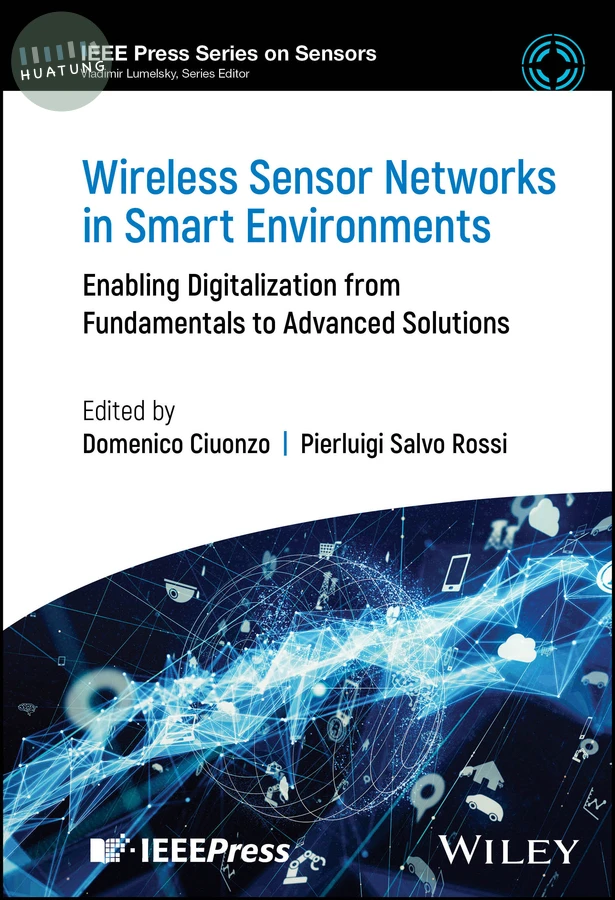
Wireless Sensor Networks in Smart Environments
$4002元 定價: $4447 9折 可訂購
簡介
Understand the fundamental building blocks of the Internet of Things The Internet of Things is the term for an ever-growing body of physical devices, vehicles, rooms, and other objects that can collect and exchange data using embedded capacities for network connectivity. Wireless Sensor Networks (WSNs) represent the ‘sensing arm’ of this network of objects, providing the mechanism for collecting and transmitting data from these objects. Wireless Sensor Networks in Smart Environments offers a timely and comprehensive overview of these networks and their broader impacts. Adopting both methodology- and application-oriented perspectives, the book covers both the foundational principles of WSNs and the most recent technological developments. Readers will also find: Concrete real-world examples of recent applications
Detailed discussion of WSNs from the perspectives of signal processing, data communication, and security
Coverage of inference, learning, control, and decision-making processes
Wireless Sensor Networks in Smart Environments is ideal for researchers and graduate students working in signal processing, communications, and machine learning.
目錄
About the Editors xvi
List of Contributors xviii
Preface xxiii
Acknowledgments xxv
Introduction xxvii
Part I Signal Processing in Wireless Sensor Networks 1
1 Graph Signal Processing in Wireless Sensor Networks 3
Gal Morgenstern, Lital Dabush, Morad Halihal, Tirza Routtenberg, and H. Vincent Poor
1.1 Introduction 3
1.2 Graph Models for WSNs 4
1.3 Concepts in GSP 8
1.4 GSP-Based Smoothness Validation for WSN Signals 13
1.5 GSP-Based Signal Recovery in WSN Models with Missing Data 17
1.6 GSP-Based Anomaly Detection for WSN 20
1.7 GSP-Based Graph Topology Identification for ModelingWSNs 23
1.8 Conclusions and Future Directions 26
2 Learning and Optimization in Wireless Sensor Networks 35
Muhammad I. Qureshi, Apostolos I. Rikos, Themistoklis Charalambous, and Usman A. Khan
2.1 Introduction 35
2.2 Notations and Definitions 38
2.3 Problem Formulation 40
2.4 Distributed Optimization Methods 41
2.5 Extensions of DGD 44
2.6 Distributed Fine-Tuning of Vision Transformers 57
2.7 Discussion and Future Directions 58
3 Distributed Non-Bayesian Quickest Change Detection with Energy Harvesting Sensors 65
Emma Green and Subhrakanti Dey
3.1 Introduction 65
3.2 System Model 66
3.3 Quickest Change Detection at the FC 69
3.4 Optimization Problem Formulation 70
3.5 Detection Delay Analysis When H ≥ Es for the Distributed Scenario 72
3.6 Simulation Results 78
3.7 Conclusions and FutureWork 83
Part II Communications Technologies in Wireless Sensor Networks 87
4 RIS-Assisted Channel-Aware Decision Fusion 89
Domenico Ciuonzo, Alessio Zappone, Pierluigi Salvo Rossi, and Marco Di Renzo
4.1 Introduction 89
4.2 System Model 91
4.3 Combined Design of Fusion Rule and RIS 93
4.4 Performance Analysis 98
4.5 Conclusions and Further Reading 102
5 Data Fusion in Millimeter Wave Massive MIMO Wireless Sensor Networks 107
Apoorva Chawla, Domenico Ciuonzo, Aditya K. Jagannatham, and Pierluigi Salvo Rossi
5.1 Introduction 107
5.2 System Model 109
5.3 Problem Formulation 111
5.4 Sensor Gain Optimization 115
5.5 Power Scaling Laws 116
5.6 SBL-Based CSI Estimation 118
5.7 Simulation Results 122
5.8 Conclusions 125
6 Software-Defined Radio (SDR)-Based Real-Time WLANs for Industrial Wireless Sensing and Control 129
Zelin Yun, Natong Lin, Shengli Zhou, and Song Han
6.1 Introduction 129
6.2 RT-WiFi Based on IEEE 802.11a/g 132
6.3 SRT-WiFi Based on IEEE 802.11a/g 135
6.4 GR-WiFi Based on 802.11a/g/n/ac 146
6.5 Conclusion and Future Work 153
Part III Cyber-Security in Wireless Sensor Networks 157
7 Security and Privacy in Distributed Kalman Filtering 159
Naveen K. D. Venkategowda, Ashkan Moradi, and Stefan Werner
7.1 Introduction 159
7.2 Distributed Kalman Filter 161
7.3 Security in Distributed Kalman Filter 164
7.4 Privacy in Distributed Kalman Filters 171
8 Event-Triggered and Privacy-Preserving Anomaly Detection for Smart Environments 185
Yasin Yilmaz, Mehmet Necip Kurt, and Xiaodong Wang
8.1 Introduction 185
8.2 Background and Literature Review 186
8.3 Event-Triggered Anomaly Detection 188
8.4 Privacy-Preserving Anomaly Detection 194
9 Decision-Making in Energy-Efficient Ordered Transmission-Based Networks Under Byzantine Attacks 209
Chen Quan and Pramod K. Varshney
9.1 Introduction 209
9.2 Byzantine Attack Model 210
9.3 COT-Based System 213
9.4 CEOT-Based System 217
9.5 Comparison of COT-Based and CEOT-Based Systems Under Attack 222
9.6 Conclusion 227
Part IV Applications in Smart Environments 231
10 Internet of Musical Things for Smart Cities 233
Paolo Casari and Luca Turchet
10.1 Introduction 233
10.2 Key-Enabling Technologies for IoMusT in Smart Musical Cities 236
10.3 Smart Musical City Concept and Services 240
10.4 Conclusions 245
11 Robust Target Tracking in Sensor Networks with Measurement Outliers 253
Hongwei Wang, Hongbin Li, and Jun Fang
11.1 Introduction 253
11.2 Problem Formulation 255
11.3 Centralized Robust Target Tracking 258
11.4 Decentralized Robust Target Tracking 261
11.5 Numerical Examples 266
11.6 Conclusion 270
12 A Federated Prototype-Based Model for IoT Systems: A Study Case for Leakage Detection in a Real Water Distribution Network 273
Diego P. Sousa, José M. B. da Silva Jr, Charles C. Cavalcante, and Carlo Fischione
12.1 Introduction 273
12.2 Prototype-Based Learning 275
12.3 Federated Learning 278
12.4 Federated Prototype-Based Models 279
12.5 Case Study:Water Distribution Network in Stockholm 282
12.6 Results and Discussions 289
12.7 Conclusions 294
13 Multi-Agent Inverse Learning for Sensor Networks: Identifying Coordination in UAV Networks 299
Luke Snow and Vikram Krishnamurthy
13.1 Introduction 299
13.2 Multi-Objective Optimization and Revealed Preferences 300
13.3 Multi-Objective Optimization in UAV Networks 308
13.4 Detection of Coordination 320
13.5 Conclusion 324
14 Immersive IoT Technologies for Smart Environments 327
Subhas C. Mukhopadhyay, Anindya Nag, and Nagender K. Suryadevara
14.1 Introduction 327
14.2 State-of-the-Art 328
14.3 Immersive Technologies 333
14.4 Immersive IoT Technologies 336
14.5 Network and Remote Execution Model 339
14.6 Results 344
15 Deployment of IoT in Smart Environments: Challenges and Experiences 353
Waltenegus Dargie, Michel Rottleuthner, Thomas C. Schmidt, and Matthias Wählisch
15.1 Introduction 353
15.2 Application Scenarios and Use Cases 356
15.3 Requirements Analysis 367
15.4 System Support 369
15.5 Open Issues and Conclusions 372
Bibliography 372
Index 377