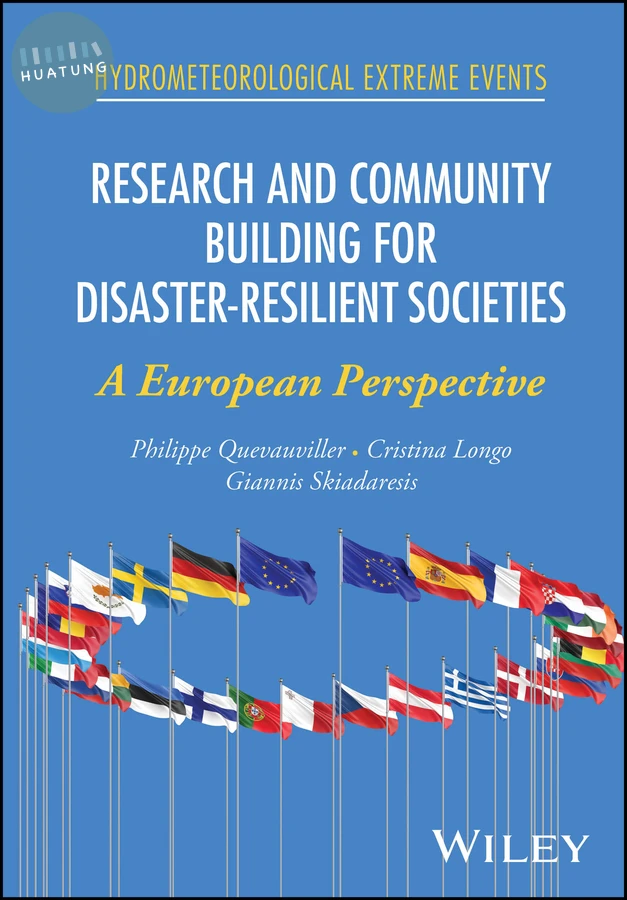
Research and Community Building for Disaster-Resilient Societies
$3349元 定價: $3721 9折 可訂購
簡介
LESSONS FROM A DECADE OF EUROPEAN DISASTER MANAGEMENT RESEARCH EXPLAINED FOR PRACTITIONERS WORLDWIDE Climate threats, pandemics, and humanitarian crises demand coordinated disaster risk reduction strategies. Research and Community Building for Disaster-Resilient Societies synthesizes a decade of research and practical experience from EU countries and organisations. This final volume in the Hydrometeorological Extreme Events series provides a critical evaluation of modern community-based approaches to disaster management, extending beyond hydrometeorological hazards to other geohazards, nuclear and biohazards, as well as large-scale medical emergencies. The book delivers a critical evaluation of European disaster risk reduction policies, research trends, and networking efforts, particularly the Community for European Research and Innovation for Security (CERIS) initiative. It examines approaches to prevention, mitigation, preparedness, threat monitoring, response and recovery while also highlighting human factors and effective crisis communication. Readers will find: Inside perspectives on Europe’s largest and most thoroughly researched disaster mitigation programs developed through successive EU Framework Programmes
Community-based approaches that integrate human factors and effective communication strategies essential for coordinated disaster response and recovery efforts
Policy backgrounds connecting research activities to internationally accepted frameworks since the early 2010s, including the Sendai Framework for Action
Networking and community-building models demonstrating how multi-stakeholder collaboration strengthens disaster resilience across regional and national boundaries
Coverage spanning hydrometeorological events, geohazards, medical emergencies, and security threats for comprehensive disaster risk understanding
Designed for scientists and practitioners in disaster risk management, this volume also serves policymakers, industry professionals, civil society organizations, and regional authorities. It delivers actionable insights from a decade of coordinated European research supporting effective disaster prevention, response, and recovery strategies.
目錄
Foreword xix
Series Preface xxvii
The Authors xxxi
1 Disaster Threats in Europe 1
1.1 Disaster Risk Landscape in Europe 1
1.2 Climate Change 4
1.3 Geophysical Hazards 18
1.4 Health and Plant Hazards 19
1.5 Societal Risks and Accidental Threats 26
1.6 Security Threats 33
1.7 Emerging Risks 40
1.8 Progress, Challenges and Prospects 44
1.9 Conclusions 46
2 EU Disaster Risk Reduction Policies 49
2.1 Introduction 49
2.2 DRR Policy Framework 54
2.3 DRR National Risk Assessments and EU Actions 71
2.4 Conclusions and Future Directions for Disaster Risk Management 105
3 Science- Policy Interface 113
3.1 Introduction 113
3.2 Governance and Knowledge Transfer 114
3.3 Interactions with the Scientific Community 117
3.4 Concept of Science and Policy Interface 119
3.5 Matching Research with Policy Needs 120
3.6 Conclusions 125
4 EU Community- Building in Support of DRR 127
4.1 Introduction: The Community of Users (CoU) 127
4.2 Ceris 137
4.3 CERIS and UCPKN 145
5 EU Funding Instruments 149
5.1 Introduction 149
5.2 Horizon Europe 149
5.3 Capacity- Building 156
5.4 Education and Training 159
6 EU Research on Disaster- Resilient Societies (DRS) 161
6.1 Introduction 161
6.2 First Wave of DRS Topics Under H2020: Safeguarding and Securing Society, Including Adapting to Climate Change 165
6.3 Second Wave of DRS Topics Under H2020 185
6.4 Third Wave of DRS Topics Under H 2020 195
6.5 Horizon Europe: Civil Security for Society – First Wave 205
6.6 Horizon Europe Civil Security for Society – Second Wave 229
6.7 Conclusions 245
7 Societal Resilience 247
7.1 Introduction 247
7.2 Operationalising Resilience Concepts, Ethical/Societal Dimension and Public Awareness/Preparedness 248
7.3 Disaster Resilience and Climate Change, Risk Reduction and Innovation Plans 272
7.4 Conclusions 284
8 Disaster Risk Management and Governance 289
8.1 Introduction 289
8.2 Integrated Tools for Response Planning and Scenario Building 290
8.3 Enhanced Assessment of (Multi- Hazard) Disaster Risks and Preparedness 293
8.4 Integrated Disaster Risk Reduction for Extreme Climate Events 304
8.5 Improved Impact Forecasting and Early Warning Systems Supporting the Rapid Deployment of First Responders in Vulnerable Areas 309
8.6 Strengthening Capacity- Building, Management of Pandemic Crisis and Disaster Response to Health Emergencies 313
8.7 Critical Infrastructure Protection 318
8.8 Pan- European Networks of Practitioners 324
8.9 Conclusions 330
9 Technologies and Integrated Solutions for First and Second Responders 333
9.1 Introduction 333
9.2 Technologies for First Responders 334
9.3 Technologies for Health Monitoring and Medical First Responders 355
9.4 Communication Technologies and Interoperability for Emergency Management 370
9.5 Pan- European Networks of Practitioners 376
9.6 Conclusions 381
10 Integrated and Policy- Driven Approach to CBRN Threats 387
10.1 Introduction 387
10.2 Mass CBRN Contamination and/or Exposure: Tools for Detection, Traceability, Triage and Individual Monitoring of Victims 389
10.3 CBRN Cluster 392
10.4 Enhanced Situational Awareness, Detection, Prevention and Capacities 404
10.5 Networking of CBRN- E Training Centres and of Practitioners 414
10.6 Conclusions 420
11 Interoperability and Support to Standardisation 423
11.1 Introduction 423
11.2 Addressing Standardisation Opportunities in Support of Increasing Disaster Resilience in Europe 424
11.3 Pre- Normative Research and Demonstration for Disaster- Resilient Societies 428
11.4 Conclusions 441
12 Conclusions and Perspectives 443
12.1 Introduction 443
12.2 The Changing Context of Disaster Resilience in Europe 443
12.3 Evolution of the DRS Agenda in Horizon Europe 444
12.4 Integrating Science, Technology and Society in DRS 444
12.5 Thematic Synthesis: Towards a ‘Resilience Union’ 445
12.6 Global and Cross- Border Perspectives 446
12.7 Governance, Innovation and Uptake Pathways 446
12.8 Lessons Learnt from Horizon 2020 and Horizon Europe (2021– 2025) 447
12.9 Emerging Challenges Beyond 2027 447
12.10 The DRS Way Forward: A Strategic Vision 448
12.11 Final Reflections: From Preparedness to a Culture of Resilience 448
12.12 Series Editor’s Final Words 449
References 451
Index 501