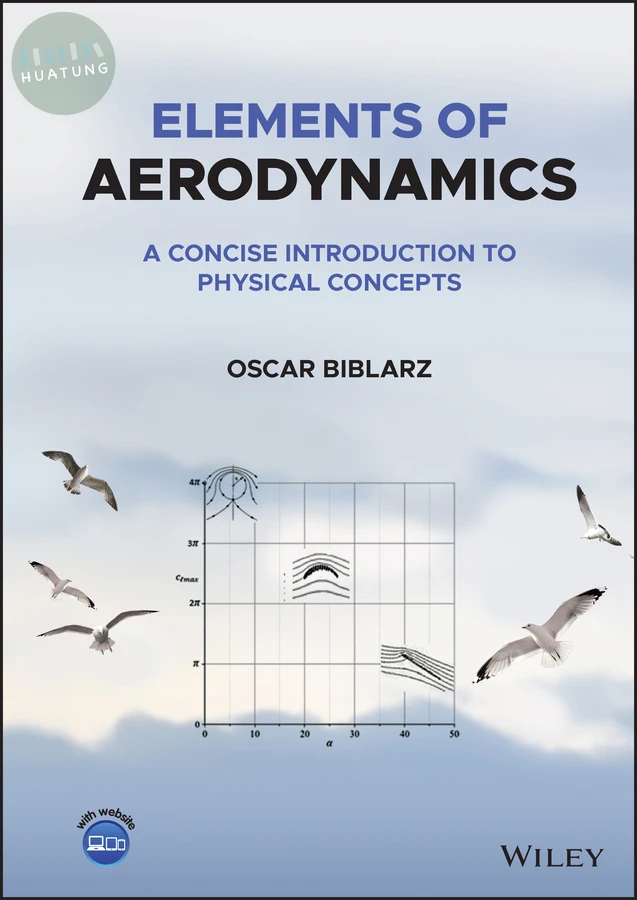
Elements of Aerodynamics
$4114元 定價: $4571 9折 可訂購
簡介
ELEMENTS OF AERODYNAMICS A comprehensive and highly accessible hands-on textbook filled with chapter objectives, examples, practice problems, and sample tests, featuring a new, dedicated online aero-calculator
In Elements of Aerodynamics, Professor Oscar Biblarz delivers a concise and fundamentals-oriented approach to aerodynamics suitable for both undergraduate and graduate-level students. The text offers numerous problems, examples, and check tests, allowing students to gain and cement their knowledge through hands-on practice.
Using a unique blend of fundamentals, the book provides readers with a new approach to ideal high-lift airfoils including applications designed to complement the theory. It covers the most vital information on incompressible and compressible flow over two-dimensional and three-dimensional wings. A companion website that includes an interactive aero-calculator and additional student resources makes this a suitable text for online, hybrid, and distance learning.
Readers will also find:
A concise introduction to units and notation with more correct formulations of the force coefficients along with proper usage of other dimensionless coefficients in aerodynamics, featuring descriptions of airflow as an incompressible and compressible but low-viscosity medium past streamlined wings
Comprehensive re-evaluation of the fundamentals of fluid dynamics, including the differential control volume approach and formulation of lift, drag, and pitching moments for thin, attached boundary layers over slender wings at high angles of attack
Practical applications of mass, momentum, and energy relations, derived from Euler’s equation, Bernoulli’s equation, and the Kutta-Joukowski theorem
Selected special treatment of transonic and hypersonic aerodynamic aspects, including supercritical airfoils, the non-linear small perturbation potential equation, and hypersonic lift and drag with the Newtonian theory approximation
Well-suited for students enrolled in an introductory aerodynamics course as part of an engineering program, Elements of Aerodynamics will also earn a place in the libraries of physics students and those interested in basic fluid mechanics.
目錄
Preface ix
To the Student xi
About the Companion Website xiii
1 Introduction and Approach 1
1.1 Introduction 1
1.2 Necessary Assumptions 2
1.3 Units 2
1.4 Equation of State and Fluid Properties 4
1.5 Other Concepts 10
Review Questions 11
Problems 13
Glossary of Terms and Symbols 14
2 Fluid Dynamic Fundamentals 17
2.1 Introduction 17
2.2 Objectives 17
2.3 Control Volume Approach 18
2.4 Lift, Drag, and Pitching Moment 22
2.5 Dimensional Analysis 22
2.6 Small Perturbation Theory in Steady Compressible Flows 29
2.7 Summary 31
Problems 32
Check Test 33
3 Dynamics of Incompressible Flows 35
3.1 Introduction 35
3.2 Objectives 35
3.3 Elementary Flows 36
3.4 Circulation 39
3.5 Superposition of Elementary Flows 41
3.6 Theorems of Helmholtz and Kelvin 42
3.7 Real Flows 43
3.8 Summary 44
Problems 45
Check Test 45
4 Mass, Momentum, and Energy Principles 47
4.1 Introduction 47
4.2 Objectives 47
4.3 Bernoulli’s Equation 47
4.4 Airspeed Indicator 49
4.5 Kutta–Joukowski Theorem 50
4.6 Pressure–Energy Equation 52
4.7 Enrichment Topics 53
4.8 Summary 56
Problems 57
Check Test 58
5 Thin Airfoils in Two-Dimensional Incompressible Flow 59
5.1 Introduction 59
5.2 Objectives 60
5.3 The Vortex Filament 60
5.4 Thin Airfoil Theory in Incompressible Flow 60
5.5 Symmetric Contribution at Angle of Attack 62
5.6 Camber Contribution at Zero Angle of Attack 66
5.7 Flapped Symmetric Airfoil at Zero Angle of Attack 68
5.8 Enrichment Topics 70
5.9 Summary 71
Problems 71
Check Test 73
6 Thin Wings of Finite Span in Incompressible Flow 75
6.1 Introduction 75
6.2 Objectives 75
6.3 Lifting Line Theory 76
6.4 Downwash Velocity and Elliptic Spanwise Lift Distribution 76
6.5 Experimental Verification Using Drag Polars 80
6.6 Non-elliptic Planforms and Twist 81
6.7 Effects of Lifting Line Theory on Airplane Performance 82
6.8 Enrichment Topics 84
6.9 Summary 86
Problems 87
Check Test 88
7 Viscous Boundary Layers 89
7.1 Introduction 89
7.2 Objectives 89
7.3 The Boundary Layer Concept 90
7.4 Contributions to Drag 91
7.5 Skin-Friction Drag on Airfoils 92
7.6 Approximate Viscous Boundary Layer Profiles 96
7.7 Enrichment Topics 99
7.8 Summary 100
Problems 101
Check Test 102
8 Fundamentals of Compressible Flow 103
8.1 Introduction 103
8.2 Objectives 103
8.3 Speed of Sound and Mach Waves 104
8.4 Steady-State Isentropic Flow 105
8.5 Supersonic Flows 106
8.6 Critical Mach Number 112
8.7 Supersonic Flat-plate Airfoils 114
8.8 Enrichment Topic 116
8.9 Summary 117
Problems 118
Check Test 119
9 Thin Airfoils in Compressible Flow 121
9.1 Introduction 121
9.2 Objectives 121
9.3 Two-Dimensional Compressible Flow Around Thin Airfoils 122
9.4 The Mach Number Dependence 125
9.5 Supersonic Airfoils 129
9.6 Aircraft Wings in Compressible Flow 132
9.7 Enrichment Topic 134
9.8 Summary 135
Problems 136
Check Test 138
10 Transonic and Hypersonic Aerodynamics 139
10.1 Introduction 139
10.2 Objectives 139
10.3 Transonic Flow 140
10.4 Thick Airfoils for High Subsonic and Transonic Flight 144
10.5 Hypersonic Flow 145
10.6 Enrichment Topics 150
10.7 Summary 152
Problems 152
Check Test 153
11 High-Lift Airfoils in Incompressible Flow 155
11.1 Introduction and Approach 155
11.2 Objectives 156
11.3 Nonlinear Thin Airfoil Theory 156
11.4 Pitching Moment at c/4 and the Aerodynamic Center 162
11.5 High-Lift Wing Mechanisms 163
11.6 Finite Wings 166
11.7 Enrichment Topics 166
11.8 Recapitulation 170
Problems 171
Check Test 172
Appendix A Standard Atmosphere SI Units 173
Appendix B Software 175
Appendix C Equations for Chapters 5 and 6 179
Selected References 181
Answers to Selected Problems 183
Index 187