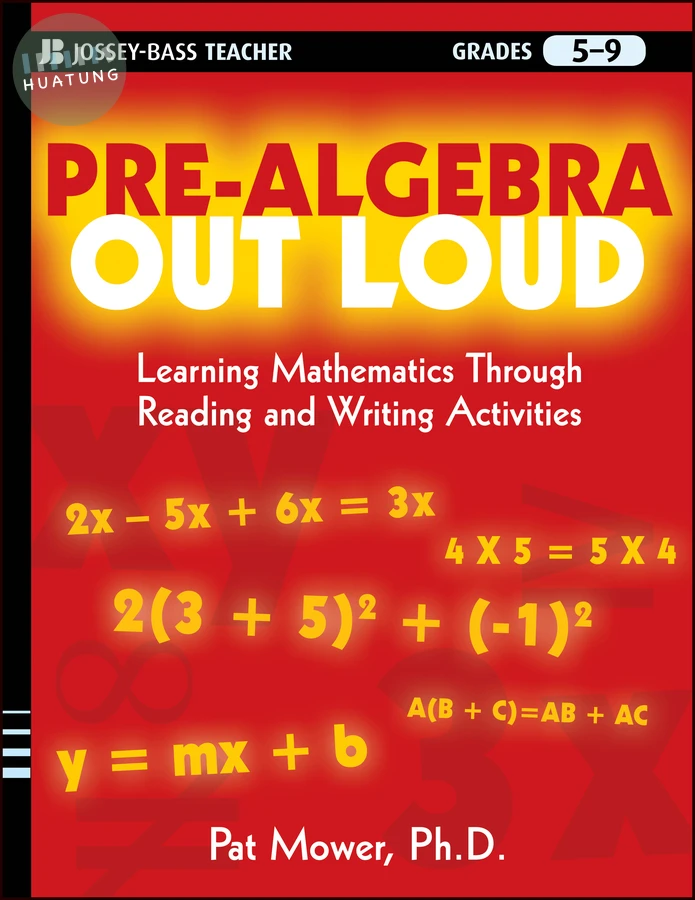

Pre-Algebra Out Loud
$872元 定價: $969 9折 可訂購
簡介
An essential guide for teaching students in grades 5-9 how to write about math Learning to read and write efficiently regarding mathematics helps students to understand content at a deeper level. In this third book in the popular math 'Out Loud' series, Mower provides a variety of reading and writing strategies and activities suitable for elementary and middle school pre-algebra courses, covering such key skills as integers and exponents, fractions, decimals and percents, graphing, statistics, factoring, evaluating expressions, geometry and the basics of equations.
Includes dozens of classroom tested strategies and techniques
Shows how reading and writing can be incorporated in any math class to improve math skills
Provides unique, fun activities that will keep students interested and make learning stick
This important guide offers teachers easy-to-apply lessons that will help students develop a deeper understanding of mathematics.
目錄
About the Author ix Acknowledgments xi
Introduction xiii
1 The Basic Tools of Algebra 1
Mini-Lesson 1.1 The Big Ideas of Algebra 2
Activity 1.1 The Writing Is on the Wall 4
Activity 1.2 Semantic Word Maps 7
Activity 1.3 Math Glossary 10
Activity 1.4 Concept Circles 12
Mini-Lesson 1.2 Solving Simple Equations 16
Activity 1.5 Math Story 18
Activity 1.6 Algorithm Writing 20
Activity 1.7 One-Minute Summary 23
2 Exploring Infinite Sets 25
Mini-Lesson 2.1 Infinite Sets 26
Activity 2.1 Magic Square 28
Activity 2.2 One-Minute Summary 33
Mini-Lesson 2.2 Properties of the Real Numbers 34
Activity 2.3 Graphic Organizers 38
Activity 2.4 Reading Math Symbols 41
Activity 2.5 Math Glossary 43
Activity 2.6 Semantic Feature Analysis 45
Activity 2.7 In Your Own Words: A Paraphrasing Activity 49
3 Topics in Integers 53
Mini-Lesson 3.1 Egyptian Multiplication 54
Activity 3.1 The Writing Is on the Wall 57
Activity 3.2 Concept Cards 59
Activity 3.3 Frayer Model 61
Mini-Lesson 3.2 Integral Exponents 64
Activity 3.4 What’s My Rule? 67
Activity 3.5 Comparison-and-Contrast Matrix 70
Activity 3.6 Knowledge Ratings 74
4 Number Theory 77
Mini-Lesson 4.1 Divisibility Rules 78
Activity 4.1 Number Riddles 81
Activity 4.2 In Your Own Words: A Paraphrasing Activity 84
Activity 4.3 Magic Square 86
Mini-Lesson 4.2 Greatest Common Denominator and Least Common Multiple 89
Activity 4.4 Semantic Feature Analysis 93
5 Fractions, Decimals, and Percents 99
Mini-Lesson 5.1 Pizza Math 100
Activity 5.1 What’s My Rule? 102
Activity 5.2 Writing Prompts 104
Mini-Lesson 5.2 Conversions 106
Activity 5.3 Comparison-and-Contrast Matrix 108
Activity 5.4 Semantic Word Maps 111
6 Equations and Inequalities 115
Mini-Lesson 6.1 Solving Multistep Equations 116
Activity 6.1 In Your Own Words: A Paraphrasing Activity 118
Activity 6.2 Method of Operation 121
Mini-Lesson 6.2 Solving Linear Inequalities 123
Activity 6.3 Translating Words into Algebra 126
Activity 6.4 Writing Word Problems 128
Activity 6.5 Math Glossary 131
Activity 6.6 Biographies of Algebraists 133
7 Visualizing Algebra by Graphing Lines 137
Mini-Lesson 7.1 The xy-Plane and Lines 138
Activity 7.1 Muddiest Point 141
Activity 7.2 Reading and Understanding Graphs 143
Activity 7.3 K-W-L 146
Mini-Lesson 7.2 The Slope of a Line 149
Activity 7.4 Semantic Feature Analysis 151
Activity 7.5 Anticipation Guide 154
8 Geometry 157
Mini-Lesson 8.1 Plane Figures 158
Activity 8.1 Geometric Figure Description 161
Activity 8.2 Semantic Feature Analysis 165
Mini-Lesson 8.2 Pyramids and Prisms 168
Activity 8.3 Writing a Method of Operation 170
Activity 8.4 Math Story 175
Activity 8.5 In Your Own Words: A Paraphrasing Activity 179
Activity 8.6 Biographies of Geometers 181
References 185