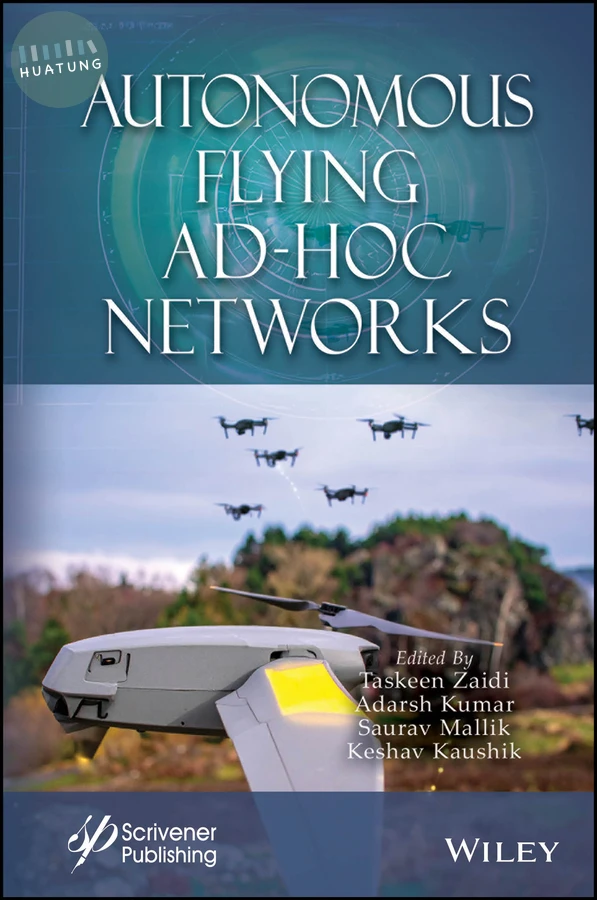

Autonomous Flying Ad-Hoc Networks
$5969元 定價: $6632 9折 可訂購
簡介
Learn to leverage the power of Autonomous Flying Ad-Hoc Networks (FANETs) for everything from urban surveillance to disaster relief, and stay ahead in the rapidly evolving world of drone technology and AI. Flying ad-hoc networks (FANETS) are emerging as an innovative technology in the Unmanned Aerial Vehicles (UAV) space, which has proven its usefulness in urban surveillance, disaster management, and rescue operations. In FANETs, a swarm of UAVs are locally connected together through a base station and the nearby environment to gather the information. FANETs are able to cover larger distances than its predecessors, MANETs (Mobile Ad-hoc Networks) and VANETs (Vehicle Ad-Hoc Networks), making them an ideal solution for gathering vital data. As artificial intelligence is implemented across a number of industries, this technology has the capability to train large datasets. Researchers are exploring ways to improve AI algorithms and quantum computing using this technology. Autonomous Flying Ad-Hoc Networks offers comprehensive coverage of the fundamentals of FANET technology by comparing the differences between FANETs, MANETs, and VANETs, including their characteristics, features, and design models, and discussing the applications and challenges of FANET adoption.
目錄
Preface xv
1 Research Perspectives of Various Routing Protocols for Flying Ad Hoc Networks (FANETs) 1
Kanthavel R., Adline Freeda R., Anju A., Dhaya R. and Frank Vijay
1.1 Introduction 2
1.2 Unmanned Aerial Vehicles 3
1.3 FANET Characteristics 5
1.4 Routing Protocols for FANETs 6
1.5 Communication Pedagogy for FANETs 7
1.6 Challenges and Applications of FANET Configuration 9
1.6.1 Issues and Challenges in FANETs 9
1.6.2 Applications for FANETs 10
1.6.2.1 Multilevel-UAV Collaboration 10
1.6.2.2 UAV-to-Ground Cooperation 11
1.6.2.3 UAVs in VANETs 12
1.7 Conclusion 12
References 13
2 Exploring Quantum Cryptography, Blockchain, and Flying Ad Hoc Networks: A Comprehensive Survey with Mathematical Analysis 15
Tarun Kumar Vashishth, Vikas Sharma, Kewal Krishan Sharma, Bhupendra Kumar, Sachin Chaudhary and Rajneesh Panwar
2.1 Introduction to Quantum Cryptography 16
2.1.1 Quantum Mechanics Primer 16
2.1.2 Genesis of Quantum Cryptography 16
2.2 Quantum Key Distribution 16
2.2.1 Components of Quantum Key Distribution 17
2.2.2 Key Aspects and Security 18
2.2.3 Challenges and Practical Considerations 18
2.2.4 Applications 18
2.3 Literature Review 19
2.4 Blockchain Technology: Enhancing Security and Transparency 20
2.4.1 Decentralization and Consensus Mechanisms 21
2.4.2 Enhancing Security 21
2.4.3 Transparency and Auditability 23
2.4.4 Use Cases 24
2.4.5 Challenges and Prospects 25
2.4.6 Synergy Between Quantum Cryptography and Blockchain 26
2.5 Flying Ad Hoc Networks: A Dynamic Communication Infrastructure 28
2.5.1 Key Characteristics and Components 28
2.5.2 Challenges and Considerations 29
2.5.3 Applications 30
2.5.4 Convergence of Quantum Cryptography, Blockchain, and FANETs 30
2.6 Future Directions and Challenges 32
2.6.1 Future Directions 32
2.6.2 Challenges 33
2.7 Conclusion 33
References 34
3 A Survey on Security Issues, Challenges, and Future Perspectives on FANETs 37
Syed Mohd Faisal, Wasim Khan, Mohammad Ishrat and Taskeen Zaidi
3.1 Introduction 38
3.2 Architecture of FANET 40
3.3 Unmanned Aerial Vehicle Classification 44
3.3.1 Classification of UAVs According to the Size 46
3.3.1.1 Very Small UAVs 46
3.3.1.2 Small UAVs 48
3.3.1.3 Medium UAV 51
3.3.1.4 Large UAVs 52
3.3.2 Classification of UAVs Based on Wing Type 53
3.3.2.1 Multi-Rotor Drones 53
3.3.2.2 Fixed-Wing Drones 53
3.3.2.3 Single-Rotor Helicopter Drones 55
3.3.2.4 Fixed-Wing Hybrid VTOL Drones 55
3.3.3 Classifications of Drones Based on Payload 56
3.3.3.1 Featherweight Drones 56
3.3.3.2 Lightweight Drones 56
3.3.3.3 Middleweight Drones 56
3.3.3.4 Heavy Lift Drones 56
3.4 Security Requirements 57
3.4.1 Confidentiality 57
3.4.2 Integrity 58
3.4.3 Availability 58
3.4.4 Authentication 58
3.4.5 Non-Repudiation 58
3.4.6 Authorization 58
3.4.7 Non-Disclosure 59
3.5 Routing Protocols 59
3.5.1 Static Routing Protocol 59
3.5.1.1 Load Carry and Deliver Routing 60
3.5.1.2 Multi-Level Hierarchical Routing Protocol 61
3.5.1.3 Data-Centric Routing 62
3.5.2 Proactive Routing Protocol 63
3.5.2.1 Destination Sequenced Distance Vector (DSDV) Routing Protocol 63
3.5.2.2 Optimized Link State Routing 64
3.5.3 Reactive Routing Protocol 65
3.5.3.1 Dynamic Source Routing Protocol 66
3.5.3.2 Ad Hoc On-Demand Distance Vector Routing Protocol 66
3.5.3.3 Time-Slotted On-Demand Routing Protocol 67
3.5.4 Hybrid Routing Protocols 67
3.5.4.1 Zone Routing Protocol 67
3.5.4.2 Temporarily Ordered Routing Algorithm 68
3.5.5 Geographic-Based Routing Protocols 68
3.5.5.1 Greedy Perimeter Stateless Routing 69
3.5.5.2 Mobility-Oriented Geographical Routing 69
3.5.6 Hierarchical Routing Protocols 69
3.5.7 Mobility Prediction Clustering Algorithm 69
3.5.8 Clustering Algorithm 70
3.6 Security Issues and Countermeasures in FANET 70
3.6.1 Sensor Level Security Issues 70
3.6.1.1 Vulnerabilities and Treats 70
3.6.1.2 Sensor-Based Attacks 71
3.6.1.3 Defense Mechanisms Against Sensor-Based Attacks 72
3.6.2 Hardware Level Issues 73
3.6.2.1 Vulnerabilities and Threats 73
3.6.2.2 Hardware-Based Attacks 74
3.6.2.3 Defense Mechanisms Against Hardware- Based Attack 76
3.6.3 Software Level Issues 77
3.6.3.1 Vulnerabilities and Threats 78
3.6.3.2 Software-Level Attacks 78
3.6.3.3 Defense Mechanism Against Software- Based Attack 79
3.7 Conclusion 80
References 81
4 Quantum Cryptography for Secure FANET 87
Taskeen Zaidi and Neha S.
Abbreviations 87
4.1 Introduction 88
4.2 Network Security Requirements 88
4.3 Security Threats 89
4.3.1 Taxonomy of Security Threats/Attacks 90
4.3.1.1 Denial of Service Attack 90
4.3.1.2 Modification and Fabrication Attacks 92
4.3.1.3 Routing Attacks 94
4.3.1.4 Other Attacks 95
4.3.2 Summary 97
4.4 Quantum Cryptography 100
4.4.1 Quantum Cryptography Introduction 100
4.4.2 QPKE Based FANET Model (Based on the Encryption Model Introduced by Yuqi Wang) 101
4.5 Conclusion 104
References 104
5 A Review of Various Routing Protocols for FANET 105
Nitya Nand Dwivedi
5.1 Introduction 105
5.2 Flying Ad Hoc Network Routing Protocol 107
5.2.1 Static Routing 107
5.2.2 Hierarchical Routing 108
5.2.2.1 Data-Centric Routing 108
5.2.2.2 Load, Carry, and Delivery Routing 109
5.2.3 Proactive Routing 109
5.2.3.1 Optimized Link State Routing 109
5.2.3.2 Destination-Sequenced Distance Vector (dsdv) 110
5.2.4 Reactive Routing 110
5.2.4.1 Dynamic Source Routing 111
5.2.4.2 Ad Hoc On-Demand Distance Vector 111
5.2.5 Hybrid Routing 111
5.2.5.1 Zone Routing Protocol 112
5.2.5.2 Temporarily Ordered Routing Algorithm (tora) 112
5.2.6 Geographic (or Position)-Based Routing 112
5.2.6.1 DREAM (Temporarily Ordered Routing Algorithm) 113
5.2.6.2 Location-Aided Routing 113
5.2.6.3 Greedy Perimeter Stateless Routing 113
5.2.6.4 AeroRP 113
5.2.7 Cross-Layer Routing 114
5.3 Conclusion 114
References 115
6 The Integration of the Internet of Things in FANET 119
Ankur Chaudhary, Neetu Faujdar and Ritesh Rastogi
6.1 Introduction 120
6.1.1 Integration of IoT Technology with a FANET 120
6.1.2 Overview of FANET and Its Applications 121
6.1.3 Introduction of IoT and Its Relevance in FANET 124
6.1.4 Importance of Integrating IoT with FANET for Enhanced Capabilities 125
6.2 Fundamentals of FANETs 127
6.2.1 Explanation of FANET Architecture and Operation 129
6.2.1.1 Challenges in FANET Activity 130
6.2.1.2 Activity of FANETs 130
6.2.2 Explanation of FANET Architecture and Operation 131
6.2.2.1 Key Characteristics and Difficulties of FANETs 131
6.2.3 Use Cases and Advantages of a FANET in Various Industries 132
6.2.3.1 Applications of a FANET 132
6.2.3.2 Benefits of a FANET 133
6.3 Introduction to the IoT 134
6.3.1 Advantages of the IoT 135
6.3.2 Difficulties of the IoT 136
6.3.2.1 Definition and Core Principles of the IoT 136
6.3.2.2 Components and Layers of the IoT Ecosystem 138
6.4 Internet-of-Things-Enabled Communication in a FANET 139
6.5 Internet-of-Things Communication Protocol 141
6.5.1 Message Queuing Telemetry Transport 141
6.5.2 Constrained Application Protocol 141
6.5.3 Data Aggregation and Routing Strategies in IoT-Enabled FANET 142
6.5.3.1 Methodologies of IoT-Enabled FANETs 142
6.5.3.2 Methodologies of IoT-Empowered FANETs 143
6.6 Conclusion 143
6.6.1 Recap of the Key Points 143
6.6.2 Potential Impact of IoT Integration on the Future of FANET 145
Bibliography 145
7 Enhancing Precision Agriculture Through Bio-Inspired Routing Protocols for Flying Ad Hoc Networks 149
S. Nandhini and K. S. Jeen Marseline
7.1 Introduction 150
7.2 Precision Agriculture 151
7.3 Bio-Inspired Routing Protocols for FANET 152
7.3.1 Gray Wolf Optimization 155
7.3.2 BAT Algorithm 155
7.3.3 Sand Cat Swarm Optimization Algorithm 155
7.3.4 Ant Colony Optimization Algorithm 156
7.3.5 Bee Colony Optimization 156
7.3.6 Firefly Optimization Algorithm 157
7.3.7 Case Studies and Real-World Examples of FANET in Precision Agriculture 157
7.3.7.1 Case Study 1 157
7.3.7.2 Case Study 2 157
7.3.7.3 Case Study 3 158
7.3.7.4 Case Study 4 158
7.3.7.5 Case Study 5 158
7.4 Real-World Applications 158
7.5 Conclusion 160
References 160
8 Disaster Recovery Management in FANETs 165
Amit Kumar, Sachin Ahuja and Ganesh Gupta
8.1 Introduction 166
8.2 Related Work/Literature Survey 167
8.3 Disaster Recovery Method of FANETs 168
8.4 Proposed New Solutions for Improved Disaster Management in FANETs 170
8.5 Conclusion 172
8.6 Future Techniques for Disaster Recovery in FANETs 173
Bibliography 175
9 AI-Based Cybersecurity Opportunities and Issues on the IIoT 177
Akashdeep Bhardwaj
9.1 Introduction 177
9.2 Application of AI in IIoT Cybersecurity 179
9.2.1 Anomaly Detection 180
9.2.2 Threat Intelligence 181
9.2.3 Network Security 182
9.2.4 User Behavioral Analysis 183
9.2.5 Predictive Maintenance 185
9.2.6 Fraud Detection 186
9.2.7 Cybersecurity Automation 187
9.3 Potential Benefits and Issues 189
9.4 AI-Cybersecurity Use Cases 191
9.4.1 Siemens 192
9.4.2 Honeywell 192
9.4.3 Darktrace 193
9.4.4 Symantec 194
9.4.5 Ibm 195
9.5 Conclusion 196
References 197
10 Exploring the Synergy of Fog Computing and FANETs for Next-Generation Networking 199
Akashdeep Bhardwaj
10.1 Introduction 200
10.2 Fog Computing and FANET 205
10.3 Synergy Between Fog Computing and FANETs 207
10.4 Integration Challenges 213
10.5 Architectural Implications 217
10.6 Deployment Considerations 222
10.7 Conclusion 230
References 230
11 Quantum Cryptography and FANET Security 233
M. G. Sumithra, R. Remya, Ashwini A., G. Dhivyasri and M. Manikandan
11.1 Introduction 233
11.1.1 How Does It Work? 234
11.1.2 Difference Between Post-Quantum Cryptography and Quantum Cryptography 235
11.1.3 Tomorrow’s Solution 236
11.1.4 Flying Ad Hoc Network Security 236
11.2 Components of a FANET 236
11.2.1 Unmanned Aerial Vehicles 236
11.2.2 Communication Hardware 237
11.2.3 Routing Protocol 237
11.2.4 Mobility 237
11.2.5 Sensors and Payloads 237
11.2.6 Autonomy and Control 237
11.2.7 Energy Considerations 238
11.2.8 Ground Control Station 238
11.3 Characteristics of FANETS 238
11.3.1 Mobility 238
11.3.2 Decentralization 238
11.3.3 Scalability 238
11.3.4 Constraint to Resources 238
11.4 Challenges in FANETS 239
11.5 Applications of FANETS 239
11.5.1 Search and Rescue 239
11.5.2 Precision Agriculture 240
11.5.3 Communication Relays 240
11.5.4 Military and Defense 241
11.6 Quantum Computing in FANET Security 241
Conclusion 242
References 242
About the Editors 245
Index 247