
簡介
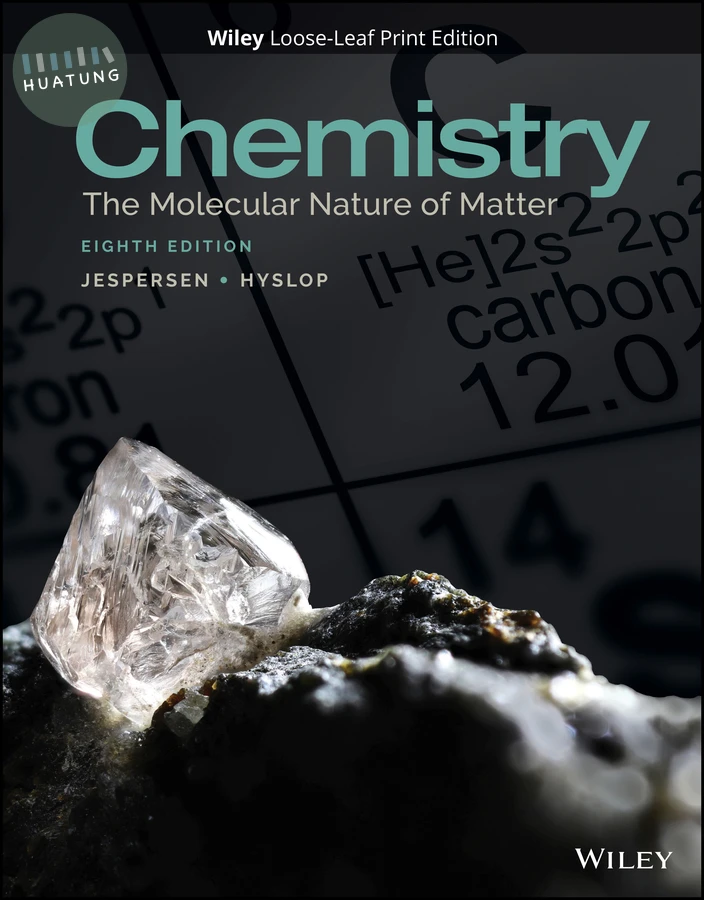
Chemistry: The Molecular Nature of Matter, 8th Edition bridges the invisible molecular world with observable chemical phenomena, making the abstract tangible for students at every level. This edition transforms how students understand chemistry by revealing the intimate relationship between atomic structure and the macroscopic properties they can see, touch, and measure in their daily lives.
What distinguishes this text is its revolutionary integration of real-world relevance with rigorous scientific thinking. Updated examples connect student experiences directly to chemical principles while aligning with contemporary career paths in environmental science, engineering, biology, pharmaceuticals, and medicine. The result is a learning experience where chemistry becomes not just understandable, but personally meaningful and professionally relevant.
The 8th edition's strategic focus on problem-solving mastery ensures students don't just memorize—they develop the analytical thinking skills that define scientific success. Problems progress systematically from confidence-building basics to complex applications, creating a scaffold for deep understanding and long-term retention.
目錄
0 A Very Brief History of Chemistry 1
0.1 Chemistry's Important Concepts 2
0.2 Stars, Supernovas, and the Elements 3
0.3 Elements and the Earth 6
0.4 Dalton's Atomic Theory 8
0.5 Internal Structure of the Atom 9
1 Scientific Measurements 27
1.1 Laws and Theories: The Scientific Method 28
1.2 Matter and Its Classifications 30
1.3 Physical and Chemical Properties 34
1.4 Measurement of Physical and Chemical Properties 36
1.5 Making Measurements in the Laboratory 46
1.6 Dimensional Analysis 51
1.7 Density and Specific Gravity 55
2 Elements, Compounds, and the Periodic Table 70
2.1 The Periodic Table 71
2.2 Metals, Nonmetals, and Metalloids 74
2.3 Molecules and Chemical Formulas 77
2.4 Chemical Reactions and Chemical Equations 84
2.5 Ionic Compounds 87
2.6 Nomenclature of Ionic Compounds 94
2.7 Molecular Compounds 98
2.8 Nomenclature of Molecular Compounds 102
3 The Mole and Stoichiometry 115
3.1 The Mole and Avogadro's Constant 116
3.2 The Mole, Formula Mass, and Stoichiometry 122
3.3 Chemical Formula and Percentage Composition 126
3.4 Determining Empirical and Molecular Formulas 128
3.5 Stoichiometry and Chemical Equations 136
3.6 Limiting Reactants 144
3.7 Theoretical Yield and Percentage Yield 148
4 Molecular View of Reactions in Aqueous Solutions 163
4.1 Describing Aqueous Solutions 164
4.2 Electrolytes and Nonelectrolytes 166
4.3 Balanced Equations for Ionic Reactions 168
4.4 Introducing Acids and Bases 172
4.5 Naming Acids and Bases 180
4.6 Double Replacement (Metathesis) Reactions 181
4.7 Molarity 192
4.8 Solution Stoichiometry 198
4.9 Titrations and Chemical Analysis 203
5 Oxidation–Reduction Reactions 219
5.1 Oxidation–Reduction Reactions 220
5.2 Balancing Redox Equations 227
5.3 Acids as Oxidizing Agents 233
5.4 Redox Reactions of Metals 236
5.5 Molecular Oxygen as an Oxidizing Agent 241
5.6 Stoichiometry of Redox Reactions 245
6 Energy and Chemical Change 259
6.1 Energy: The Ability to Do Work 260
6.2 Heat, Temperature, and Internal Energy 263
6.3 Measuring Heat 267
6.4 Energy of Chemical Reactions 272
6.5 Heat, Work, and the First Law of Thermodynamics 274\
6.6 Heats of Reaction 278
6.7 Thermochemical Equations 284
6.8 Hess's Law 286
6.9 Standard Heats of Reaction 291
7 The Quantum Mechanical Atom 309
7.1 Electromagnetic Radiation 311
7.2 Line Spectra and the Rydberg Equation 319
7.3 The Bohr Theory 322
7.4 The Wave Mechanical Model 324
7.5 Quantum Numbers of Electrons in Atoms 330
7.6 Electron Spin 333
7.7 Energy Levels and Ground State Electron Configurations 334
7.8 Periodic Table and Ground State Electron Configurations 337
7.9 Atomic Orbitals: Shapes and Orientations 343
7.10 Periodic Table and Properties of the Elements 347
8 The Basics of Chemical Bonding 365
8.1 Energy Requirements for Bond Formation 366
8.2 Ionic Bonding 367
8.3 Octet Rule and Electron Configurations of Ions 371
8.4 Lewis Symbols: Keeping Track of Valence Electrons 375
8.5 Covalent Bonds 377
8.6 Bond Polarity and Electronegativity 382
8.7 Lewis Structures 387
8.8 Resonance Structures 398
8.9 Covalent Compounds of Carbon 402
9 Theories of Bonding and Structure 418
9.1 Five Basic Molecular Geometries 420
9.2 Molecular Shapes and the Valence Shell Electron Pair Repulsion (VSEPR) Model 423
9.3 Molecular Structure and Dipole Moments 432
9.4 Valence Bond Theory 436
9.5 Hybrid Orbitals and Molecular Geometry 439
9.6 Hybrid Orbitals and Multiple Bonds 451
9.7 Molecular Orbital Theory Basics 457
9.8 Delocalized Molecular Orbitals 464
9.9 Bonding in Solids 465
9.10 Bonding of the Allotropes of the Elements 467
10 Properties of Gases 483
10.1 A Molecular Look at Gases 484
10.2 Measurement of Pressure 485
10.3 Gas Laws 490
10.4 Stoichiometry Using Gas Volumes 496
10.5 Ideal Gas Law 501
10.6 Dalton's Law of Partial Pressures 509
10.7 Kinetic Molecular Theory of Gases 519
10.8 Real Gases 522
11 Intermolecular Attractions and the Properties of Liquids and Solids 533
11.1 Intermolecular Forces 535
11.2 Intermolecular Forces and Physical Properties 543
11.3 Changes of State and Dynamic Equilibria 549
11.4 Vapor Pressures of Liquids and Solids 551
11.5 Boiling Points of Liquids 553
11.6 Energy and Changes of State 555
11.7 Phase Diagrams 559
11.8 Le Chatelier's Principle and Changes of State 563
11.9 Determining Heats of Vaporization 565
11.10 Structures of Crystalline Solids 567
11.11 Determining the Structure of Solids 575
11.12 Crystal Types and Physical Properties 577
12 Mixtures at the Molecular Level: Properties of Solutions 595
12.1 Intermolecular Forces and the Formation of Solutions 597
12.2 Heats of Solution 600
12.3 Solubility as a Function of Temperature 604
12.4 Henry's Law 606
12.5 Concentration Units 608
12.6 Colligative Properties 615
12.7 Heterogeneous Mixtures 633
13 Chemical Kinetics 647
13.1 Factors that Affect the Rate of Chemical Change 648
13.2 Measuring Reaction Rates 650
13.3 Rate Laws 656
13.4 Integrated Rate Laws 665
13.5 Molecular Basis of Collision Theory 676
13.6 Molecular Basis of Transition State Theory 679
13.7 Activation Energies 682
13.8 Mechanisms of Reactions 687
13.9 Catalysts 694
14 Chemical Equilibrium 713
14.1 Dynamic Equilibrium in Chemical Systems 714
14.2 Equilibrium Laws 717
14.3 Equilibrium Laws Based on Pressures or Concentrations 721
14.4 Equilibrium Laws for Heterogeneous Reactions 725
14.5 Position of Equilibrium and the Equilibrium Constant 726
14.6 Equilibrium and Le Chatelier's Principle 728
14.7 Calculating Equilibrium Constants 733
14.8 Using Equilibrium Constants to Calculate Concentrations 736
15 Acids and Bases: A Molecular Look 759
15.1 Bronsted–Lowry Acids and Bases 760
15.2 Strengths of Bronsted–Lowry Acids and Bases 765
15.3 Periodic Trends in the Strengths of Acids 768
15.4 Lewis Acids and Bases 774
15.5 Acid–Base Properties of Elements and Their Oxides 778
15.6 Advanced Ceramics and Acid–Base Chemistry 781
16 Acid–Base Equilibria in Aqueous Solutions 792
16.1 Water, pH, and "p" Notation 793
16.2 pH of Strong Acid and Base Solutions 798
16.3 Ionization Constants, Ka and Kb 799
16.4 Determining Ka and Kb Values 804
16.5 pH of Weak Acid and Weak Base Solutions 807
16.6 Acid–Base Properties of Salt Solutions 812
16.7 Buffer Solutions 816
16.8 Polyprotic Acids 823
16.9 Acid–Base Titrations 829
17 Solubility and Simultaneous Equilibria 847
17.1 Equilibria in Solutions of Slightly Soluble Salts 848
17.2 Solubility of Basic Salts 860
17.3 Equilibria in Solutions of Metal Oxides and Sulfides 863
17.4 Selective Precipitation 866
17.5 Equilibria Involving Complex Ions 873
17.6 Complexation and Solubility 877
18 Thermodynamics 889
18.1 First Law of Thermodynamics 890
18.2 Spontaneous Change 894
18.3 Entropy 896
18.4 Second Law of Thermodynamics 901
18.5 Third Law of Thermodynamics 905
18.6 Standard Free Energy Change, ΔG° 908
18.7 Maximum Work and ΔG 910
18.8 Free Energy and Equilibrium 914
18.9 Equilibrium Constants and ΔG° 920
18.10 Bond Energies 923
19 Electrochemistry 938
19.1 Galvanic (Voltaic) Cells 939
19.2 Cell Potentials 944
19.3 Utilizing Standard Reduction Potentials 951
19.4 E°cell and ΔG° 956
19.5 Cell Potentials and Concentrations 959
19.6 Electricity 965
19.7 Electrolytic Cells 971
19.8 Electrolysis Stoichiometry 977
19.9 Practical Applications of Electrolysis 981
20 Nuclear Reactions and Their Role in Chemistry 994
20.1 Law of Conservation of Mass–Energy 995
20.2 Nuclear Binding Energy 997
20.3 Radioactivity 999
20.4 Band of Stability 1006
20.5 Transmutation 1009
20.6 Measuring Radioactivity 1012
20.7 Medical and Analytical Applications of Radionuclides 1016
20.8 Nuclear Fission and Fusion 1021
21 Metal Complexes 1037
21.1 Complex Ions 1038
21.2 Metal Complex Nomenclature 1044
21.3 Coordination Number and Structure 1046
21.4 Isomers of Metal Complexes 1049
21.5 Bonding in Metal Complexes 1053
21.6 Biological Functions of Metal Ions 1060
22 Organic Compounds, Polymers, and Biochemicals 1070
22.1 Organic Structures and Functional Groups 1071
22.2 Hydrocarbons: Structure, Nomenclature, and Reactions 1076
22.3 Organic Compounds Containing Oxygen 1084
22.4 Organic Derivatives of Ammonia 1091
22.5 Organic Polymers 1093
22.6 Carbohydrates, Lipids, and Proteins 1100
22.7 Nucleic Acids, DNA and RNA 1109
Tools for Problem Solving 1115
Review Questions and Problems 1117
Appendices
Appendix A Review of Mathematics A–1
Appendix B Answers to Practice Exercises and Selected Problems A–6
Appendix C Tables of Selected Data A–30
Glossary G–1
Index I–1