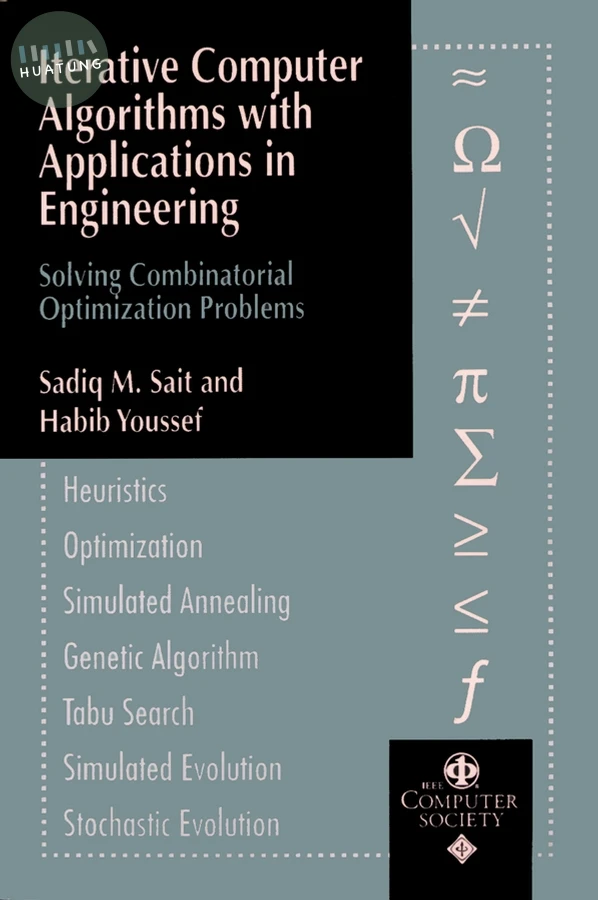

Iterative Computer Algorithms with Applications in Engineering
$4484元 定價: $4982 9折 可訂購
簡介
Iterative Computer Algorithms with Applications in Engineering describes in-depth the five main iterative algorithms for solving hard combinatorial optimization problems: Simulated Annealing, Genetic Algorithms, Tabu Search, Simulated Evolution, and Stochastic Evolution. The authors present various iterative techniques and illustrate how they can be applied to solve several NP-hard problems.
For each algorithm, the authors present the procedures of the algorithm, parameter selection criteria, convergence property analysis, and parallelization. There are also several real-world examples that illustrate various aspects of the algorithms. The book includes an introduction to fuzzy logic and its application in the formulation of multi-objective optimization problems, a discussion on hybrid techniques that combine features of heuristics, a survey of recent research work, and examples that illustrate required mathematical concepts.
The unique features of this book are: An integrated and up-to-date description of iterative non-deterministic algorithms; Detailed descriptions of Simulated Evolution and Stochastic Evolution; A level of treatment suitable for first year graduate student and practicing engineers; Parallelization aspects and particular parallel implementations; A brief survey of recent research work; Graded exercises and an annotated bibliography in each chapter
目錄
Preface.
1. Introduction.
1.1 Combinatorial Optimization.
1.2 Optimization Methods.
1.3 States, Moves, and Optimality.
1.4 Local Search.
1.5 Optimal versus Final Solution.
1.6 Single versus Multicriteria Constrained Optimization.
1.7 Convergence Analysis of Iterative Algorithms.
1.8 Markov Chains.
1.9 Parallel Processing.
1.10 Summary and Organization of the Book.
References.
Exercises.
2. Simulated Annealing (SA).
2.1 Introduction.
2.2 Simulated Annealing Algorithm.
2.3 SA Convergence Aspects.
2.4 Parameters of the SA Algorithm.
2.5 SA Requirements.
2.6 SA Applications.
2.7 Parallelization of SA.
2.8 Conclusions and Recent Work.
References.
Exercises.
3. Genetic Algorithms (GAs).
3.1 Introduction.
3.2 Genetic Algorithm.
3.3 Schema Theorem and Implicit Parallelism.
3.4 GA Convergence Aspects.
3.5 GA in Practice.
3.6 Parameters of GAs.
3.7 Applications of GAs.
3.8 Parallelization of GA.
3.9 Other Issues and Recent Work.
3.10 Conclusions.
References.
Exercises.
4. Tabu Search (TS).
4.1 Introduction.
4.2 Tabu Search Algorithm.
4.3 Implementation-Related Issues.
4.4 Limitations of Short-Term Memory.
4.5 Examples of Diversifying Search.
4.6 TS Convergence Aspects.
4.7 TS Applications.
4.8 Parallelization of TS.
4.9 Other Issues and Related Work.
4.10 Conclusions.
References.
Exercises.
5. Simulated Evolution (SimE).
5.1 Introduction.
5.2 Historical Background.
5.3 Simulated Evolution Algorithm.
5.4 SimE Operators and Parameters.
5.5 Comparison of SimE, SA, and GA.
5.6 SimE Convergence Aspects.
5.7 SimE Applications.
5.8 Parallelization of SimE.
5.9 Conclusions and Recent Work.
References.
Exercises.
6. Stochastic Evolution (StocE).
6.1 Introduction.
6.2 Historical Background.
6.3 Stochastic Evolution Algorithm.
6.4 Stochastic Evolution Convergence Aspects.
6.5 Stochastic Evolution Applications.
6.6 Parallelization of Stochastic Evolution.
6.7 Conclusions and Recent Work.
References.
Exercises.
7. Hybrids and Other Issues.
7.1 Introduction.
7.2 Overview of Algorithms.
7.3 Hybridization.
7.4 GA and Multiobjective Optimization.
7.5 Fuzzy Logic for Multiobjective Optimization.
7.6 Artificial Neural Networks.
7.7 Quality of the Solution.
7.8 Conclusions.
References.
Exercises.
About the Authors.
Index.