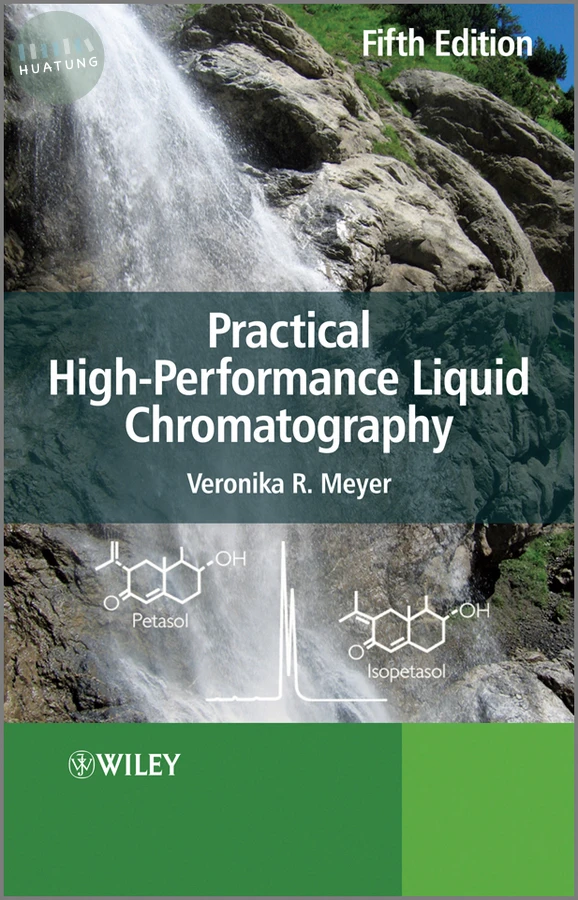
Practical High-Performance Liquid Chromatography
$5707元 定價: $6341 9折 可訂購
簡介
Jump into the HPLC adventure! Three decades on from publication of the 1st German edition of Veronika Meyer's book on HPLC, this classic text remains one of the few titles available on general HPLC aimed at practitioners.
New sections on the following topics have been included in this fifth edition:
Comparison of HPLC with capillary electrophoresis
How to obtain peak capacity
van Deemter curves and other coherences
Hydrophilic interaction chromatography
Method transfer
Comprehensive two-dimensional HPLC
Fast separations at 1000 bar
HPLC with superheated water
In addition, two chapters on the instrument test and troubleshooting in the appendix have been updated and expanded by Bruno E. Lendi, and many details have been improved and numerous references added.
A completely new chapter is presented on quality assurance covering:
Is it worth the effort?
Verification with a second method
Method validation
Standard operating procedures
Measurement uncertainty
Qualifications, instrument test, and system suitability test
The quest for quality
Reviews of earlier editions
"That this text is written by an expert in both the practice and teaching of HPLC is evident from the first paragraph....not only an enjoyable, fascinating and easy read, but a truly excellent text that has and will serve many teachers, students and practitioners very well." —The Analyst
“…provides essential information on HPLC for LC practitioners in academia, industry, government, and research laboratories…a valuable introduction." - American Journal of Therapeutics
目錄
Preface to the Fifth Edition xiii
Important and Useful Equations for HPLC 1 vii
1 Introduction 5
1.1 HPLC: A powerful separation method 5
1.2 A first HPLC experiment 5
1.3 Liquid chromatographic separation modes 8
1.4 The HPLC instrument 9
1.5 Safety in the HPLC laboratory 10
1.6 Comparison between high-performance liquid chromatography and gas chromatography 11
1.7 Comparison between high-performance liquid chromatography and capillary electrophoresis 12
1.8 Units for pressure, length and viscosity 13
1.9 Scientific journals 14
1.10 Recommended books 15
2 Theoretical Principles 17
2.1 The chromatographic process 17
2.2 Band broadening 19
2.3 The chromatogram and its purport 23
2.4 Graphical representation of peak pairs with different degree of resolution 30
2.5 Factors affecting resolution 35
2.6 Extra-column volumes (dead volumes) 40
2.7 Tailing 41
2.8 Peak capacity and statistical resolution probability 46
2.9 Effects of temperature in HPLC 49
2.10 The limits of HPLC 51
2.11 How to obtain peak capacity 55
3 Pumps 59
3.1 General requirements 59
3.2 The short-stroke piston pump 59
3.3 Maintenance and repair 62
3.4 Other pump designs 63
4 Preparation of Equipment up to Sample Injection 65
4.1 Selection of the mobile phase 65
4.2 Preparation of the mobile phase 67
4.3 Gradient systems 68
4.4 Capillary tubing 70
4.5 Fittings 72
4.6 Sample injectors 74
4.7 Sample solution and sample volume 78
5 Solvent Properties 81
5.1 Table of organic solvents 81
5.2 Solvent selectivity 83
5.3 Miscibility 83
5.4 Buffers 84
5.5 Shelf life of mobile phases. 87
5.6 The mixing cross 88
6 Detectors 91
6.1 General 91
6.2 UV detectors 96
6.3 Refractive index detectors 99
6.4 Fluorescence detectors 101
6.5 Electrochemical (amperometric) detectors 103
6.6 Light-scattering detectors 104
6.7 Other detectors 106
6.8 Multiple detection 107
6.9 Indirect detection 108
6.10 Coupling with spectroscopy 109
7 Columns and Stationary Phases 117
7.1 Columns for HPLC 117
7.2 Precolumns 119
7.3 General properties of stationary phases 120
7.4 Silica 125
7.5 Chemically modified silica 126
7.6 Styrene-divinylbenzene 129
7.7 Some other stationary phases 133
7.8 Column care and regeneration 136
8 HPLC Column Tests 141
8.1 Simple tests for HPLC columns 141
8.2 Determination of particle size 143
8.3 Determination of breakthrough time 144
8.4 The test mixture 146
8.5 Dimensionless parameters for HPLC column characterization 148
8.6 The van Deemter equation from reduced parameters and its use in column diagnosis 152
8.7 van Deemter curves and other coherences 153
8.8 Diffusion coefficients 155
9 Adsorption Chromatography: Normal-Phase Chromatography 159
9.1 What is adsorption? 159
9.2 The eluotropic series 162
9.3 Selectivity properties of the mobile phase 165
9.4 Choice and optimization of the mobile phase 166
9.5 Applications 168
10 Reversed-Phase Chromatography 173
10.1 Principle 173
10.2 Mobile phases in reversed-phase chromatography 174
10.3 Solvent selectivity and strength 177
10.4 Stationary phases 181
10.5 Method development in reversed-phase chromatography 185
10.6 Applications 188
10.7 Hydrophobic interaction chromatography 191
11 Chromatography with Chemically Bonded Phases 195
11.1 Introduction 195
11.2 Properties of some stationary phases 195
11.3 Hydrophilic interaction chromatography 200
12 Ion-Exchange Chromatography 203
12.1 Introduction 203
12.2 Principle 203
12.3 Properties of ion exchangers 204
12.4 Influence of the mobile phase 207
12.5 Special possibilities of ion exchange 208
12.6 Practical hints 210
12.7 Applications 213
13 Ion-Pair Chromatography 217
13.1 Introduction 217
13.2 Ion-pair chromatography in practice 218
13.3 Applications 220
13.4 Appendix: UV detection using ion-pair reagents 221
14 Ion Chromatography 225
14.1 Principle 225
14.2 Suppression techniques 226
14.3 Phase systems 226
14.4 Applications 230
15 Size-Exclusion Chromatography 231
15.1 Principle 231
15.2 The calibration chromatogram 234
15.3 Molecular mass determination by means of size-exclusion chromatography 238
15.4 Coupled size-exclusion columns 241
15.5 Phase systems 243
15.6 Applications 244
16 Affinity Chromatography. 249
16.1 Principle 249
16.2 Affinity chromatography as a special case of HPLC 251
16.3 Applications 252
17 Choice of Method 255
17.1 The various possibilities 255
17.2 Method transfer 260
18 Solving the Elution Problem 263
18.1 The elution problem 263
18.2 Solvent gradients 264
18.3 Column switching 270
18.4 Comprehensive two-dimensional HPLC 272
18.5 Optimization of an isocratic chromatogram using four solvents 273
18.6 Optimization of the other parameters 276
18.7 Mixed stationary phases 284
19 Analytical HPLC 285
19.1 Qualitative analysis 285
19.2 Trace analysis 287
19.3 Quantitative analysis 291
19.4 Recovery 296
19.5 Peak-height and peak-area determination for quantitative analysis 299
19.6 Integration errors 303
19.7 The detection wavelength 304
19.8 Derivatization 306
19.9 Unexpected peaks: Ghost and system peaks 308
20 Quality Assurance 311
20.1 Is it worth the effort? 311
20.2 Verification with a second method 312
20.3 Method validation 312
20.4 Standard operating procedures 314
20.5 Measurement uncertainty 315
20.6 Qualifications, instrument test and system suitability test 317
20.7 The quest for quality 318
21 Preparative HPLC 321
21.1 Problem 321
21.2 Preparative HPLC in practice 322
21.3 Overloading effects 325
21.4 Fraction collection 328
21.5 Recycling 330
21.6 Displacement chromatography 331
22 Separation of Enantiomers 333
22.1 Introduction 333
22.2 Chiral mobile phases 335
22.3 Chiral liquid stationary phases 336
22.4 Chiral solid stationary phases 337
22.5 Indirect separation of enantiomers 345
23 Special Possibilities 349
23.1 Micro, capillary and chip HPLC 349
23.2 High-speed and super-speed HPLC 352
23.3 Fast separations at 1000 bar: UHPLC 353
23.4 HPLC with supercritical mobile phases 355
23.5 HPLC with superheated water 359
23.6 Electrochromatography 361
24 Appendix 1: Applied HPLC Theory 363
25 Appendix 2: How to Perform the Instrument Test 373
25.1 Introduction 373
25.2 Test sequence 373
25.3 Preparations 374
25.4 Pump test. 377
25.5 UV detector test 379
25.6 Autosampler test 383
25.7 Column oven test 383
25.8 Equations and calculations. 384
25.9 Documentation 385
26 Appendix 3: Troubleshooting 387
26.1 Pressure problems 387
26.2 Leak in the pump system 389
26.3 Deviating retention times 389
26.4 Injection problems 390
26.5 Baseline problems 390
26.6 Peak shape problems 392
26.7 Problems with light-scattering detectors 393
26.8 Other causes 394
26.9 Instrument test 395
27 Appendix 4: Column Packing 397
Index of Separations 401
Subject Index 403