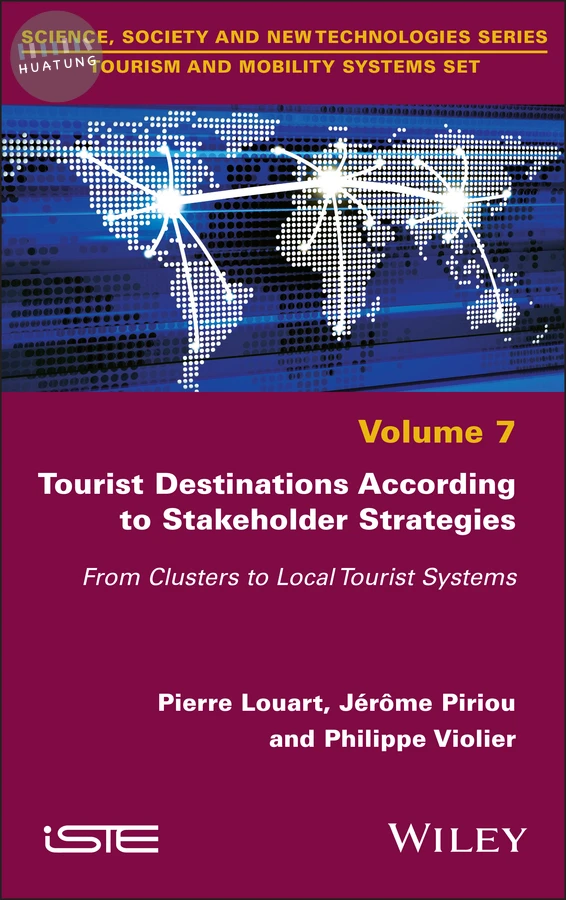
Tourist Destinations According to Stakeholder Strategies
$4897元 定價: $5441 9折 可訂購
簡介
Tourist destinations are subject to the strategies and interactions of the people who reside in them, with complementary and sometimes conflicting interests. To ensure that these destinations remain competitive, Destination Management Organizations (DMOs) are tasked with stimulating cooperation between all partners (independents, organizations, networks).
Tourist Destinations According to Stakeholder Strategies is based on a series of case studies that are analyzed and discussed from a dual geographical and managerial perspective. This enables us to extract operational typologies and propose recommendations for actors in the tourism sector.
The authors have opted for an original and innovative name for the object of study, "Localized Tourism Systems" (LTS), thus emphasizing the triple aim of territorialization, tourism activities and actors that interact together in collective projects.
目錄
Introduction. Tourist Destinations: At the Crossroads between Geographic and Organizational Proximity xi
Chapter 1. Case Studies 1
1.1. Amnéville or the extravagant invention 1
1.2. Center Parcs: a system driven by a large company 14
1.3. Cognac: spirits giant, tourist dwarf 19
1.4. Destination Anjou: a system developed by the CCI 42
1.5. The Dordogne Valley: political ambition at the service of administrative division 45
1.6. Tourism in the Lake Geneva region: the challenge for actors to step beyond boundaries. 51
1.7. Autour du Louvre-Lens: a UFO in a disadvantaged economic landscape 63
1.8. Mélusine accueil: a system of actors with no intermediation 70
1.9. Experimenting with a tourism cluster in Morbihan 71
1.10. Saumur and its region: making the territory an internationally recognized tourist destination 91
1.11. Saint-Jean-de-Monts: a community mostly gathering small entrepreneurs 96
1.12. Innovating tourism: the reason for being of the "Tourism InnovationLab" cluster 109
1.13. Nantes: from a little-frequented city to tourist destination 120
Chapter 2. Geographic Analyses 129
2.1. Temporal circumstances 129
2.2. The circumstances of places and spaces 141
2.3. The games of actors 156
Chapter 3. Managerial Analyses 169
3.1. How to manage tourism systems? 170
3.2. How to manage existing resources and enrich them or recompose them in an effective manner? 174
3.3. Building a project or a group of compatible projects within the territory 179
3.4. The revitalization of the networks of actors 186
3.5. The establishment of appropriate governance 198
3.6. Acknowledgments 207
Chapter 4. Typologies and Recommendations 209
4.1. Two open typologies 210
4.2. General recommendations 222
4.3. General conclusion: taking into account the spirit of the place! 246
References 251
Index 263