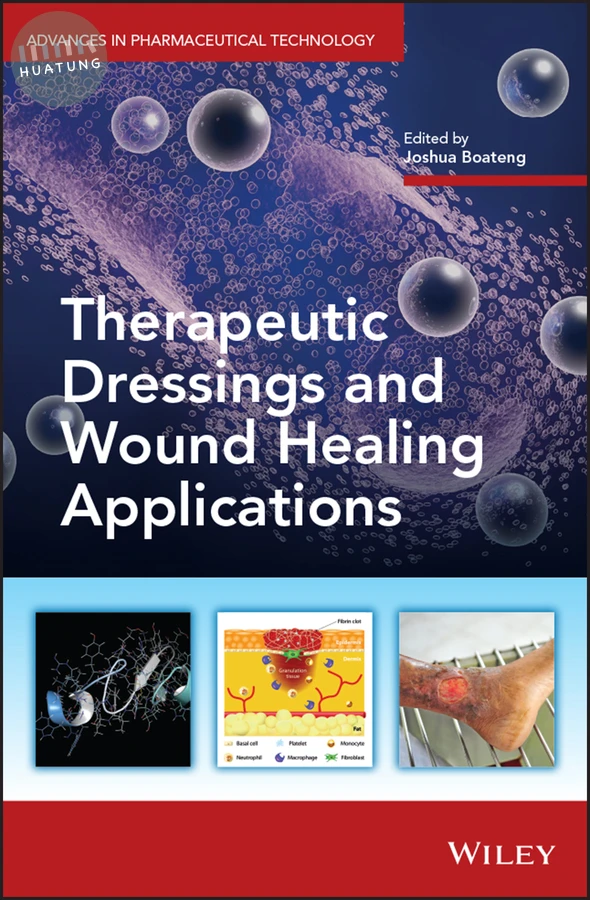

Therapeutic Dressings and Wound Healing Applications
$6202元 定價: $6891 9折 可訂購
簡介
The latest research on techniques for effective healing of chronic and difficult to heal wounds
The healing of chronic wounds is a global medical concern, specifically for patients suffering from obesity and type II diabetes. Therapeutic Dressing and Wound Healing Applications is an essential text for research labs, industry professionals, and general clinical practitioners that want to make the shift towards advanced therapeutic dressing and groundbreaking wound application for better healing.
This book takes a clinical and scientific approach to wound healing, and includes recent case studies to highlight key points and areas of improvement. It is divided into two key sections that include insight into the biochemical basis of wounds, as well as techniques and recent advancements. Chapters include information on:
● Debridement and disinfection properties of wound dressing
● Biofilms, silver nanoparticles, and honey dressings
● Clinical perspectives for treating diabetic wounds
● Treating mixed infections
● Wound healing and tissue regeneration treatments
● Gene based therapy, 3D bioprinting and freeze-dried wafers
Anyone looking to update and improve the treatment of chronic wounds for patients will find the latest pertinent information in Therapeutic Dressing and Wound Healing Applications.
目錄
List of Contributors xiii
Series Preface xvii
Preface xix
1 Chronic Wound Healing: Molecular and Biochemical Basis 1
Sophia Tate and Keith Harding
1.1 Introduction 1
1.2 Acute Wound Healing 1
1.3 Categories of Chronic Wound 3
1.3.1 Pressure Ulcers 3
1.3.2 Venous Stasis Ulcers 4
1.3.3 Ischaemic Ulcers 4
1.3.4 Diabetic Foot Ulcers 4
1.4 How a Chronic Wound Develops: Intrinsic Components 4
1.4.1 Cell Phenotype 5
1.4.2 Immune Cells and Inflammatory Mediators 6
1.4.3 Reactive Oxygen Species 8
1.4.4 Growth Factors 8
1.4.5 The Role of Matrix Metalloproteinases 12
1.5 How a Chronic Wound Develops: Extrinsic Factors 13
1.5.1 Infection 13
1.5.2 Nutrition 13
1.5.3 Tobacco Smoking 14
1.5.4 Hypoxia and Ischaemia–Reperfusion Injury 15
1.6 Concluding Remarks 15
References 16
2 Clinical Perspectives for Treating Chronic Wounds 21
Barun Majumder, Kirstie Lane, Diane Beck, Sandeep Singh and Duniya Majumder
2.1 Background 21
2.2 Aetiology of Diabetic Foot Ulcers 22
2.3 Standard of Care for Treatment of Diabetic Foot Ulcers 22
2.4 Commonly Used Wound Dressings for Diabetic Foot Ulcers and Their Mechanism of Action 22
2.5 Absorbent and Superabsorbent Dressings 23
2.6 Alginates 23
2.7 Films 23
2.8 Foams 24
2.9 Honeys 24
2.10 Hydrogels 25
2.11 The Role of a Split Thickness Skin Graft in Diabetic Foot Ulcers 25
2.12 Negative Pressure Wound Therapy 25
2.13 Larval Therapy 27
2.14 Clinical Case Studies from Multidisciplinary Diabetic Foot Clinic 27
2.14.1 Neuropathic Wound 27
2.14.2 Ischaemic Wound 29
2.14.3 Neuro-Ischaemic Wound 31
2.14.4 Osteomyelitis 33
2.14.5 Charcot’s Foot 35
2.14.6 Necrotising Fasciitis in a Patient with Diabetes 36
2.15 Summary 39
Acknowledgements 39
References 39
3 Prediction, Prevention, Assessment, and Management of Skin Tears in the Aging Population 43
Kimberly LeBlanc and Karen Campbell
3.1 Introduction 43
3.2 Skin Tear Prevalence and Incidence 44
3.3 Predicting Skin Tears 45
3.4 Prevention 47
3.5 ISTAP Risk Reduction Program 49
3.5.1 General Health 49
3.5.2 Mobility 50
3.5.3 Skin 51
3.6 Assessment 52
3.7 Management 54
3.8 Treatment 54
3.9 Conclusion 55
References 55
4 Importance of Debriding and Wound Cleansing Agents in Wound Healing 59
Gwendolyn Cazander, Bianca K. den Ottelander, Sandra Kamga, Martijn C.H.A. Doomen, Tim H.C. Damen and Anne Marie E. van Well
4.1 What is Debridement? 59
4.2 The History of Debridement 59
4.3 Why Undertake Debridement? 60
4.4 Debridement Techniques and Wound Cleansing Agents 62
4.4.1 Mechanical Debridement 62
4.4.2 Biological Debridement 72
4.4.3 Enzymatic Debridement 74
4.4.4 Autolytic Debridement 77
4.4.5 Wound Cleansing 79
4.4.6 Other Debridement Therapies 80
4.5 What is the Future of Debridement? 81
References 82
5 Treatment of Mixed Infections in Wounds 91
Asif Ahmed and Joshua Boateng
5.1 Introduction 91
5.1.1 Wound Healing Process 92
5.1.2 Types of Chronic Wounds 92
5.2 Prevalence of Mixed Infections 94
5.2.1 Bacterial–Fungal Interactions 95
5.2.2 Bacterial–Bacterial Interactions 98
5.2.3 Host Responses to Mixed Infections and Drug Resistance 99
5.3 Management of Mixed Infected Wounds 100
5.3.1 Clinical and Microbiological Diagnosis 101
5.3.2 Debridement and Cleansing 101
5.3.3 Antimicrobial Therapies 102
5.3.4 Hyperbaric Oxygen Therapy 104
5.3.5 Phage Therapy 104
5.4 Summary and Future Perspectives 104
References 105
6 Treatment of Biofilms in Infected Wounds 115
Philip Debrah, Awo Afi Kwapong and Mansa Fredua-Agyeman
6.1 Introduction 115
6.2 Why and How Biofilms Form 116
6.3 Wound Biofilms 118
6.3.1 Wound Healing 119
6.4 Biofilms and Wounds 119
6.4.1 Simulation of Biofilms in Wounds 120
6.5 Treatment of Biofilms in Wounds 126
6.5.1 Biofilm Eradication 126
6.5.2 Current Treatment Protocols 128
6.6 Clinical Examples 128
6.7 Summary 128
References 130
7 Freeze-Dried Wafers for Wound Healing 137
Shiow-Fern Ng
7.1 Introduction 137
7.2 Wafer as a Modern Wound Dressing 138
7.3 Freeze-Drying Process 139
7.4 Wafer Preparation 140
7.5 Wafer Assessments 141
7.5.1 Morphology 142
7.5.2 Swelling Index 144
7.5.3 Mechanical Properties 145
7.5.4 In Vitro Drug Release 145
7.5.5 Cell Viability 146
7.6 Wafer Biopolymers 146
7.6.1 Alginate 147
7.6.2 Chitosan 148
7.6.3 Carboxymethylcellulose 149
7.7 Conclusion 150
References 150
8 Silver and Silver Nanoparticle-Based Antimicrobial Dressings 157
Joshua Boateng and Ovidio Catanzano
8.1 Introduction 157
8.1.1 Brief History of Silver as an Antibiotic 159
8.1.2 Mechanism of Action 160
8.1.3 Bacterial Resistance to Silver 164
8.2 Silver Dressings in Wound Healing 167
8.2.1 Silver-Based Antimicrobial Dressings 169
8.2.2 Silver Nanoparticle-Based Antimicrobial Dressings 170
8.3 Cost-Effectiveness of Silver Dressings 175
8.4 Concluding Remarks 176
References 177
9 Hydrogel Dressings 185
Galiya S. Irmukhametova, Grigoriy A. Mun and Vitaliy V. Khutoryanskiy
9.1 Introduction 185
9.1.1 Classification by Origin of Materials Used to Prepare Hydrogels 186
9.1.2 Classification by Composition and Structure of Hydrogels 186
9.1.3 Classification by the Type of Cross-Linking 187
9.1.4 Classification Based on the Shape and Dimensions of Hydrogels 187
9.1.5 Classification Based on the Charge of Macromolecules Forming Hydrogels 187
9.1.6 Classification Based on Functional Properties of the Hydrogels 187
9.2 Mechanism of Hydrogel Swelling 187
9.2.1 Swelling of Temperature-Sensitive Hydrogels and Their Application in Wound Healing 189
9.2.2 Swelling of Light-Sensitive Hydrogels 190
9.2.3 Swelling of Electro-Sensitive Hydrogels 191
9.3 Application of Hydrogels as Wound Dressings 191
9.4 Industrial Methods for the Synthesis of Hydrogels for Wound Dressings 193
9.4.1 Polymerization Methods 193
9.4.2 Cross-Linking of Polymers 195
9.5 Antimicrobial Hydrogels with Special Additives 198
9.6 Conclusion 200
Acknowledgments 201
References 201
10 Gene Therapy for the Treatment of Chronic Wounds 209
Marcos Garcia-Fuentes
10.1 Introduction 209
10.2 Pharmacodynamics of Gene Therapy in Chronic Wounds 210
10.2.1 Signalling Supplementation 210
10.2.2 Pathway Inhibition 211
10.3 Administration Routes and Methods 212
10.3.1 Systemic Delivery 212
10.3.2 Topical Delivery 212
10.3.3 Intralesional Delivery 213
10.4 Gene Delivery Systems 213
10.4.1 Physical Methods 214
10.4.2 Viral Vectors 215
10.4.3 Chemical Delivery Systems 217
10.4.4 Gene-Activated Matrices 220
10.5 Clinical Evaluation 221
10.6 Conclusion 226
Acknowledgements 226
References 227
11 Honey in Wound Healing 235
Emi Maruhashi
11.1 The History of Honey 235
11.2 Composition 236
11.3 Honey Research 236
11.4 Medical Grade Honey 237
11.5 Modes of Action 238
11.6 Applications and Specific Wound Types 242
11.7 Practical Considerations 246
11.8 Novel Concepts and Conclusions 247
References 248
12 Regeneration Using Tissue Engineered Skin Strategies 255
Lucília P. da Silva, Mariana T. Cerqueira and Alexandra P. Marques
12.1 Introduction 255
12.2 Skin Physiology and Wounding 256
12.3 Skin Tissue Engineering 258
12.4 Evolving Skin Tissue Engineering Strategies 259
12.4.1 Balancing the Inflammatory Phase 261
12.4.2 Enhancement of Re-Epithelialization 263
12.4.3 Target of Dermal Matrix Synthesis and Remodeling 269
12.4.4 Re-Establishment of the Vascular Network 270
12.4.5 Innervation Shaping 280
12.4.6 Appendages and Pigmentation 281
12.5 Conclusion 282
References 283
13 Local Delivery of Growth Factors Using Wound Dressings 291
Ovidio Catanzano and Joshua Boateng
13.1 Wound Dressings as Delivery Platforms for Growth Factors 291
13.2 Growth Factors Involved in the Wound Healing Process 292
13.3 Local Delivery of Growth Factors Using Wound Dressings 296
13.4 Integration of Platelet-Rich Plasma in Wound Dressings 299
13.5 Enhancing Local Growth Factor Expression Using Gene Therapy 300
13.6 Wound Delivery of Growth Factors from Living Systems 302
13.7 Regulatory Considerations 305
13.8 Conclusions and Future Perspectives 306
References 307
14 Electrospinning Technologies in Wound Dressing Applications 315
Giuseppina Sandri, Silvia Rossi, Maria Cristina Bonferoni, Carla Caramella and Franca Ferrari
14.1 Introduction 315
14.2 Basic Concept and Electrospinning Set-Up 316
14.3 Parameters Affecting the Electrospinning Process 318
14.4 Process Parameters 319
14.4.1 Electric Field Strength 319
14.4.2 Flow Rate 319
14.4.3 Needle-to-Collector Distance 320
14.4.4 Collector and Needle Types 320
14.5 Solution Parameters 321
14.5.1 Molecular Weight and Polymer Concentration 321
14.5.2 Surface Tension 322
14.5.3 Conductivity/Surface Charge Density 322
14.5.4 Environmental Parameters 322
14.6 Biomedical Applications of Nanofibrous Membranes 323
14.6.1 Wound Dressings and Wound Healing 323
14.6.2 Electrospun Dressings 325
14.7 Chemicophysical and Biopharmaceutical Characterizations 325
14.8 Dressing/Scaffold Parameters Affecting Cell Functions 327
14.9 Materials for Fabricating Nanofibers 328
14.9.1 Biopolymers 328
14.10 Concluding Remarks 333
References 333
15 The Place of Biomaterials in Wound Healing 337
Annalisa Bianchera, Ovidio Catanzano, Joshua Boateng and Lisa Elviri
15.1 Introduction to Biomaterials for Wound Healing 337
15.1.1 Definition of Biomaterials 337
15.1.2 Functional Requirements of Wound Repair Biomaterials 338
15.1.3 Classification of Biomaterials Commonly Used in Wound Healing 338
15.2 Synthetic Biomaterials for Wound Healing 339
15.2.1 Polyurethanes and their Derivatives 340
15.2.2 Poly l-Lactic Acid 340
15.2.3 Poly(Ethylene Glycol) 341
15.2.4 Polycaprolactone 341
15.2.5 Poly(Glycolic Acid) and Poly(Lactic-co-Glycolic Acid) 342
15.3 Natural Biomaterials for Wound Healing 343
15.3.1 Polysaccharide-Based Biomaterials 343
15.3.2 Protein-Based Biomaterials 348
15.4 Application of Biomaterials in Wound Healing 350
15.4.1 Traditional and Impregnated Dressings 350
15.4.2 Hydrogels 352
15.4.3 Film Dressings 353
15.4.4 Foam Dressings 354
15.4.5 Nanofiber-Based Dressings 355
15.4.6 Three-Dimensional Printed Dressings 356
15.5 New Trends in Biomaterials for Wound Healing 357
15.5.1 Extracellular Matrix-Derived Biomaterials 357
15.5.2 Tissue Engineered Skin Substitutes 357
15.6 Conclusions and Future Perspectives 358
References 359
16 Wound Dressings and Pressure Ulcers 367
Michael Clark
16.1 Overview 367
16.2 Introduction to Pressure Ulcers 367
16.3 The Impact of Pressure Ulcers 369
16.4 Managing Pressure Ulcers 370
16.5 Wound Dressings in Pressure Ulcer Treatment 371
16.6 Pressure Ulcer Prevention and Wound Dressings 377
16.6.1 Pressure Ulcers at the Nose 378
16.6.2 Pressure Ulcers at the Heel 378
16.6.3 Pressure Ulcers at the Sacrum 378
16.7 Conclusions 380
References 380
17 3D Printed Scaffolds for Wound Healing and Tissue Regeneration 385
Atabak Ghanizadeh Tabriz, Dennis Douroumis and Joshua Boateng
17.1 Introduction 385
17.2 3D Printing 386
17.3 Laser-Based Bioprinting 387
17.4 Jet-Based Printing 389
17.5 Extrusion-Based Printing 391
17.6 Hybrid Printing 393
17.7 Conclusions 395
References 395
Index 399