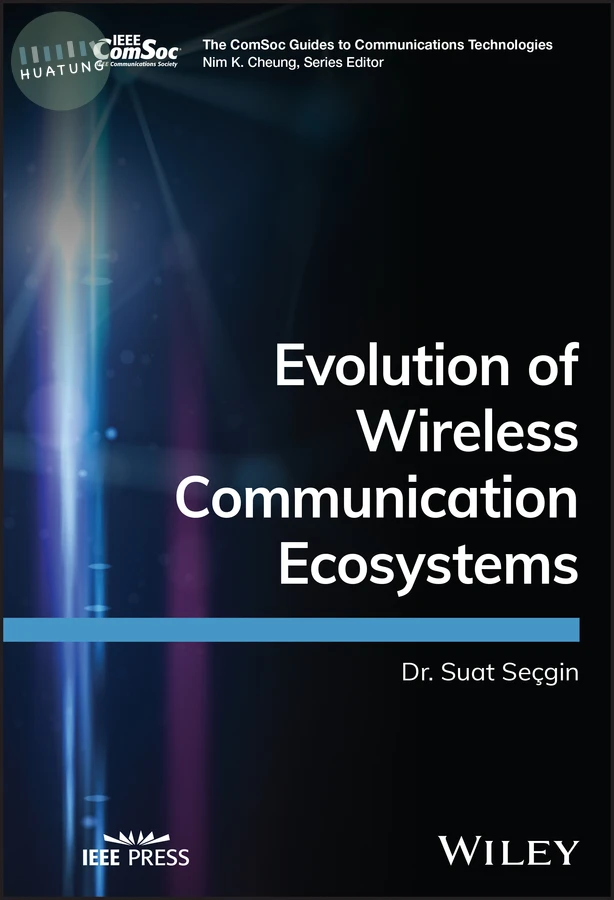
Evolution of Wireless Communication Ecosystems
$3902元 定價: $4335 9折 可訂購
簡介
Evolution of Wireless Communication Ecosystems Understand a world transformed by wireless communication with this groundbreaking guide Since the advent of the internet, few technologies have proven more transformative than wireless communication. Never have we lived in a more comprehensively connected world, with the cloud and the coming sixth generation (6G) of wireless technology creating a vast and interconnected communications infrastructure. Global citizens of this newly interconnected reality are grappling like never before with its many challenges. Evolution of Wireless Communication Ecosystems provides readers with a history of wireless communication and a thorough overview of emerging frontiers. It traces wireless communication from the first generation through to the current fifth before surveying the current state of wireless technology and the ongoing research into 6G. The result is a book that understands wireless communication for the first time as an ecosystem, endlessly interconnected, growing, and boundlessly complex, but made intelligible by this highly readable introduction. Readers will also find: Detailed explanations of the journey starting from 1G to 6G
Descriptions the infrastructure of 4G, 5G, and 6G systems, this all-connected communication ecosystem, the sub-components of this ecosystem, and the relationship among them
Depictions of events seen in the capillaries of the communication echo system that show switching techniques, modulation, and multiplexing techniques
Coverage of access techniques, protocols, the methods used in M2M and IoT connections at the endpoints, and security issues that show how they are an integral part of wireless communication infrastructure
Evolution of Wireless Communication Ecosystems from 1G to 6G is an essential reference for wireless and telecommunications professionals, as well as researchers interested in 6G or other emerging wireless technologies.
目錄
About the Author xv
Preface xvii
List of Abbreviations xxi
1 Basic Concepts 1
1.1 Introduction 1
1.2 Main Components of Communication Systems 1
1.3 Circuit, Packet, and Cell Switching 3
1.4 Duplexing in Communication 6
1.5 Historical Developments of Wireless Communication Systems 7
2 Modulation and Demodulation 9
2.1 Introduction 9
2.2 What Are Modulation and Demodulation? 9
2.3 Analog Modulation Methods 10
2.4 Digital Modulation Methods 13
3 Multiplexing Methods 19
3.1 Introduction 19
3.2 Frequency Division Multiplexing 20
3.3 Time Division Multiplexing 22
3.4 Orthogonal Frequency Division Multiplexing 23
3.5 Non-Orthogonal Multiple Access 24
3.6 Wavelength Division Multiplexing 25
3.7 Code Division Multiplexing 26
3.8 Spatial Division Multiplexing 27
3.9 Orbital Angular Momentum Multiplexing 27
3.10 Polarization Division Multiplexing 30
4 Network Performance Metrics 33
4.1 Introduction 33
4.2 Spectral Efficiency 33
4.3 Important Network Performance Metrics 35
5 Seven Layers of ISO/OSI 41
5.1 Introduction 41
5.2 Application Layer 43
5.3 Presentation Layer 44
5.4 Session Layer 45
5.5 Transport Layer 45
5.6 Network Layer 46
5.7 Data Link Layer 48
5.8 Physical Layer 49
6 Cellular Communication and 1G Systems 51
6.1 Introduction 51
6.2 A Brief History of Wireless Communication 51
6.3 Cellular Communication 52
6.4 1G Systems 54
7 2G Systems 57
7.1 Introduction 57
7.2 1G and 2G Comparisons 57
7.3 2G Architecture 59
7.4 Detailed Infrastructure and 2.5G 62
8 3G Systems 65
8.1 Introduction 65
8.2 2G and 3G Comparison 65
8.3 3G Architecture 67
9 4G Systems 71
9.1 Introduction 71
9.2 Toward 4G 72
9.3 Services and Servers 75
9.4 Architectural Structure and Novel Concepts 77
9.5 Voice over LTE (VoLTE) 82
9.6 Mobile IP 84
9.7 Multiple Access Techniques 87
9.8 Multiple Input- Multiple Output (MIMO) Antenna Systems and SDM Access 90
9.9 Voice over WiFi (VoWiFi) 92
10 5G Systems 97
10.1 Introduction 97
10.2 5G Cell Structure 101
10.3 Topology 102
10.4 Millimeter Wave 106
10.5 Network Slicing 111
10.6 Massive MIMO and Beamforming 114
10.7 Carrier Aggregation (CA) and Dual Connectivity (DC) 116
11 6G Systems 119
11.1 Introduction 119
11.2 Network 122
11.3 Terahertz Communication 126
11.4 Visible Light Communication 128
11.5 Satellite Integration 131
11.6 Cloud Radio Access Network 132
11.7 Holographic MIMO Surfaces 135
11.8 Massive Cell- Free MIMO 140
11.9 Mobile Cloud Computing (MCC)–Mobile Edge Computing (MEC) 143
11.10 ML, AI, and Blockchain Usage in 6G 148
11.11 Quantum Computing in Future Wireless Networks 155
11.12 5G Concepts in 6G (eMBB, uRLLC, and mMTC) 159
11.13 6G Use Cases 161
11.14 Comparison of 5G and 6G Network Architectures 169
12 Internet of Things (IoT) 177
12.1 Introduction 177
12.2 IoT Vision 178
12.3 Architecture and Communication Model 181
13 Non- IP- Based WPAN Technologies 191
13.1 Introduction 191
13.2 802.15 Standards 194
13.3 Radio Frequency Identification 195
13.4 Near- Field Communication 198
13.5 Infrared Data Association 198
13.6 Bluetooth 199
13.7 Zigbee 202
13.8 Z- Wave 207
13.9 Power Line Communication 209
14 IP- Based WPAN and WLAN 211
14.1 Introduction 211
14.2 HaLow WiFi (Low- Power WiFi) 211
14.3 ISA 100.11a Wireless 212
14.4 Wireless Highway Addressable Remote Transducer Protocol (HART) 215
14.5 Wireless Networks for Industrial Automation- Process Automation (WIA- PA) 216
14.6 6LoWPAN 218
14.7 WPAN with IP Thread 222
15 Low- Power Wide- Area Networks 227
15.1 Introduction 227
15.2 General Architecture 227
15.3 EC- GSM- IoT 228
15.4 Random Phase Multiple Access 230
15.5 Dash7 231
15.6 Long- Term Evolution for Machines 233
15.7 Narrowband IoT 234
15.8 Massive IoT 234
15.9 IoTivity 237
15.10 LoRa and LoRaWAN 238
15.11 Sigfox 241
16 IoT Edge to Cloud Protocols 245
16.1 Introduction 245
16.2 Message Queue Telemetry Transport Protocol 248
16.3 MQTT over WebSockets 251
16.4 MQTT for Sensor Networks 251
16.5 Constrained Application Protocol 253
16.6 Embedded Binary HTTP 256
16.7 Lean Transport Protocol 257
16.8 Advanced Message Queuing Protocol 258
16.9 Data Distribution Service 260
16.10 Simple Text- Oriented Messaging Protocol 263
16.11 Extensible Messaging and Presence Protocol 264
16.12 Lightweight M2M 266
16.13 Health Device Profile Protocol (Continua HDP) 268
16.14 Devices Profile for Web Services 270
16.15 Protocol Comparisons 271
17 Popular Operating Systems of IoT 277
17.1 Introduction 277
17.2 OpenWSN 278
17.3 TinyOS 279
17.4 FreeRTOS 279
17.5 Ti- Rtos 280
17.6 Riot 281
17.7 Contiki OS 282
18 IoT Security 285
18.1 Introduction 285
18.2 Limitations in IoT End Devices 285
18.3 Security Requirements 287
18.4 Attack Types and Points 290
19 IoT Applications 301
19.1 Introduction 301
19.2 Tactile Internet 301
19.3 Waste Management 304
19.4 Healthcare 304
19.5 Smart Agriculture and Smart Water Supply 305
19.6 Web of Things (WoT) 307
References 308
Index 311