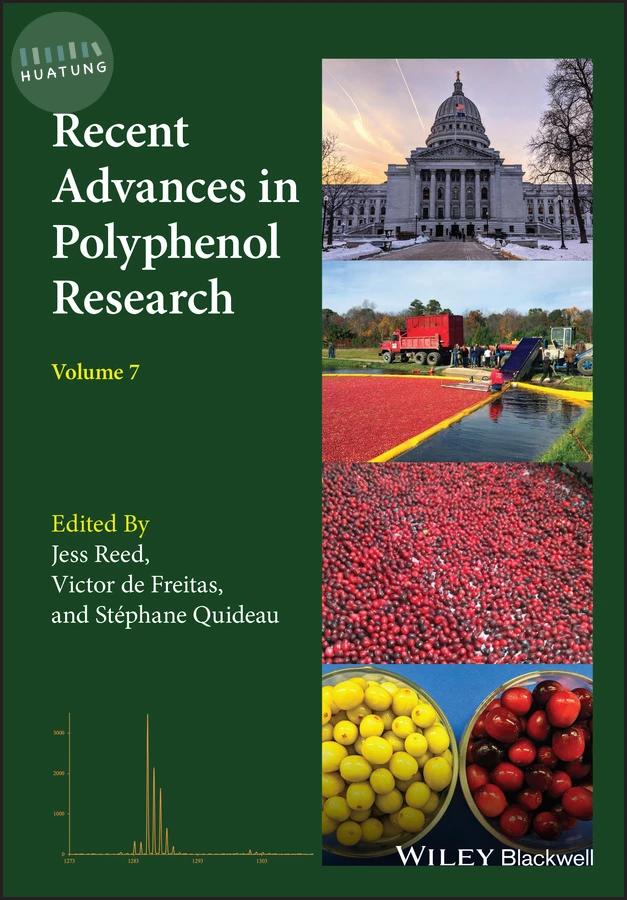
Recent Advances in Polyphenol Research, Volume 7
$6162元 定價: $6847 9折 可訂購
簡介
RECENT ADVANCES IN POLYPHENOL RESEARCH Plant polyphenols are secondary metabolites that constitute one of the most common and widespread groups of natural products. They are essential plant components for adaptation to the environment and possess a large and diverse range of biological functions that provide many benefits to both plants and humans. Polyphenols, from their structurally simplest forms to their oligo/polymeric versions (i.e. tannin and lignin), are phytoestrogens, plant pigments, antioxidants, and structural components of the plant cell wall. The interaction between tannins and proteins is involved in plant defense against predation, cause astringency in foods and beverages, and affect the nutritional and health properties of human and animal food plants.This seventh volume of the highly regarded Recent Advances in Polyphenol Research series is edited by Jess Dreher Reed, Victor Armando Pereira de Freitas, and Stéphane Quideau, and brings together chapters written by some of the leading experts working in the polyphenol sciences today. Topics covered include:Chemistry and physicochemistry
Biosynthesis, genetics and metabolic engineering
Roles in plants and ecosystems
Food, nutrition and health
Applied polyphenols
Distilling the most recent and illuminating data available, this new volume is an invaluable resource for chemists, biochemists, plant scientists, pharmacognosists and pharmacologists, biologists, ecologists, food scientists and nutritionists.
目錄
Contributors
Preface
1 Achieving Complexity at the Bottom Through the Flavylium Cation-Based Multistate. A Comprehensive Kinetic and Thermodynamic Study
Johan Mendoza and Fernando Pina
1.1 Introduction
1.2 Flavylium cation as a metamorphosis generator
1.3 Extending the multistate of anthocyanins and related compounds to the basic region
1.4 The kinetic processes
1.5 Conclusions and perspectives
2 Proanthocyanidin Oligomers with Doubly-Linked (A-Type) Interflavan Connectivity: Structure and Synthesis
Ken Ohmori and Keisuke Suzuki
2.1 Introduction
2.2 Structure
2.3 Synthetic studies
2.4 Conclusion
3 Answering the Call of the Wild: Polyphenols in Traditional Therapeutic Practice
Mary Ann Lila and Kriya Dunlap
3.1 Introduction
3.2 The wildcrafting tradition
3.3 How wildcrafted edible plants differ from agricultural commodities
3.4 Animal mimickry/Zoopharmacognosy
3.5 Probing the mechanisms behind polyphenol-rich traditional medicines bioactivity
3.6 Commercialization prospects for wildcrafted polyphenol-rich plants
3.7 Acknowledgements
4 Causes and Consequences of Condensed Tannin Variation in Populus: A Molecules to Ecosystems Perspective
Kennedy F. Rubert-Nason and Richard L. Lindroth
4.1 Introduction
4.2 Condensed tannin biosynthesis
4.3 Allocational tradeoffs influence CT production
4.4 Causes of quantitative and qualitative variation in Populus CTs
4.5 Roles of CT variation in Populus-environment interactions
4.6 Importance of CTs in Populus-dominated ecosystems of the Anthropocene
4.7 Conclusions and challenges
5 Matrix-Assisted Laser Desorption/Ionization Time-of-Flight Mass Spectrometry (MALDI-TOF MS) of Proanthocyanidins to Determine Authenticity of Functional Foods and Dietary Supplements
Daniel Esquivel-Alvarado, Jess D. Reed, and Christian G. Krueger
5.1 Introduction
5.2 Introduction to matrix-assisted laser desorption/ionization time-of-flight mass spectrometry (MALDI-TOF MS)
5.3 Mass spectrometry of proanthocyanidins
5.4 Deconvolution of isotope patterns of A- to B-type interflavan bonds in proanthocyanidins
5.5 Multivariate analysis of MALDI-TOF MS spectra data
5.6 Conclusion
6 Challenges in Analyzing Bioactive Proanthocyanidins
Wayne E. Zeller and Irene Mueller-Harvey
6.1 Introduction
6.2 Structural diversity of proanthocyanidins
6.3 Noted challenges in proanthocyanidin analysis
6.4 Fate of proanthocyanidins in digestive tract and during plant fermentation
6.5 Definition and possible origins of non-extractable proanthocyanidins (NEPAs)
6.6 Universal problems of proanthocyanidin analysis
6.7 Proanthocyanidin characterization by depolymerization
6.8 Mass spectrometry
6.9 Nuclear Magnetic Resonance Spectroscopy
6.10 Colorimetry
6.11 Infra-red spectroscopy
6.12 Conclusions
7 Lignin Monomers Derived from the Flavonoid and Hydroxystilbene Biosynthetic Pathways
José C. del Río, Jorge Rencoret, Ana Gutiérrez, Wu Lan, Hoon Kim and John Ralph
7.1 Lignin monomers derived from the monolignol biosynthetic pathway
7.2 Flavonoid and hydroxystilbene biosynthetic pathways
7.3 Radical coupling of flavonoids and hydroxystilbenes with monolignols – flavonolignans and stilbenolignans
7.4 Lignin monomers derived from the flavonoid and hydroxystilbene biosynthetic pathways
7.5 Conclusions and future prospects
7.6 Acknowledgements
8 Complex Regulation of Proanthocyanidin Biosynthesis in Plants by R2R3 MYB Activators and Repressors
Dawei Ma and C. Peter Constabel
8.1 Introduction to PAs and flavan-3-ols
8.2 Regulation of PA and flavonoid biosynthesis by MYB transcription factors
8.3 The importance of repressor MYBs in PA and flavonoid metabolism
8.4 The complex interaction of PA MYB activators, MYB repressors and bHLH transcription factors
8.5 Developmental and plant hormone-mediated regulation of the PA pathway via MYBs
8.6 Stress activation of PA synthesis by MYBs in poplar and other woody plants
8.7 Summary and conclusions
8.8 Acknowledgements
9 Conservation and Divergence Between Bryophytes and Angiosperms in the Biosynthesis and Regulation of Flavonoid Production
Kevin M. Davies, Rubina Jibran, Nick W. Albert, Yanfei Zhou and Kathy E. Schwinn
9.1 Introduction
9.2 Flavonoid biosynthesis in basal plants
9.3 Origins of the phenylpropanoid biosynthetic pathway and conservation across the embryophytes
9.4 Notable phenylpropanoids of bryophytes
9.5 Regulation of flavonoid production
9.6 Concluding remarks
9.7 Acknowledgements
10 Matching Proanthocyanidin Use with Appropriate Analytical Method
James A. Kennedy
10.1 Introduction
10.2 General proanthocyanidin structure and analysis
10.3 Red Wine Mouthfeel
10.4 Biological Activity
10.5 Summary
11 Imaging Polyphenolic Compounds in Plant Tissues
Marisa S. Otegui
11.1. Introduction
11.2. The chemical nature and intrinsic fluorescence properties of polyphenols
11.3. Microscopy-based methods for imaging plant phenolic compounds
11.4 Polyphenols and microscopy imaging
11.5 Future challenges and opportunities in imaging plant metabolites
Acknowledgments
References
Index