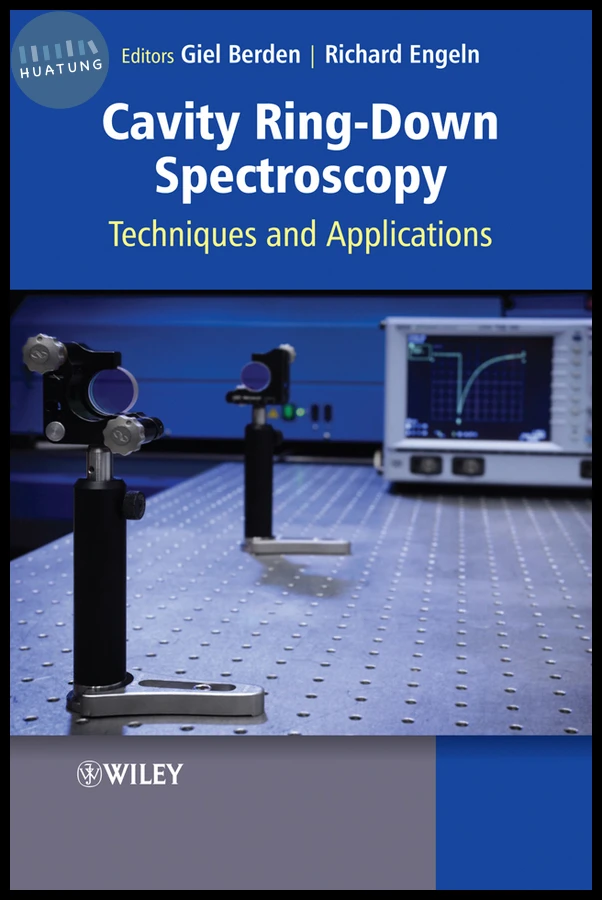

Cavity Ring-Down Spectroscopy
$6681元 定價: $7423 9折 可訂購
簡介
Cavity Ring-Down Spectroscopy: Techniques and Applications provides a practical overview of this valuable analytical tool, explaining the fundamental concepts and experimental methods, and illustrating important applications. Designed as both an introductory text and a reference source, this book is relevant for scientists unfamiliar with CRDS who are interested in using the technique in their research, as well as experienced users.
目錄
Preface List of contributors
Glossary
Chapter 1 - An introduction to cavity ring-down spectroscopy
1.1 Introduction
1.2 Direct absorption spectroscopy
1.3 Basic cavity ring down spectroscopy setup
1.4 A more refined picture
1.5 Fitting of cavity ring down transients
1.6 A few examples
1.7 Going beyond the standard pulsed CRDS experiment
1.8 Summary
1.9 References
Chapter 2 - Cavity enhanced techniques using continuous wave lasers
2.1 Introduction
2.1 Properties of optical cavities and cw lasers relevant to cavity enhanced spectroscopy
2.3 Experimental methods for cw laser cavity enhanced spectroscopy
2.4 Spectroscopy with resonant cavities
2.5 Summary
Chapter 3 - Broadband cavity ring-down spectroscopy
3.1 Introduction.
3.2 The time and wavelength evolution of a single ringdown event.
3.3 Two dimensional techniques: resolving broadband cavity output in time and wavelength.
3.4 One dimensional techniques: time or wavelength.
3.5 How to extract quantitative information from broadband spectra.
3.6 Optimising the sensitivity of a broadband measurement.
3.7 Applications of broadband cavity methods.
3.8 References.
Chapter 4 - Cavity ring-down spectroscopy in analytical chemistry
4.1 Introduction
4.2 Condensed media CRDS
4.3 Evanescent-wave CRDS
4.4 Future trends and perspectives
Chapter 5 - Cavity ring-down spectroscopy using waveguides
5.1. Introduction
5.2. The basic experiments
5.3. Optics and Instrumentation
5.4. Review of waveguide CRD literature
5.5. Conclusion and outlook
5.6. Acknowledgements
Chapter 6 - Cavity ring down spectroscopy of molecular transients of astrophysical interest
6.1. Introduction
6.2. Experimental
6.3. Astronomical considerations
6.4. Results
6.5. Outlook
Acknowledgements
References
Chapter 7 - Applications of cavity ring-down spectroscopy in atmospheric chemistry
7.1. Brief overview
7.2. Measurement of trace atmospheric species by CRDS
7.3. Laboratory based studies of atmospheric interest
7.4. Optical properties of atmospheric aerosol particles
7.5. Future developments
Chapter 8 - Cavity ring-down spectroscopy for medical applications
8.1. Introduction
8.2. Trace gases in medicine and biology
8.3. Instrumentation for laser analytics of breath and other biological gas samples
8.4. Applications to life sciences
8.5. Conclusion and Perspectives
8.6. References
Chapter 9: Studies into the growth mechanism of a-Si:H using in situ cavity ring-down techniques
9.1. Introduction
9.2. Gas phase CRDS on SiHx radicals
9.3. Thin film CRDS on dangling bonds in a-Si:H films (ex situ)
9.4. Evanescent wave CRDS on dangling bonds during a-Si:H film growth
Chapter 10 – Cavity ring down spectroscopy for combustion studies
10.1. Introduction
10.2. General description of cavity ring down spectroscopy in flames
10.3. Experimental set-up
10.4. Quantitative concentration measurements in flames
10.5. Concentration profile determination
10.6. Specific difficulties in combustion studies
10.7. Case of particles: soot volume fraction determination
10.8. Conclusion and prospective
References
Appendix A Literature