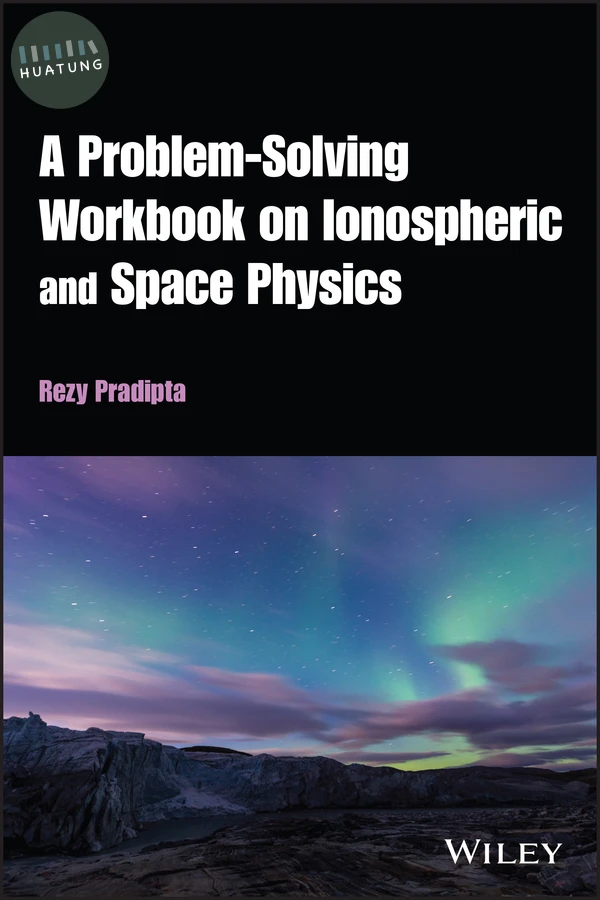

A Problem-Solving Workbook on Ionospheric and Space Physics
$3396元可訂購
簡介
A Problem-Solving Workbook on Ionospheric and Space Physics Enables students to understand and master basic and advanced concepts of space, atmosphere, and ionospheric physics A Problem-Solving Workbook on Ionospheric and Space Physics is a unique textbook that contains a set of problems and exercises accompanied with complete solutions that explore and elucidate the most relevant concepts in ionospheric and space physics. The author has chosen problems that are interesting topic-wise, challenging, and that exemplify the physical and mathematical reasoning in ionospheric and space physics. Specifically, the text conveys core concepts of ionospheric and space physics using a problem-based approach. Each problem elucidates prototypical aspects that readers can easily generalize. Each problem also consists of multi-part questions to facilitate step-by-step understanding. A short introduction to each problem defines the theme and provides context to the readers. In A Problem-Solving Workbook on Ionospheric and Space Physics, readers can expect to learn about: Remote sensing of ionospheric plasmas from the ground, ionospheric slab thickness of a transparent layer, reflectometry, and doppler effects in reflection/refraction of electromagnetic waves
Chapman theory of ionospheric layer formation, magnetic fields generated by the equatorial electrojet current, and fundamentals of GPS total electron content (TEC) measurements
Barker codes and radar pulse compression, abel inversion of ionosonde trace data, and phase and group velocities of acoustic-gravity waves
The use of deconvolution in radar scans, sporadic-E layers and Kelvin-Helmholtz instability due to wind shear, and Brunt-Vaisala frequency
Thanks to the careful selection of included material, A Problem-Solving Workbook on Ionospheric and Space Physics serves as a gateway for advanced students and early-career researchers towards actual research-level problems in the field. As the problems are textbook-agnostic, students can easily self-study and learn about the subject outside the classroom.
目錄
Chapter 1. Chapman Theory of Ionospheric Layer Formation
Chapter 2. Magnetic Fields Resulting from the Equatorial Electrojet Current
Chapter 3. Phase and Group Velocities of Acoustic-Gravity Waves
Chapter 4. Wind Shear, Sporadic-E Layer, and Kelvin-Helmholtz Instability
Chapter 5. Brunt-Vaisala Frequency and Convective Instability
Chapter 6. Whistler Waves in the Ionosphere and Magnetosphere
Chapter 7. Radio Wave Absorption in the D-region Ionosphere
Chapter 8. The Sun is Down, the Equatorial Plasma Bubbles are Up
Chapter 9. Drunken Forest in Space: Why do the Bubbles Tilt?
Chapter 10. Linking Two Hemispheres: Geomagnetic Field Conjugacy
Chapter 11. Equatorial Plasma Bubbles Revisited diagnostic instruments and techniques
Chapter 12. Ionosonde: Sensing Ionospheric Plasmas from the Ground
Chapter 13. Fundamentals of GPS Total Electron Content (TEC) Measurements
Chapter 14. Barker Codes and Radar Pulse Compression
Chapter 15. Abel Inversion of Ionosonde Trace Data
Chapter 16. Direction-scan Radar and Deconvolution
Chapter 17. Bragg Scattering and Ionospheric Radars
Chapter 18. Witchcraft: Poor Man's Abel Inversion of Ionograms
Chapter 19. Fabry-Perot Interferometers and the Optical Airglow
Chapter 20. Don't Put out the Glow: What in Heaven is this \Rayleigh" Unit?
Chapter 21. Focus! Parabolic Ionospheric Layer Approximation
Chapter 22. Fast and Furious: Zonal Drift applying basic physics to space physics
Chapter 23. Seeing Ghost: Slab Thickness of a Transparent Layer
Chapter 24. Reflectometry: A Classical Mechanics Analogy
Chapter 25. Doppler Effects in Reaction/Refraction of Electromagnetic Waves
Chapter 26. Magnetic Mirrors and the Loss Cone
Chapter 27. Kolmogorov's 5/3 Law: An Order in Disorders
Chapter 28. Pushed to the Limit: True Resolution in Spectroscopy
Chapter 29. MIR Mortals: Rapid Depressurization in Space
Chapter 30. The Gradient-B Plasma Drift Demystified
Chapter 31. No Escape: Charged Particles in Magnetic Field
Chapter 32. EXB Drift for Explorers