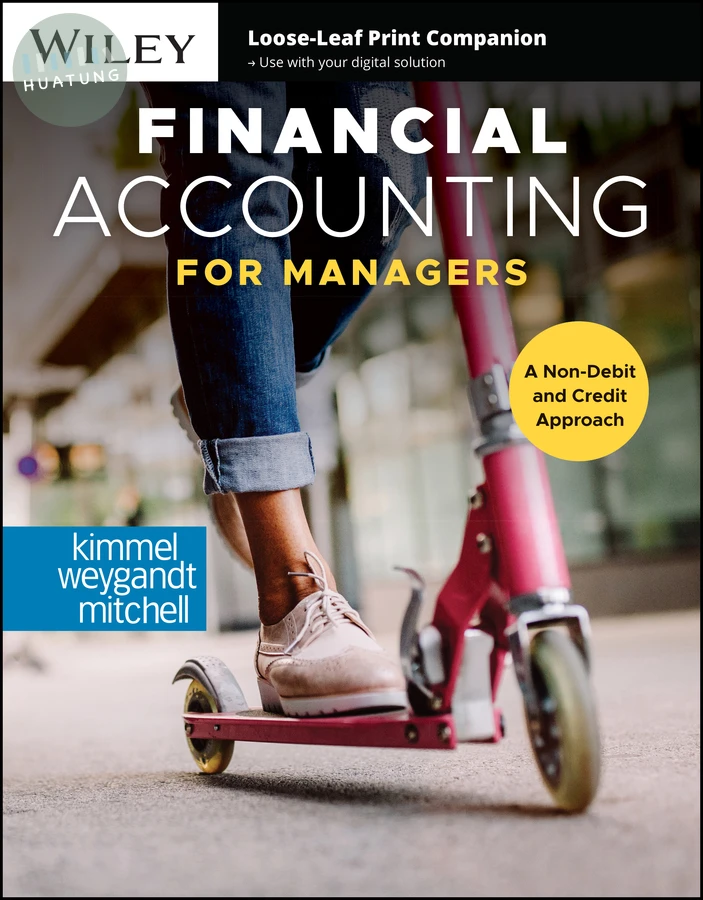
Financial Accounting for Managers
$5985元可訂購
簡介
Provide future business professionals with a practical introduction to financial accounting without the use of debits and credits. With its unique focus on building students’ decision-making skills and emphasis on financial statements, Financial Accounting for Managers, 1st Edition meaningfully integrates data analytics and the importance of using accounting information in real-world decision-making. Engaging real-world industry examples student understanding of accounting concepts and illustrate how these are relevant to their everyday lives and future careers in business and accounting.
目錄
1 Introduction to Financial Statements 1-1
Knowing the Numbers: Columbia Sportswear Company 1-1
1.1 Business Organization and Accounting Information Uses 1-2
Forms of Business Organization 1-3
Users and Uses of Financial Information 1-4
Data Analytics 1-6
Ethics in Financial Reporting 1-7
1.2 The Three Types of Business Activity 1-8
Financing Activities 1-9
Investing Activities 1-9
Operating Activities 1-10
1.3 The Four Financial Statements 1-11
Income Statement 1-12
Retained Earnings Statement 1-13
Balance Sheet 1-14
Statement of Cash Flows 1-16
ESG Reporting: Beyond the Four Financial Statements 1-17
Interrelationships of Statements 1-17
Elements of an Annual Report 1-20
Appendix 1A: Career Opportunities in Accounting 1-23
“Show Me the Money” 1-24
2 A Further Look at the Balance Sheet 2-1
Just Fooling Around?: The Motley Fool 2-2
2.1 The Classified Balance Sheet 2-2
Current Assets 2-4
Long-Term Investments 2-5
Property, Plant, and Equipment 2-5
Intangible Assets 2-5
Current Liabilities 2-7
Long-Term Liabilities 2-7
Stockholders’ Equity 2-7
2.2 Analyzing the Balance Sheet Using Ratios 2-8
Ratio Analysis 2-8
Using a Classified Balance Sheet 2-9
3 The Accounting Information System 3-1
Accidents Happen: MF Global Holdings Ltd 3-1
3.1 Financial Reporting Concepts 3-2
The Standard-Setting Environment 3-2
Qualities of Useful Information 3-4
Assumptions in Financial Reporting 3-5
Principles in Financial Reporting 3-6
Cost Constraint 3-6
3.2 Using the Accounting Equation to Analyze Transactions 3-8
Accounting Transactions 3-8
Analyzing Transactions 3-9
Summary of Transactions 3-16
Preparing Financial Statements 3-16
4 Accrual Accounting Concepts 4-1
Keeping Track of Groupons: Groupon 4-1
4.1 Accrual-Basis Accounting and Adjustments 4-2
The Revenue Recognition Principle 4-3
The Expense Recognition Principle 4-3
Accrual versus Cash Basis of Accounting 4-5
The Need for Adjustments 4-6
Types of Adjustments 4-6
4.2 Adjustments for Deferrals 4-8
Prepaid Expenses 4-8
Unearned Revenues 4-12
4.3 Adjustments for Accruals 4-15
Accrued Revenues 4-15
Accrued Expenses 4-16
Summary of Basic Relationships 4-19
4.4 Preparing Financial Statements 4-21
Preparing Financial Statements from the Adjusted Tabular Summary 4-21
Quality of Earnings 4-21
5 Fraud, Internal Control, and Cash 5-1
Minding the Money in Madison: Barriques 5-1
5.1 Fraud and Internal Control 5-3
Fraud 5-3
The Sarbanes-Oxley Act 5-3
Internal Control 5-4
Principles of Internal Control Activities 5-5
Data Analytics and Internal Controls 5-10
Limitations of Internal Control 5-11
5.2 Cash Controls 5-12
Cash Receipts Controls 5-12
Cash Disbursements Controls 5-14
Petty Cash Fund 5-16
5.3 Control Features of a Bank Account 5-17
Electronic Banking 5-17
Bank Statements 5-18
Reconciling the Bank Account 5-20
5.4 Reporting Cash 5-26
Cash Equivalents 5-26
Restricted Cash 5-26
Managing and Monitoring Cash 5-27
Cash Budgeting 5-29
Data Analytics in Action 5-51
6 Merchandising Operations and the Multiple-Step Income Statement 6-1
Buy Now, Vote Later: REI 6-1
6.1 Merchandising Operations and Inventory Purchases 6-2
Flow of Costs 6-3
Recording Purchases Under a Perpetual Inventory System 6-4
Freight Costs 6-5
Purchase Returns and Allowances 6-7
Purchase Discounts 6-7
Summary of Purchasing Transactions 6-8
6.2 Recording Sales Under a Perpetual Inventory System 6-9
Recording Sales 6-10
Sales Returns and Allowances 6-10
Sales Discounts 6-11
Data Analytics and Credit Sales 6-11
6.3 Multiple-Step Income Statement 6-13
Format of the Multiple-Step Income Statement 6-13
Components of the Multiple-Step Income Statement 6-13
6.4 Gross Profit Rate and Profit Margin 6-17
Gross Profit Rate 6-17
Profit Margin 6-18
Data Analytics in Action 6-33
7 Reporting and Analyzing Inventory and Receivables 7-1
“Where Is That Spare Bulldozer Blade?”: Caterpillar 7-1
7.1 Classifying and Determining Inventory 7-3
Classifying Inventory 7-3
Determining Inventory Quantities 7-3
7.2 Inventory Methods and Financial Effects 7-6
Specific Identification 7-7
Cost Flow Assumptions 7-7
Financial Statement and Tax Effects of Cost Flow Methods 7-13
7.3 Reporting Receivables 7-15
Types of Receivables 7-16
Recognizing Accounts Receivable 7-16
Valuing Accounts Receivable 7-16
Data Analytics and Receivables Management 7-21
7.4 Inventory Presentation and Analysis 7-23
Presentation 7-23
Analysis 7-23
Data Analytics in Action 7-46
8 Reporting and Analyzing Long-Lived Assets 8-1
A Tale of Two Airlines: American Airlines 8-1
8.1 Plant Asset Expenditures 8-3
Determining the Cost of Plant Assets 8-3
Expenditures During Useful Life 8-6
8.2 Depreciation Methods 8-8
Factors in Computing Depreciation 8-8
Depreciation Methods 8-9
Revising Periodic Depreciation 8-14
Impairments 8-15
8.3 Plant Asset Disposals 8-16
Sale of Plant Assets 8-16
Retirement of Plant Assets 8-18
8.4 Intangible Assets 8-18
Accounting for Intangible Assets 8-19
Types of Intangible Assets 8-20
Research and Development Costs 8-22
8.5 Statement Presentation and Analysis 8-23
Presentation 8-23
Analysis 8-25
Data Analytics in Action 8-45
9 Reporting and Analyzing Liabilities 9-1
And Then There Were Two: Maxwell Car Company 9-1
9.1 Accounting for Current Liabilities 9-3
What Is a Current Liability? 9-3
Notes Payable 9-3
Sales Taxes Payable 9-4
Unearned Revenues 9-5
Current Maturities of Long-Term Debt 9-6
Payroll and Payroll Taxes Payable 9-6
9.2 Characteristics of Bonds 9-9
Types of Bonds 9-9
Issuing Procedures 9-10
Bond Trading 9-10
Determining the Market Price of a Bond 9-11
9.3 Accounting for Bond Transactions 9-14
Issuing Bonds at Face Value 9-14
Discount or Premium on Bonds 9-15
Issuing Bonds at a Discount 9-16
Issuing Bonds at a Premium 9-17
Redeeming Bonds at Maturity 9-19
9.4 Accounting for Long-Term Notes Payable 9-20
9.5 Presentation and Analysis 9-21
Presentation 9-21
Analysis 9-22
10 Reporting and Analyzing Stockholders’ Equity 10-1
Oh Well, I Guess I’ll Get Rich: Meta 10-1
10.1 Corporate Form of Organization 10-3
Characteristics of a Corporation 10-3
Forming a Corporation 10-6
Stockholder Rights 10-7
Stock Issue Considerations 10-8
Corporate Capital 10-10
10.2 Accounting for Common, Preferred, and Treasury Stock 10-11
Accounting for Common Stock 10-11
Accounting for Preferred Stock 10-13
Accounting for Treasury Stock 10-14
10.3 Accounting for Cash Dividends, Stock Dividends, and Stock Splits 10-16
Cash Dividends 10-17
Dividend Preferences 10-18
Stock Dividends 10-20
Stock Splits 10-21
10.4 Presentation and Analysis of Stockholders’ Equity 10-24
Balance Sheet Presentation of Stockholders’ Equity 10-24
Analysis of Stockholders’ Equity 10-24
Debt versus Equity Decision 10-27
Data Analytics in Action 10-47
11 Statement of Cash Flows 11-1
Got Cash?: Microsoft 11-1
11.1 Usefulness and Format of the Statement of Cash Flows 11-3
Usefulness of the Statement of Cash Flows 11-3
Classification of Cash Flows 11-3
Significant Noncash Activities 11-4
Format of the Statement of Cash Flows 11-5
11.2 Preparing the Statement of Cash Flows—Indirect Method 11-6
Indirect and Direct Methods 11-7
Indirect Method—Computer Services Company 11-7
Step 1: Operating Activities 11-9
Summary of Conversion to Net Cash Provided by Operating Activities—Indirect Method 11-13
Step 2: Investing and Financing Activities 11-14
Step 3: Net Change in Cash 11-16
11.3 Analyzing the Statement of Cash Flows 11-18
The Corporate Life Cycle 11-18
Free Cash Flow 11-20
Data Analytics in Action 11-42
12 Financial Analysis: The Big Picture 12-1
It Pays to Be Patient: Warren Buffett 12-2
12.1 Sustainable Income and Quality of Earnings 12-3
Sustainable Income 12-3
Quality of Earnings 12-7
12.2 Horizontal Analysis and Vertical Analysis 12-9
Horizontal Analysis 12-10
Vertical Analysis 12-12
12.3 Ratio Analysis 12-15
Liquidity Ratios 12-16
Solvency Ratios 12-17
Profitability Ratios 12-17
Financial Analysis and Data Analytics 12-18
Comprehensive Example of Ratio Analysis 12-18
Appendix A Specimen Financial Statements: Apple Inc. A- 1
Appendix B Specimen Financial Statements: Columbia Sportswear Company B- 1
Appendix C Specimen Financial Statements: Under Armour, Inc. C- 1
Appendix D Double-Entry Accounting System D- 1
D.1 Accounts, Debits, and Credits D- 2
Debits and Credits D- 2
Debit and Credit Procedures D- 3
Summary of Debit/Credit Rules D- 5
D.2 Using a Journal and Ledger D- 6
The Recording Process D- 6
The Journal D- 6
The Ledger D- 7
Chart of Accounts D- 7
Posting D- 7
The Recording Process Illustrated D- 7
D.3 The Trial Balance D- 10
D.4 Adjusting Entries D- 11
The Need for Adjusting Entries D- 11
The Adjusting Process Illustrated D- 12
Preparing Financial Statements D- 13
Appendix E Time Value of Money E- 1
E.1 Interest and Future Values E- 2
Nature of Interest E- 2
Future Value of a Single Amount E- 3
Future Value of an Annuity E- 5
E.2 Present Values E- 8
Present Value Variables E- 8
Present Value of a Single Amount E- 9
Present Value of an Annuity E- 11
Time Periods and Discounting E- 13
Present Value of a Long-Term Note or Bond E- 13
E.3 Capital Budgeting Situations E- 16
E.4 Using Technological Tools E- 18
Present Value of a Single Sum E- 19
Present Value of an Annuity E- 20
Future Value of a Single Sum E- 21
Future Value of an Annuity E- 22
Internal Rate of Return E- 22
Useful Applications E- 23
Appendix F Reporting and Analyzing Investments F- 1
F.1 Accounting for Debt Investments F- 2
Why Corporations Invest F- 2
Accounting for Debt Investments F- 2
F.2 Accounting for Stock Investments F- 4
Holdings of Less Than 20% F- 5
Holdings Between 20% and 50% F- 6
Holdings of More Than 50% F- 7
F.3 Reporting Investments in Financial Statements F- 9
Debt Securities F- 9
Equity Securities F- 13
Balance Sheet Presentation F- 14
Presentation of Realized and Unrealized Gain or Loss F- 15
Company Index / Subject Index I- 1
Rapid Review