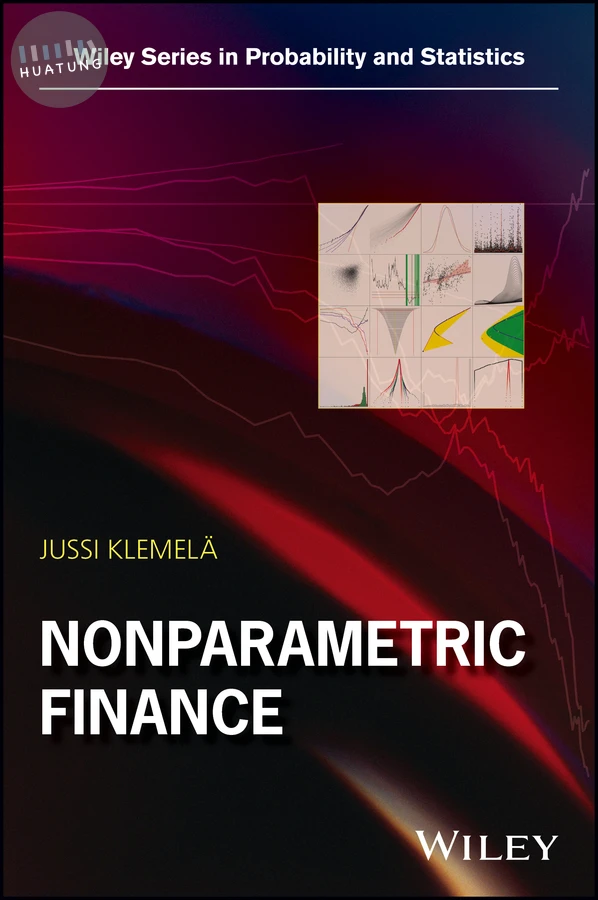
Nonparametric Finance
$4338元 定價: $4820 9折 可訂購
簡介
An Introduction to Machine Learning in Finance, With Mathematical Background, Data Visualization, and R
Nonparametric function estimation is an important part of machine learning, which is becoming increasingly important in quantitative finance. Nonparametric Finance provides graduate students and finance professionals with a foundation in nonparametric function
estimation and the underlying mathematics. Combining practical applications, mathematically rigorous presentation, and statistical data analysis into a single volume, this book presents detailed instruction in discrete chapters that allow readers to dip in as needed without reading from beginning to end.
Coverage includes statistical finance, risk management, portfolio management, and securities pricing to provide a practical knowledge base, and the introductory chapter introduces basic finance concepts for readers with a strictly mathematical background. Economic significance
is emphasized over statistical significance throughout, and R code is provided to help readers reproduce the research, computations, and figures being discussed. Strong graphical content clarifies the methods and demonstrates essential visualization techniques, while deep mathematical and statistical insight backs up practical applications.
Written for the leading edge of finance, Nonparametric Finance:
• Introduces basic statistical finance concepts, including univariate and multivariate data analysis, time series analysis, and prediction
• Provides risk management guidance through volatility prediction, quantiles, and value-at-risk
• Examines portfolio theory, performance measurement, Markowitz portfolios, dynamic portfolio selection, and more
• Discusses fundamental theorems of asset pricing, Black-Scholes pricing and hedging, quadratic pricing and hedging, option portfolios, interest rate derivatives, and other asset pricing principles
• Provides supplementary R code and numerous graphics to reinforce complex content
Nonparametric function estimation has received little attention in the context of risk management and option pricing, despite its useful applications and benefits. This book provides the essential background and practical knowledge needed to take full advantage of these little-used methods, and turn them into real-world advantage.
Jussi Klemelä, PhD, is Adjunct Professor at the University of Oulu. His research interests include nonparametric function estimation, density estimation, and data visualization. He is the author of Smoothing of Multivariate Data: Density Estimation and Visualization and Multivariate Nonparametric Regression and Visualization: With R and Applications to Finance.
目錄
Preface xiii
1 Introduction 1
1.1 Statistical Finance 2
1.2 Risk Management 3
1.3 Portfolio Management 5
1.4 Pricing of Securities 6
Part I Statistical Finance 11
2 Financial Instruments 13
2.1 Stocks 13
2.1.1 Stock Indexes 14
2.1.2 Stock Prices and Returns 15
2.2 Fixed Income Instruments 19
2.2.1 Bonds 19
2.2.2 Interest Rates 20
2.2.3 Bond Prices and Returns 22
2.3 Derivatives 23
2.3.1 Forwards and Futures 23
2.3.2 Options 24
2.4 Data Sets 27
2.4.1 Daily S&P 500 Data 27
2.4.2 Daily S&P 500 and Nasdaq-100 Data 28
2.4.3 Monthly S&P 500, Bond, and Bill Data 28
2.4.4 Daily US Treasury 10 Year Bond Data 29
2.4.5 Daily S&P 500 Components Data 30
3 Univariate Data Analysis 33
3.1 Univariate Statistics 34
3.1.1 The Center of a Distribution 34
3.1.2 The Variance and Moments 37
3.1.3 The Quantiles and the Expected Shortfalls 40
3.2 Univariate Graphical Tools 42
3.2.1 Empirical Distribution Function Based Tools 43
3.2.2 Density Estimation Based Tools 53
3.3 Univariate Parametric Models 55
3.3.1 The Normal and Log-normal Models 55
3.3.2 The Student Distributions 59
3.4 Tail Modeling 61
3.4.1 Modeling and Estimating Excess Distributions 62
3.4.2 Parametric Families for Excess Distributions 65
3.4.3 Fitting the Models to Return Data 74
3.5 Asymptotic Distributions 83
3.5.1 The Central Limit Theorems 84
3.5.2 The Limit Theorems for Maxima 88
3.6 Univariate Stylized Facts 91
4 Multivariate Data Analysis 95
4.1 Measures of Dependence 95
4.1.1 Correlation Coefficients 97
4.1.2 Coefficients of Tail Dependence 101
4.2 Multivariate Graphical Tools 103
4.2.1 Scatter Plots 103
4.2.2 Correlation Matrix: Multidimensional Scaling 104
4.3 Multivariate Parametric Models 107
4.3.1 Multivariate Gaussian Distributions 107
4.3.2 Multivariate Student Distributions 107
4.3.3 Normal Variance Mixture Distributions 108
4.3.4 Elliptical Distributions 110
4.4 Copulas 111
4.4.1 Standard Copulas 111
4.4.2 Nonstandard Copulas 112
4.4.3 Sampling from a Copula 113
4.4.4 Examples of Copulas 116
5 Time Series Analysis 121
5.1 Stationarity and Autocorrelation 122
5.1.1 Strict Stationarity 122
5.1.2 Covariance Stationarity and Autocorrelation 126
5.2 Model Free Estimation 128
5.2.1 Descriptive Statistics for Time Series 129
5.2.2 Markov Models 129
5.2.3 Time Varying Parameter 130
5.3 Univariate Time Series Models 135
5.3.1 Prediction and Conditional Expectation 135
5.3.2 ARMA Processes 136
5.3.3 Conditional Heteroskedasticity Models 143
5.3.4 Continuous Time Processes 154
5.4 Multivariate Time Series Models 157
5.4.1 MGARCH Models 157
5.4.2 Covariance in MGARCH Models 159
5.5 Time Series Stylized Facts 160
6 Prediction 163
6.1 Methods of Prediction 164
6.1.1 Moving Average Predictors 164
6.1.2 State Space Predictors 166
6.2 Forecast Evaluation 170
6.2.1 The Sum of Squared Prediction Errors 170
6.2.2 Testing the Prediction Accuracy 172
6.3 Predictive Variables 175
6.3.1 Risk Indicators 175
6.3.2 Interest Rate Variables 177
6.3.3 Stock Market Indicators 178
6.3.4 Sentiment Indicators 180
6.3.5 Technical Indicators 180
6.4 Asset Return Prediction 182
6.4.1 Prediction of S&P 500 Returns 184
6.4.2 Prediction of 10-Year Bond Returns 187
Part II Risk Management 193
7 Volatility Prediction 195
7.1 Applications of Volatility Prediction 197
7.1.1 Variance and Volatility Trading 197
7.1.2 Covariance Trading 197
7.1.3 Quantile Estimation 198
7.1.4 Portfolio Selection 199
7.1.5 Option Pricing 199
7.2 Performance Measures for Volatility Predictors 199
7.3 Conditional Heteroskedasticity Models 200
7.3.1 GARCH Predictor 200
7.3.2 ARCH Predictor 203
7.4 Moving Average Methods 205
7.4.1 Sequential Sample Variance 205
7.4.2 Exponentially Weighted Moving Average 207
7.5 State Space Predictors 211
7.5.1 Linear Regression Predictor 212
7.5.2 Kernel Regression Predictor 214
8 Quantiles and Value-at-Risk 219
8.1 Definitions of Quantiles 220
8.2 Applications of Quantiles 223
8.2.1 Reserve Capital 223
8.2.2 Margin Requirements 225
8.2.3 Quantiles as a Risk Measure 226
8.3 Performance Measures for Quantile Estimators 227
8.3.1 Measuring the Probability of Exceedances 228
8.3.2 A Loss Function for Quantile Estimation 231
8.4 Nonparametric Estimators of Quantiles 233
8.4.1 Empirical Quantiles 234
8.4.2 Conditional Empirical Quantiles 238
8.5 Volatility Based Quantile Estimation 240
8.5.1 Location–Scale Model 240
8.5.2 Conditional Location–Scale Model 245
8.6 Excess Distributions in Quantile Estimation 258
8.6.1 The Excess Distributions 259
8.6.2 Unconditional Quantile Estimation 261
8.6.3 Conditional Quantile Estimators 269
8.7 Extreme Value Theory in Quantile Estimation 288
8.7.1 The Block Maxima Method 288
8.7.2 Threshold Exceedances 289
8.8 Expected Shortfall 292
8.8.1 Performance of Estimators of the Expected Shortfall 292
8.8.2 Estimation of the Expected Shortfall 293
Part III Portfolio Management 297
9 Some Basic Concepts of Portfolio Theory 299
9.1 Portfolios and Their Returns 300
9.1.1 Trading Strategies 300
9.1.2 The Wealth and Return in the One- Period Model 301
9.1.3 The Wealth Process in the Multiperiod Model 304
9.1.4 Examples of Portfolios 306
9.2 Comparison of Return and Wealth Distributions 312
9.2.1 Mean–Variance Preferences 313
9.2.2 Expected Utility 316
9.2.3 Stochastic Dominance 325
9.3 Multiperiod Portfolio Selection 326
9.3.1 One-Period Optimization 328
9.3.2 The Multiperiod Optimization 329
10 Performance Measurement 337
10.1 The Sharpe Ratio 338
10.1.1 Definition of the Sharpe Ratio 338
10.1.2 Confidence Intervals for the Sharpe Ratio 340
10.1.3 Testing the Sharpe Ratio 343
10.1.4 Other Measures of Risk-Adjusted Return 345
10.2 Certainty Equivalent 346
10.3 Drawdown 347
10.4 Alpha and Conditional Alpha 348
10.4.1 Alpha 349
10.4.2 Conditional Alpha 355
10.5 Graphical Tools of Performance Measurement 356
10.5.1 Using Wealth in Evaluation 356
10.5.2 Using the Sharpe Ratio in Evaluation 359
10.5.3 Using the Certainty Equivalent in Evaluation 364
11 Markowitz Portfolios 367
11.1 Variance Penalized Expected Return 369
11.1.1 Variance Penalization with the Risk-Free Rate 369
11.1.2 Variance Penalization without the Risk-Free Rate 371
11.2 Minimizing Variance under a Sufficient Expected Return 372
11.2.1 Minimizing Variance with the Risk-Free Rate 372
11.2.2 Minimizing Variance without the Risk-Free Rate 374
11.3 Markowitz Bullets 375
11.4 Further Topics in Markowitz Portfolio Selection 380
11.4.1 Estimation 380
11.4.2 Penalizing Techniques 381
11.4.3 Principal Components Analysis 382
11.5 Examples of Markowitz Portfolio Selection 383
12 Dynamic Portfolio Selection 385
12.1 Prediction in Dynamic Portfolio Selection 387
12.1.1 Expected Returns in Dynamic Portfolio Selection 387
12.1.2 Markowitz Criterion in Dynamic Portfolio Selection 390
12.1.3 Expected Utility in Dynamic Portfolio Selection 391
12.2 Backtesting Trading Strategies 393
12.3 One Risky Asset 394
12.3.1 Using Expected Returns with One Risky Asset 394
12.3.2 Markowitz Portfolios with One Risky Asset 401
12.4 Two Risky Assets 405
12.4.1 Using Expected Returns with Two Risky Assets 405
12.4.2 Markowitz Portfolios with Two Risky Assets 409
Part IV Pricing of Securities 419
13 Principles of Asset Pricing 421
13.1 Introduction to Asset Pricing 422
13.1.1 Absolute Pricing 423
13.1.2 Relative Pricing Using Arbitrage 424
13.1.3 Relative Pricing Using Statistical Arbitrage 428
13.2 Fundamental Theorems of Asset Pricing 430
13.2.1 Discrete Time Markets 431
13.2.2 Wealth and Value Processes 432
13.2.3 Arbitrage and Martingale Measures 436
13.2.4 European Contingent Claims 448
13.2.5 Completeness 451
13.2.6 American Contingent Claims 454
13.3 Evaluation of Pricing and Hedging Methods 456
13.3.1 The Wealth of the Seller 456
13.3.2 The Wealth of the Buyer 458
14 Pricing by Arbitrage 459
14.1 Futures and the Put–Call Parity 460
14.1.1 Futures 460
14.1.2 The Put–Call Parity 464
14.1.3 American Call Options 465
14.2 Pricing in Binary Models 466
14.2.1 The One-Period Binary Model 467
14.2.2 The Multiperiod Binary Model 470
14.2.3 Asymptotics of the Multiperiod Binary Model 475
14.2.4 American Put Options 484
14.3 Black–Scholes Pricing 485
14.3.1 Call and Put Prices 485
14.3.2 Implied Volatilities 495
14.3.3 Derivations of the Black–Scholes Prices 498
14.3.4 Examples of Pricing Using the Black–Scholes Model 501
14.4 Black–Scholes Hedging 505
14.4.1 Hedging Errors: Nonsequential Volatility Estimation 506
14.4.2 Hedging Frequency 508
14.4.3 Hedging and Strike Price 511
14.4.4 Hedging and Expected Return 512
14.4.5 Hedging and Volatility 514
14.5 Black–Scholes Hedging and Volatility Estimation 515
14.5.1 Hedging Errors: Sequential Volatility Estimation 515
14.5.2 Distribution of Hedging Errors 517
15 Pricing in Incomplete Models 521
15.1 Quadratic Hedging and Pricing 522
15.2 Utility Maximization 523
15.2.1 The Exponential Utility 524
15.2.2 Other Utility Functions 525
15.2.3 Relative Entropy 526
15.2.4 Examples of Esscher Prices 527
15.2.5 Marginal Rate of Substitution 529
15.3 Absolutely Continuous Changes of Measures 530
15.3.1 Conditionally Gaussian Returns 530
15.3.2 Conditionally Gaussian Logarithmic Returns 532
15.4 GARCH Market Models 534
15.4.1 Heston–Nandi Method 535
15.4.2 The Monte Carlo Method 539
15.4.3 Comparison of Risk-Neutral Densities 541
15.5 Nonparametric Pricing Using Historical Simulation 545
15.5.1 Prices 545
15.5.2 Hedging Coefficients 548
15.6 Estimation of the Risk-Neutral Density 551
15.6.1 Deducing the Risk-Neutral Density from Market Prices 552
15.6.2 Examples of Estimation of the Risk-Neutral Density 552
15.7 Quantile Hedging 554
16 Quadratic and Local Quadratic Hedging 557
16.1 Quadratic Hedging 558
16.1.1 Definitions and Assumptions 559
16.1.2 The One Period Model 562
16.1.3 The Two Period Model 569
16.1.4 The Multiperiod Model 575
16.2 Local Quadratic Hedging 583
16.2.1 The Two Period Model 583
16.2.2 The Multiperiod Model 587
16.2.3 Local Quadratic Hedging without Self-Financing 593
16.3 Implementations of Local Quadratic Hedging 595
16.3.1 Historical Simulation 596
16.3.2 Local Quadratic Hedging Under Independence 599
16.3.3 Local Quadratic Hedging under Dependence 604
16.3.4 Evaluation of Quadratic Hedging 610
17 Option Strategies 615
17.1 Option Strategies 616
17.1.1 Calls, Puts, and Vertical Spreads 616
17.1.2 Strangles, Straddles, Butterflies, and Condors 619
17.1.3 Calendar Spreads 621
17.1.4 Combining Options with Stocks and Bonds 623
17.2 Profitability of Option Strategies 625
17.2.1 Return Functions of Option Strategies 626
17.2.2 Return Distributions of Option Strategies 634
17.2.3 Performance Measurement of Option Strategies 644
18 Interest Rate Derivatives 649
18.1 Basic Concepts of Interest Rate Derivatives 650
18.1.1 Interest Rates and a Bank Account 651
18.1.2 Zero-Coupon Bonds 653
18.1.3 Coupon-Bearing Bonds 656
18.2 InterestRateForwards 659
18.2.1 Forward Zero-Coupon Bonds 659
18.2.2 Forward Rate Agreements 661
18.2.3 Swaps 663
18.2.4 Related Fixed Income Instruments 665
18.3 Interest Rate Options 666
18.3.1 Caplets and Floorlets 666
18.3.2 Caps and Floors 668
18.3.3 Swaptions 668
18.4 Modeling Interest Rate Markets 669
18.4.1 HJM Model 670
18.4.2 Short-Rate Models 671
References 673
Index 681