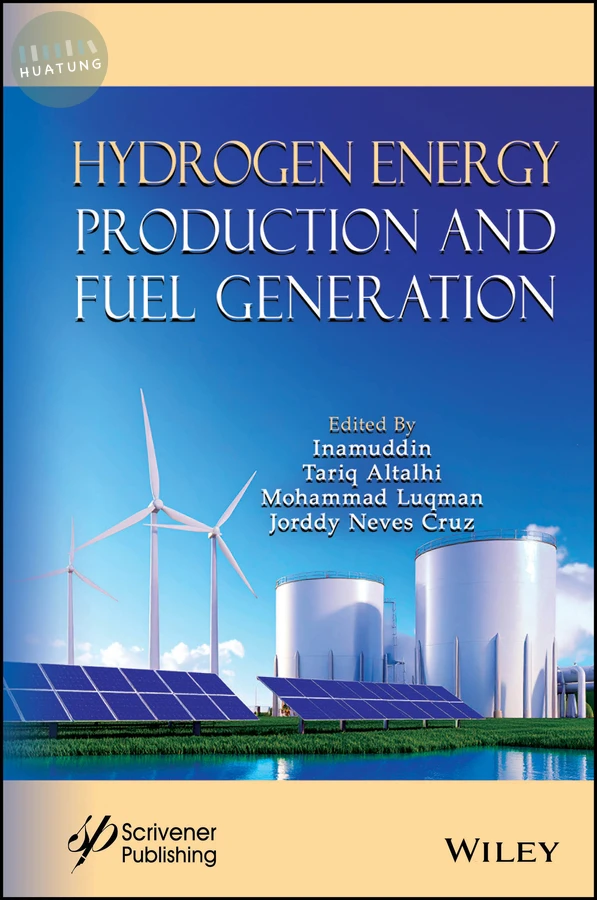

Hydrogen Energy Production and Fuel Generation
$7600元 定價: $8444 9折 可訂購
簡介
Invest in the future of the planet by delving into this comprehensive guide on hydrogen energy, a critical solution for sustainable power, and gain the knowledge to contribute to this revolutionary field. Hydrogen energy has emerged as one of the most promising solutions to the energy and environmental challenges of the 21st century. As we look for sustainable and clean alternatives to replace fossil fuels, hydrogen stands out not only for its abundance but also for its potential to revolutionize diverse sectors such as transport, industry, and energy generation. However, for this revolution to become a reality, a comprehensive and interdisciplinary understanding of the technologies and methods related to the production, storage, distribution, and utilization of hydrogen is essential. The subject of hydrogen energy production and fuel generation is closely linked to the broader goals of sustainability, energy transition, and climate change mitigation. The development of efficient and cost-effective methods to produce hydrogen from renewable sources, such as electrolysis powered by renewable electricity, contributes to the shift towards a green energy economy. Additionally, the integration of hydrogen with renewable energy systems enables the storage and utilization of intermittent renewable sources, enhancing the reliability and stability of the grid. This book encompasses principles and advancements in chemistry, physics, materials science, engineering, and environmental sciences. This interdisciplinary approach fosters collaboration and knowledge exchange, leading to breakthroughs in hydrogen production, storage, and utilization. In terms of industry development, the book addresses the growing demand for alternative energy sources in sectors such as transportation, industry, and power generation. As the world moves towards decarbonization and reducing reliance on fossil fuels, hydrogen has emerged as a promising solution due to its high energy density and potential for zero-emission operations. The book explores the practical applications of hydrogen energy, including fuel cell vehicles, hydrogen-powered industrial processes, and integrated energy systems. By addressing this comprehensive context, the book serves as a valuable resource for researchers, professionals, and policymakers seeking to understand and contribute to the advancement of this critical field.
目錄
Preface xxiii
1 Introduction to the Hydrogen Energy Production and Fuel Generation 1
Gazi Farhan Ishraque Toki and M. Khalid Hossain
1.1 Introduction 2
1.2 Hydrogen, Types, and Its Properties 4
1.3 Hydrogen Production Methods 6
1.4 H2 Storage Approaches 12
1.5 Transportation and Distribution of Hydrogen 17
1.6 Applications of Hydrogen Fuel 21
1.7 Future Outlook and Challenges 23
1.8 Conclusion 27
2 Solar-Driven Water Splitting for Hydrogen Production 37
Leena V. Bora, Ritul Tiwari, Ananya Singh and Nisha V. Bora
2.1 Introduction 37
2.2 Water Splitting Techniques Driven by Solar Energy 38
2.3 Recent Advancements 53
2.4 Market Perspective and Demand 55
2.5 Challenges 56
2.6 Conclusions 56
3 Advances in Catalysts and Materials for Hydrogen Production 63
Adriana Marizcal-Barba, Karina Nava-Andrade, Suresh Ghotekar, Mamoun Fellah and Alejandro Pérez-Larios
4 Dark Fermentation: The Path to an Economically and Environmentally Viable Energy Source 95
Ballesteros-Lopez, M.E., Rodríguez-Villa, A.G., Cruz-Salas, A.A., Alvarez-Zeferino J.C., Galicia-Piedra, M.L. and Hernández-Soriano, A.I.
4.1 Introduction 96
4.2 Dark Fermentation (DF) 96
4.3 Energy Comparison of BioH2 with Other Energy Sources 106
4.4 Perspectives 110
4.5 Final Comments 114
5 Metal Hydrides for Hydrogen Storage 121
Urwa Muaaz, Syed Ali Raza Naqvi, Tauqir A. Sherazi, Sadaf Ul Hassan, Naseem Abbas, Mazhar Hussain, Muhammad Rehan Hasan ShahGilani, Mahreen Imam and Aisha Yasin
5.1 Introduction 122
5.2 Metal Hydrides 123
5.3 Classes of Metal Hydrides 124
5.4 Techniques that Generate Nanoscale or Nanocrystalline Metal Hydrides 133
5.5 Morphological Effects on the Characteristics of Hydrogen Storage 137
5.6 Hydrogen Storage Tank 144
5.7 Comparison between H2 Storage Alternatives 146
5.8 Material Properties and Application Requirements 147
6 Solid-State Hydrogen Storage Materials 161
K.R. Hariprasath, M. Priyadharshini, P. Balaji and T. Pazhanivel
6.1 Introduction 161
6.2 Hydrogen as Fuel 163\
6.3 Hydrogen Storage Techniques 165
6.4 Physically Bound Hydrogen Storage 168
6.5 Chemically Bound Hydrogen Storage 170
6.6 Carbonaceous Materials for Hydrogen Storage 172
6.7 Non-Carbonaceous Materials for Hydrogen Storage 175
6.8 The Adsorption Models for Hydrogen Storage 177
6.9 Application for Energy Storage and Conversion 179
6.10 Challenges and Future Prospects 182
6.11 Conclusion 185
7 Nanomaterials for Hydrogen Storage 189
Aisha Yasin, Syed Ali Raza Naqvi, Tauqir A. Sherazi, Sadaf Ul Hassan, Muhammad Ramzan Saeed Ashraf Janjua, Muhammad Rehan Hasan Shah Gilani, Naseem Abbas, Mazhar Hussain and Urwa Muaaz
7.1 Introduction 190
7.2 Thermodynamics and Kinetics of Hydrogen Storage 191
7.3 Strategies for Enhanced Hydrogen Storage Capacity 193
7.4 Nanostructuring 195
7.5 Methods for Hydrogen Storage 198
7.6 Carbon Nanomaterials 200
7.7 Nano-Objects with a Composite Architecture 203
7.8 Metal and Metal Oxide Nanoparticles 208
7.9 Metal Hydride Nanoparticles 210
7.10 Conclusion and Future Outlook 214
8 Carbon-Based Materials for Hydrogen Storage 221
Ahmad Hussain, Nawishta Jabeen, Tafheem ul Haq and Masooma Zahra
8.1 Introduction 222
8.2 Hydrogen as a Green Energy System 224
8.3 Hydrogen Storage Carbon-Based Materials 226
8.4 Mechanism of Hydrogen Adsorption 232
8.5 Factors Affecting the Hydrogen Storage on Carbon-Based Materials 237
8.6 Hydrogen for Energy Application 240
8.7 Challenges and Future Perspectives 241
8.8 Conclusion 242
9 Composite Materials for Hydrogen Storage 247
Serkan Baslayici, Mehmet Bugdayci, Ozan Coban and Candeniz Uysal
9.1 Introduction 248
9.2 The Importance of Hydrogen for Energy Storage 248
9.3 Hydrogen Storage Methods 250
9.4 The Role of Composite Materials in Hydrogen Storage 255
9.5 Design and Structure of Composite Materials 257
9.6 Hydrogen Storage Performance and Analysis 259
10 Properties and Characteristics of Hydrogen 269
Vyacheslav S. Protsenko and Alexander B. Velichenko
10.1 Short History of Discovery and Utilization of Hydrogen 269
10.2 Occurrence of Hydrogen in Nature 272\
10.3 Hydrogen Atom 273
10.4 Hydrogen Molecule 274
10.5 Parahydrogen and Orthohydrogen 275
10.6 Hydrogen Isotopes 276
10.7 Physical Properties of Hydrogen 277
10.8 Chemical and Electrochemical Properties of Hydrogen 278
10.9 Different Colors of Hydrogen 281
10.10 Conclusions 284
11 Technological Innovations and Research Frontiers in Hydrogen Energy 289
Charles Rashama, Clemence Kudakwashe Simende and Wilfred Chipangura
11.1 Introduction 289
11.2 Innovations in Hydrogen Production Technologies 291
11.3 Innovations in Hydrogen’s Energy Applications 298\
11.4 Research in Hydrogen Energy 300
11.5 Future Perspectives on Hydrogen Energy 311
12 Organic Hydrides for Hydrogen Storage 317
Melkamu Biyana Regasa and Shibiru Yadeta Ejeta
12.1 Introduction 318
12.2 Importance and Sources of Hydrogen 319\
12.3 Importance of Hydrogen Energy 320
12.4 Methods for Clean Hydrogen Production 321
12.5 Methods of Storing Hydrogen Energy 322
12.6 Organic Hydrides 324
12.7 Requirements for Hydrogen Chemical Storage 326
12.8 Application of Organic Hydrides in Hydrogen Storage 327
12.9 Comparison of Organic Hydrides and Metal-Organic Hydrides 332
12.10 Conclusions and Future Perspectives 333
13 Microbial Electrolysis for Hydrogen Generation 341
Figen Balo and Lutfu S. Sua
13.1 Introduction 342
13.2 Design of Microbial Electrolysis Cells 347
13.3 AHP Analysis 353
13.4 Conclusions 366
14 Hydrogen in Power Generation: Fuel Cells and Combustion 373
Muthudineshkumar Ramaswamy, Vinoth Thangarasu, C. Ponmurugan Muthusamy, S. Jaisankar, T. Balamurugan, K. Manoj Prabhakar, Santhoshkumar and Gnana Sagaya Raj
14.1 Introduction 374
14.2 Hydrogen Utilization in the Power Generation Sector 380
14.3 Hydrogen Utilization in Transportation Sector 383
14.4 Conclusions and Future Research Outlook 384
15 Thermophilic Bacteria for Biohydrogen Production 389
Chun Yuan Tan and Adeline Su Yien Ting
15.1 Introduction 390
15.2 Diversity of Thermophilic Bio-H2 Producers 392
15.3 Significance of Thermophilic Isolates in Bio-H2 Production 404
15.4 Processing Conditions and Technological Advances that Influence Bio-H2 Yield 410
15.5 Conclusion 415
16 Economic Viability and Market Potential of Hydrogen Energy 427
Muthudineshkumar Ramaswamy, S. Jaisankar, R. Karthikeyan, P. Arunachalam, P. Rajasekaran, Vinoth Thangarasu, C. Ponmurugan Muthusamy and K. Sobha
16.1 Introduction 428
16.2 Hydrogen Energy and Transition of Fuel Cell 433
16.3 Economic and Environmental Impacts 434
16.4 Future Scope 437
16.5 Conclusion 437
17 Methods for Hydrogen Energy Production and Fuel Generation 441
Mukilarasan Nedunchezhiyan, Ravikumar Jayabal, Sathiyamoorthy Ramalingam and Jayabalan Chelladurai
17.1 An Overview of Massive Amounts of Hydrogen Production 442
17.2 Fuel Cell 447
17.3 Hydrogen as a Fuel 448
17.4 Environmental Impact of Hydrogen Fuel 451
17.5 Conclusion 453
18 Infrastructure and Distribution Challenges for Hydrogen Energy 457
Vimalananth V. T., Gnanamoorthi V., Jayabalan C., Muthudineshkumar Ramaswamy, N. Mukilarasan and P. Prasannaa
18.1 Introduction 458
18.2 Hydrogen Energy Overview 458
18.3 Infrastructure Challenges on Hydrogen Energy 460
18.4 Distribution Challenges 463
18.5 Technological Hurdles 464
18.6 Regulatory and Policy Challenges 465
18.7 Future Outlook 466
18.8 Conclusion 468
19 Liquid Organic Hydrogen Carriers (LOHCs) 473
Devaraj Naik Bukke, Muthudineshkumar Ramaswamy, Vinoth Thangarasu and Santhoshkumar Annamalai
19.1 Introduction 474
19.2 Concepts and Development 475
19.3 Hydrogenation and Dehydrogenation Processes 475
19.4 Advantages of LOHCs 477
19.5 Disadvantages of LOHCs 478
19.6 Safety Issues in Liquid Organic Hydrogen Carriers 479
19.7 Application of Liquid Organic Hydrogen Carriers (LOHCs) 482
19.8 Conclusions 486
20 Grid-Scale Hydrogen Energy Systems Projects and Implementation 489
Chinmay Deheri, Binayak Pattanayak, Abinash Mahapatro and Saroj Kumar Acharya
20.1 Introduction 490
20.2 Different Applications of Hydrogen in the Energy Sector 494
20.3 Green Hydrogen Production 495
20.4 Re-Electrification of Hydrogen Energy 498
20.5 Projects and Implementation 500
20.6 Conclusion 503
21 Hydrogen in Industrial Processes 509
Guocai Tian
21.1 Introduction 510
21.2 Preparation, Storage, and Transportation of Hydrogen 511
21.3 The Application of Hydrogen in the Metallurgical Industry 520
21.4 Hydrogen Application in the Petroleum and Chemical Industry 563
21.5 Main Constraints of Large-Scale Industrial Application of Green Hydrogen 586
21.6 Future Path and Strategy of Green Hydrogen in the Industrial Field 587
Acknowledgment 588
References 588
Index 605