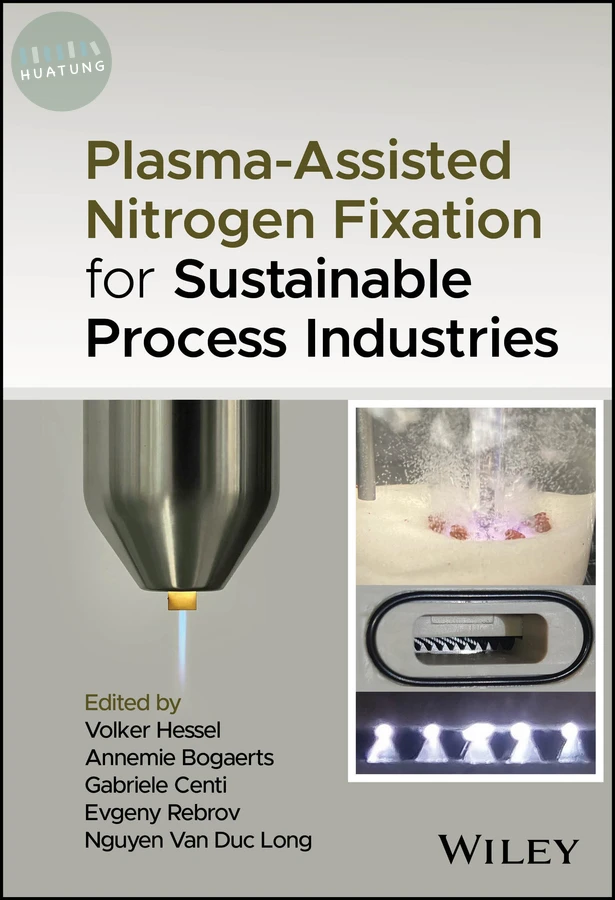
Plasma-Assisted Nitrogen Fixation for Sustainable Process Industries
$6143元 定價: $6826 9折 可訂購
簡介
Enables readers to use plasma technology in the ammonia and NOx production process for greater efficiency, resiliency, and sustainability Bridging the gap between chemistry, physics, and engineering, Plasma-Assisted Nitrogen Fixation for Sustainable Process Industries provides in-depth insights into plasma-assisted nitrogen fixation, plasma technology, plasma reactors, and ammonia and NOx production, covering fundamental principles, advanced topics, economic viability, and emerging trends. Real-world applications and case studies are included throughout to elucidate key concepts and help readers put theory into practice in order to increase efficiency, sustainability, and industrial resilience. Plasma-Assisted Nitrogen Fixation for Sustainable Process Industries discusses: Reactor designs and industrial feasibility, including decentralized production to make nitrogen fixation accessible to remote areas and smaller-scale operations
The Haber-Bosch process and its limitations and alternatives and plasma generation, ionization, and applications
Plasma-assisted NOx synthesis with a focus on reaction pathways, energy efficiency, and the role of catalysts
Cutting-edge innovations such as microplasma technology, plasma-liquid interactions for nitrogen fixation, and plasma-electrochemistry for nitrate-to-ammonia conversion
Plasma-based fertilizer applications and analytical methods in plasma diagnostics as a tool to enable innovation
Plasma-Assisted Nitrogen Fixation for Sustainable Process Industries is an essential reference on the subject for engineers, plant managers, and decision-makers seeking to optimize their ammonia and NOx manufacturing processes.
目錄
About the Editors xiii
List of Contributors xv
Preface xxi
Part I Fundamentals of Nitrogen Fixation 1
1 Fundamentals of Ammonia Production 3
Kevin Rouwenhorst and Leon Lefferts
1.1 Introduction to Nitrogen Fixation 3
1.2 The Haber-Bosch Process 4
1.3 Production Pathways to Ammonia 5
1.4 Novel Methods for Ammonia Synthesis 9
1.5 Applications of Ammonia 11
1.6 Conclusions 14
References 14
2 Fundamentals of No X Production 21
Filippo Buttignol, Alberto Garbujo, Raffaele Ostuni, Michal Bialkowski, and Pierdomenico Biasi
2.1 Introduction 21
2.2 The Ostwald Process 22
2.2.1 Catalytic Oxidation of Ammonia 22
2.2.1.1 Reaction Mechanism and Kinetics 23
2.2.1.2 Reaction Engineering and Parameter Effect 24
2.2.1.3 Catalyst: Pt and New Development 25
2.2.2 NO Oxidation to NO 2 27
2.2.2.1 Reaction Mechanism and Kinetics 28
2.2.2.2 Process Implementation Exploiting the Catalytic Oxidation of NO 29
2.2.3 Nitrogen Oxides Absorption and HNO 3 Production 30
2.3 Type of Processes 32
2.3.1 Weak Nitric Acid 32
2.3.1.1 General Process Description 35
2.3.2 Concentrated Nitric Acid 35
2.4 Environmental Protection and Treatment of Exhaust Gases 37
2.4.1 Control of No X Emissions 38
2.4.2 Control of N 2 O Emissions 41
2.4.2.1 Primary Measures 41
2.4.2.2 Secondary Measures 42
2.4.2.3 Ternary Measures 42
2.5 Future Trends 46
2.6 Conclusions 47
References 48
Part II Plasma-Assisted Nitrogen Fixation 51
3 Introduction to Plasma Technology 53
Anthony B. Murphy
3.1 Fundamental Concepts 53
3.1.1 Types of Plasma 53
3.1.2 Scaling Parameters 54
3.2 Plasma Generation 58
3.3 Plasma Chemistry 62
3.3.1 Inelastic Collisions Between Electrons and Heavy Particles 62
3.3.2 Inelastic Collisions Between Heavy Particles 64
3.3.3 Equilibrium in Plasmas 66
3.4 Plasma Technology 68
3.4.1 Low-Pressure Plasma Applications 69
3.4.2 Non-equilibrium Atmospheric-Pressure Plasma Applications 70
3.4.3 Thermal Plasma Applications 74
3.5 Role of Plasma in Ammonia and No X Synthesis 77
3.6 Conclusions 79
References 81
4 Plasma Reactors 85
Evgeny Rebrov
4.1 Introduction 85
4.2 Microwave and RF Plasma 87
4.2.1 Microwave Plasma Torch 87
4.2.2 Surfaguide-Type Discharge 90
4.2.3 RF Plasma Torch 92
4.3 Spark and High-frequency Pulsed Discharges 94
4.4 Gliding Arc 95
4.5 Propeller Arc 100
4.6 Glow Discharge 102
4.6.1 Triboelectric Nanogenerator 103
4.7 Dielectric Barrier Discharge 105
4.7.1 Micro-DBD Reactors 105
4.7.2 DBD Reactors for N 2 /Water Plasma 107
4.8 Conclusions and Outlook 109
References 111
5 Plasma-Assisted Ammonia Synthesis 119
Mateo Ruiz-Martín, Adrián Megías-Sánchez, Servando Marín-Meana, Manuel Oliva-Ramírez, Agustín R. González-Elipe, and Ana Gómez-Ramírez
5.1 Introduction 119
5.2 Advanced Plasma Technologies for Ammonia Synthesis 120
5.2.1 Ammonia Synthesis Reactions and Plasma Types 121
5.2.1.1 MW Reactions 122
5.2.1.2 RF Discharge Reactions 122
5.2.1.3 Plasma-Electrochemistry 123
5.2.1.4 Gliding Arc Reactions 123
5.2.2 Effects of Plasma Reactor Operational Conditions 124
5.2.2.1 Carrier Gas 127
5.2.2.2 Gases Proportion 127
5.2.2.3 Residence Time and Gas Flow Regime 127
5.2.2.4 Driving Voltage and Frequency 128
5.2.2.5 Barrier Materials and Catalysts 128
5.3 Plasma-Catalysis of Ammonia: Seeking Synergies to Improving Energy Efficiency 129
5.3.1 Plasma-Catalysis: A Brief Introduction 129
5.3.2 Barrier Materials and Catalysts in Packed-Bed Plasma Reactors for NH 3 Synthesis 131
5.3.2.1 Barrier Materials 131
5.3.2.2 Catalyst: Active Phase and Support 132
5.3.3 New Paradigms in Plasma-Catalysis for Ammonia Synthesis 136
5.4 Conclusions 138
References 140
6 Plasma-assisted No X Synthesis 147
Tianyu Li, Haoxuan Jiang, Rusen Zhou, Jing Sun, and Renwu Zhou
6.1 Introduction 147
6.2 The Mechanism of Plasma-Assisted Nitrogen Oxidation 151
6.3 Nitrogen Oxidation Achieved by Different Types of Plasma 156
6.4 Plasma–Water-Based Nitrogen Fixation 163
6.5 Conclusion and Outlook 168
References 170
Part III Mechanisms of Nitrogen Fixation 181
7 Ammonia Synthesis with Plasma Catalysis: Mechanisms 183
Kevin Rouwenhorst and Leon Lefferts
7.1 Introduction 183
7.2 Methods to Study Mechanisms in Catalysis 183
7.3 Experimental Kinetics: From Catalysis to Plasma Catalysis 185
7.4 Beyond Equilibrium and Reverse Reactions 187
7.5 Effect of Catalyst on Plasma 189
7.6 Kinetics of Plasma-Catalytic Ammonia Synthesis 190
7.7 Mechanism of Plasma-Catalytic Ammonia Synthesis 191
7.7.1 Dominant Pathway: Catalytic Dissociation of Excited N 2
191
7.7.2 Dominant Pathway: N 2 Dissociation in Plasma 193
7.7.3 Surface Intermediate Species 194
7.7.4 Other Mechanisms 196
7.8 Energy Efficiency 196
7.9 Conclusions 198
References 199
8 Mechanisms of Plasma-driven No X Synthesis 203
Weitao Wang and Xin Tu
8.1 Introduction 203
8.2 No X Synthesis Without a Catalyst 204
8.2.1 Plasma Physics Relevant to No X Formation 204
8.2.2 Plasma Chemistry and Key Reaction Mechanisms 208
8.2.2.1 Electrons Induced Reactions 208
8.2.2.2 Formation and Loss Processes of NO and NO 2 208
8.2.2.3 The Key Role of the Zeldovich Mechanism 212
8.2.3 Factors Influencing Reaction Pathways 213
8.2.3.1 Impact of Plasma Types 213
8.2.3.2 Impact of Gas Composition 215
8.2.3.3 Impact of Pressure 217
8.2.3.4 Impact of Pulsed Discharge 218
8.2.4 Mechanistic Insights from Experimental Studies 221
8.3 Plasma-catalytic No X Synthesis 223
8.4 Conclusion and Outlook 228
References 230
Part IV Environmental and Economic Viability 237
9 Environmental Impact and Sustainability Aspects of Plasma-Based Nitrogen Fixation 239
Nam Nghiep Tran, Nguyen Van Duc Long, Muhammad Yousaf Arshad, Jose Luis Osorio Tejada, and Volker Hessel
9.1 Introduction 239
9.2 Environmental Benefits of PANF 241
9.2.1 Carbon Footprint Analysis 243
9.2.2 Comparison with the HB Process 244
9.2.3 Energy Efficiency and Consumption 245
9.2.4 Reduction in GHG Emissions 246
9.2.5 Integration with Renewable Energy Sources 246
9.3 Circular Economy Considerations 248
9.3.1 PANF Within the Circular Economy Model 249
9.3.2 Resource Utilization and Waste Minimization 249
9.3.3 Closed-Loop Systems and Recycling Opportunities 250
9.3.4 Decentralization via Small-Scale Production 252
9.4 Life Cycle Assessment 253
9.4.1 LCA of PANF: Overview 253
9.4.2 Benchmarking Against the HB Process 254
9.4.3 Environmental Impact Analysis (Including CO 2 Emissions and Pollutants) 255
9.5 Perspectives for Sustainable Plasma-Based Nitrogen Fixation 259
9.6 Conclusion and Outlook 260
References 261
10 Industrial Applications and Economic Viability of Plasma-Based Nitrogen Fixation 271
Magnus Nyvold and Rune Ingels
10.1 Introduction 271
10.2 Overview of The Reactive Nitrogen Industry 274
10.3 Conventional Nitrogen Fixation 275
10.3.1 Fossil-Based Ammonia Production 276
10.3.2 Electricity-Based Ammonia Production 278
10.3.3 Nitric Acid Production 279
10.3.4 Overall Performance of Nitrate Production 281
10.4 Plasma-Based Nitrate Production 281
10.4.1 Stand-alone Nitric Acid Process 283
10.4.2 Integrated Nitric Acid Process 284
10.4.3 Nitrate Enrichment of Organic Substrates 286
10.4.4 Other Avenues 288
10.5 Economic Comparison 289
10.6 Competitive Landscape 293
10.7 Conclusion 294
References 295
Part V Advanced Processes of Nitrogen Fixation 299
11 Microplasma for Nitrogen Fixation 301
Liangliang Lin
11.1 Introduction 301
11.2 Microplasma Configurations for Nitrogen Fixation 306
11.3 Microplasma-Based Process for Nitrogen Fixation 309
11.3.1 No X 309
11.3.2 Nh 3 313
11.3.3 Nitride, Carbonitride, and Oxynitride Nanomaterials 318
11.3.4 N-Doped Nanomaterials 320
11.4 Challenges and Perspectives for Microplasma Nitrogen Fixation 324
11.5 Conclusions 326
Acknowledgments 326
References 327
12 Plasma–Liquid Interaction for Nitrogen Fixation 337
Tianqi Zhang, Jungmi Hong, and Patrick Cullen
12.1 Introduction 337
12.2 Plasma Systems for Plasma–Liquid Discharges 338
12.3 Mechanisms of Nitrogen Fixation in Plasma–Liquid Systems 342
12.3.1 Physical Aspects of Plasma–Liquid Interactions 342
12.3.1.1 Breakdown Mechanism of Plasma–Liquid Discharges 342
12.3.1.2 Solvation of Plasma Species Through Plasma–Liquid Interface 345
12.3.2 Chemical Aspect of Plasma–Liquid Interactions 346
12.3.2.1 Effect of Water Content in Gas-Phase Plasma Discharge 347
12.3.2.2 Production and Loss of Short-lived Species in Liquid 348
12.3.2.3 Important Pathway of Long-lived Species Formation in Liquid 349
12.3.3 Mass Transport Through the Plasma–Liquid Interface 350
12.4 Key Challenges 351
12.4.1 Diagnostics 351
12.4.2 Modeling 353
12.5 Conclusion 355
References 356
13 Plasma Electrochemistry for Nitrogen Fixation 363
Susanta Bera, Dimitrios Zagoraios, and Mihalis N. Tsampas
13.1 Introduction 363
13.2 Motivation for Plasma-Enabled N 2 Oxidation Followed by Electrochemical Reduction 365
13.3 Conventional and Plasma-enabled No X Feedstock 367
13.4 Definition of Performance Metrics 367
13.5 Electrochemical Conversion of No X to Nh 3 – Eno X Rr 368
13.5.1 Electrochemical Conversion with No X in Liquid-phase Stream 370
13.5.2 Electrochemical Conversion with No X in Gas-phase Or Catholyte-Free Stream 373
13.5.3 Overview of the Eno X Rr Studies 374
13.6 Plasma-enabled Electrochemical Studies for No X Conversion To Nh 3 – Pnor-eno X Rr 375
13.6.1 Pnor-eno X Rr Integration Approaches 377
13.6.1.1 Liquid-phase-based Pnor-eno X Rr 377
13.6.1.2 Gas-phase-based Pnor-eno X Rr 378
13.6.2 Alternative Plasma Electrochemical Systems 378
13.6.3 Experimental Pnor-eno X Rr Studies 379
13.6.3.1 Gas-phase No X Generation 379
13.6.3.2 Liquid-phase No X Generation 380
13.6.4 Overview of Pnor-eno X Rr Systems 381
13.7 Implementation at Industrial Level 383
13.8 Key Challenges and Future Outlook 383
13.8.1 Electrochemical Systems 383
13.8.2 Operational Considerations 384
13.8.3 Product Separation 384
13.8.4 Scalability and Process Integration 385
13.9 Conclusions 385
References 386
14 Analytical Techniques for Plasma Catalysis 393
Christopher Hardacre, Sarayute Chansai, and Shanshan Xu
14.1 Optical Spectroscopy 393
14.1.1 Introduction 393
14.1.2 Experimental Setup 396
14.1.3 OES Spectrum and Interpretation for Ammonia Synthesis 397
14.1.4 OES Analysis and Proposed Reaction Mechanism for Ammonia Synthesis 400
14.1.5 OES Analysis for Plasma Dynamics 401
14.1.6 TDLAS Analysis for Plasma Dynamics and Kinetics 405
14.2 Infrared Spectroscopy 406
14.2.1 Introduction 406
14.2.2 In situ Plasma-IR/DRIFTS Cell Designs and Setups 408
14.2.3 In-plasma in Situ Drifts Analysis for No X Reduction 411
14.2.4 Post Plasma in situ IR Analysis for Ammonia Synthesis 411
14.3 Summary 413
References 416
15 Perspectives in Plasma-Based Nitrogen Fixation for Fertilizer Applications 423
Yury Gorbanev and Annemie Bogaerts
15.1 Nitrogen Compounds Used for Soil Fertilization 423
15.2 Fertilizer Production: Haber-Bosch-Ostwald Process and Plasma for Nitrogen Fixation 425
15.3 Metrics of Various Pathways of Plasma-Based Nitrogen Fixation 429
15.4 Perspectives of NH 4 NO 3 Production by Plasma-Based Nitrogen Fixation 434
15.4.1 Pathway Through NH 3 Synthesis: Plasma Reduction Followed by Oxidation 434
15.4.2 Pathway Through Both Nh 3 and No X Synthesis: Combined Plasma Reduction and Plasma Oxidation 435
15.4.3 Pathway Through No X Synthesis: Plasma Oxidation Followed by Reduction 436
15.5 Plasma-Based Nitrogen Fixation for Reduction of NH 3 Emissions and Simultaneous Fertilizer Production 438
15.6 Conclusion and Outlook: Challenges and Perspectives of Plasma-Based Nitrogen Fixation 439
References 441
Index 451