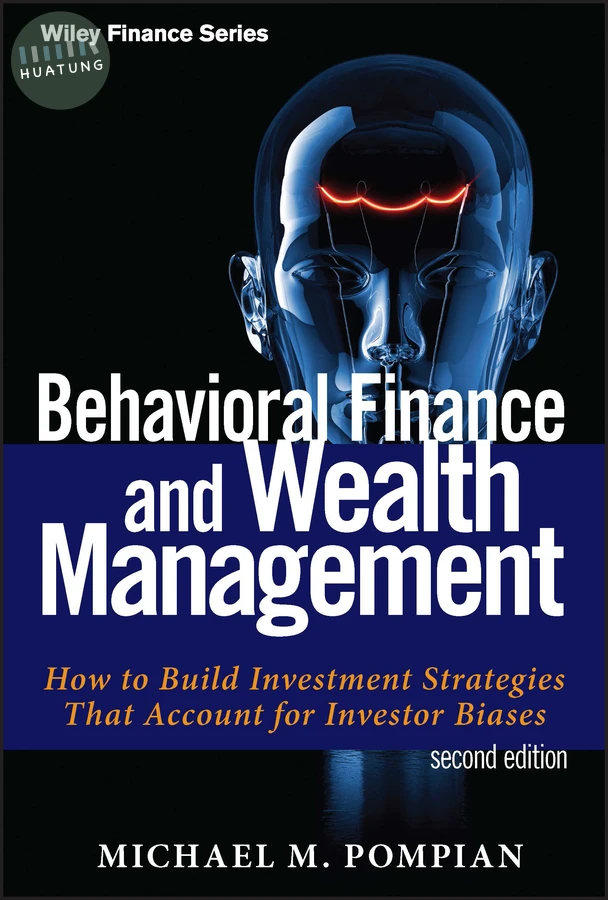
Behavioral Finance for Private Banking
$3040元可訂購
簡介
An essential framework for wealth management using behavioral finance
Behavioral Finance for Private Banking provides a complete framework for wealth management tailored to the unique needs of each client. Merging behavioral finance with private banking, this framework helps you gain a greater understanding of your client’s wants, needs, and perspectives to streamline the decision making process. Beginning with the theoretical foundations of investment decision making and behavioral biases, the discussion delves into cultural differences in global business and asset allocation over the life cycle of the investment to help you construct a wealth management strategy catered to each individual’s needs. This new second edition has been updated to include coverage of fintech and neurofinance, an extension of behavioral finance that is beginning to gain traction in the private banking space.
Working closely with clients entails deep interpersonal give and take. To be successful, private banking professionals must be as well-versed in behavioral psychology as they are in finance; this intersection is the heart of behavioral finance, and this book provides essential knowledge that can help you better serve your clients’ needs.
Understand the internal dialogue at work when investment decisions are made
Overcome the most common behavioral biases—and watch for your own
Learn how fintech and neurofinance impact all aspects of private banking
Set up a structured wealth management process that places the client’s needs front and center
Private banking clients demand more than just financial expertise. They want an advisor who truly understands their needs, and can develop and execute the kind of strategy that will help them achieve their goals. Behavioral Finance for Private Banking provides a complete framework alongside insightful discussion to help you become the solution your clients seek.
目錄
Chapter 1 Introduction 1
Chapter 2 Behavioral Biases 5
2.1 Information Selection Biases 6
2.2 Information Processing Biases 11
2.3 Biases after Receiving Feedback 31
2.4 Are More Heads Smarter Than One? 33
2.5 Summary of Biases 35
2.6 Conclusion 39
Chapter 3 Cultural Differences in Investors’ Behavior 41
3.1 What Is Financial Culture? 41
3.2 The INTRA Study 43
3.3 Conclusion 46
Chapter 4 Neurological Foundations and Biases’ Moderation 47
4.1 The Human Brain 47
4.2 Insights for Behavioral Finance 48
4.3 Moderation of Biases 49
4.4 Conclusion 50
Chapter 5 Diagnostic Tests for Investment Personality 51
5.1 A Case Study 51
5.2 Design of Diagnostic Questionnaires 52
5.3 Knowledge and Investment Experience 53
5.4 Psychology and Emotions 59
5.5 Client’s Diagnostic Profile 65
Chapter 6 Decision Theory 69
6.1 Introduction 69
6.2 A (Very) Short History of Decision Theory 70
6.3 Expected Utility 73
6.4 Mean-Variance Analysis 76
6.5 Prospect Theory 78
6.6 Rationality of Mean-Variance and Prospect Theory 87
6.7 The Optimal Asset Allocation 91
6.8 Comparing the Decision Theories 102
6.9 Conclusion 103
Chapter 7 Product Design 105
7.1 Introduction 105
7.2 Case Study 107
7.3 Theory of Product Design 114
7.4 Structured Products Designed by Customers 120
7.5 Conclusion 123
Chapter 8 Dynamic Asset Allocation 125
8.1 Time Diversification 126
8.2 Rebalancing 129
8.3 Conclusion 134
Chapter 9 Life-Cycle Planning 137
9.1 Case Study 137
9.2 Case Study Werner Bruni 139
9.3 Consumption Smoothing 140
9.4 The Life-Cycle Hypothesis 141
9.5 The Behavioral Life-Cycle Hypothesis 143
9.6 Conclusion 146
Chapter 10 Risk Profiling 147
10.1 Risk-Profiling Methodologies 148
10.2 Comparing Risk-Profiling Methodologies 151
10.3 A Case Study 152
10.4 The Risk Dimensions 153
10.5 Behavioral Risk Profiler 155
10.6 Risk Profiling and Its Regulation 166
10.7 Conclusion 167
Chapter 11 Structured Wealth Management Process 169
11.1 Benefits 172
11.2 Implementation 173
11.3 Regulatory Requirements 174
11.4 Structuring the Wealth Management Process 177
11.5 Relevance of Different Theories 196
11.6 Complying with the Regulatory Requirements 197
11.7 Information Technology in Client Advisory Services 197
Chapter 12 Fintech 201
12.1 History of Fintech 201
12.2 Current State of Fintech 201
12.3 Assessment of Fintech Solutions 202
Chapter 13 Case Studies 203
13.1 Case Study 1: Structured Wealth Management 204
13.2 Case Study 2: Experience Sampling 209
13.3 Case Study 3: Goal-based Approach 210
Chapter 14 Conclusions 219
Chapter 15 Appendix: Mathematical Arguments 221
15.1 Proof that Expected Utility Satisfies the Axioms of Rational Choice 221
15.2 Derivation of the Fourfold Pattern of Risk Taking 222
15.3 Mean-Variance as a Special Case of Prospect Theory 222
15.4 Prospect Theory Optimal Asset Allocation 224
15.5 No Time Diversification Theorem 225
References 227
Index 235