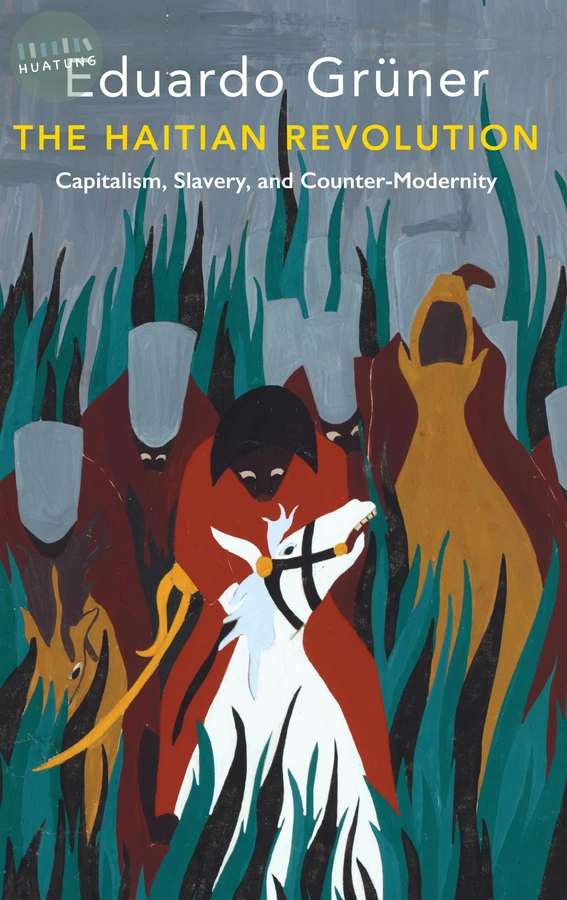

The Haitian Revolution
$2038元 定價: $2264 9折 可訂購
簡介
It is impossible to understand capitalism without analyzing slavery, an institution that tied together three world regions: Europe, the Americas, and Africa. The exploitation of slave labor led to a form of proto-globalization in which violence was indispensable to the production of wealth.
Against the background of this expanding circulation of capital and slave labor, the first revolution in Latin America took place: the Haitian Revolution, which began in 1791 and culminated with Haiti’s declaration of independence in 1804. Taking the Haitian Revolution as a paradigmatic case, Grüner shows that modernity is not a linear evolution from the center to the periphery but, rather, a co-production developed in the context of highly unequal power relations, where extreme forms of conquest and exploitation were an indispensable part of capital accumulation. He also shows that the Haitian Revolution opened up a path to a different kind of modernity, or “counter-modernity,” a path along which Latin America and the Caribbean have traveled ever since.
A key work of critical theory from a Latin American perspective, this book will be of great interest to students and scholars of critical and cultural theory and of Latin America, as well as anyone concerned with the global impact of capitalism, colonialism, and race.
目錄
Preface by Gisela Catanzaro
Prologue
Chapter 1: The Category of Slavery and Modern Racism
Elements for an Ethno-Historical Sociology of Ancient and Modern Slavery
The Question of Racism
Racism in “Early Modernity”
The Traces of Time
A Better World?
Chapter 2: The Rebellion of the (Slave) Masses and the Haitian Revolution
On the Combined and Uneven
From Particularism to (False) Universalism: A “Philosophical Revolution”
The (Uncertain) Logic of Slave Rebellions
The Rest of the Americas
Enter Saint-Domingue/Haiti
A Portrait of Saint-Domingue/Haiti in 1791
An Excursus on Vodou and its Revolutionary Character
The Social Complexities of Saint-Domingue
The Confused Dynamic of the Revolution
The Meaning(s) of the Haitian Revolution
On “Creative” Violence
Chapter 3: The Disavowed “Philosophical Revolution”: From Enlightenment Thought to the Crisis of Abstract Universalism
Shadows in the Enlightenment: Rousseau, Montesquieu, Voltaire, and Slavery
Slavery without Scare Quotes: Between Hegel and Marx
The Black Enlightenment: The Haitian “Constitutional Revolution”
The Difficulties of Theorizing (Haitian) Revolution
Literature and Art Have Their Say
Epilogue