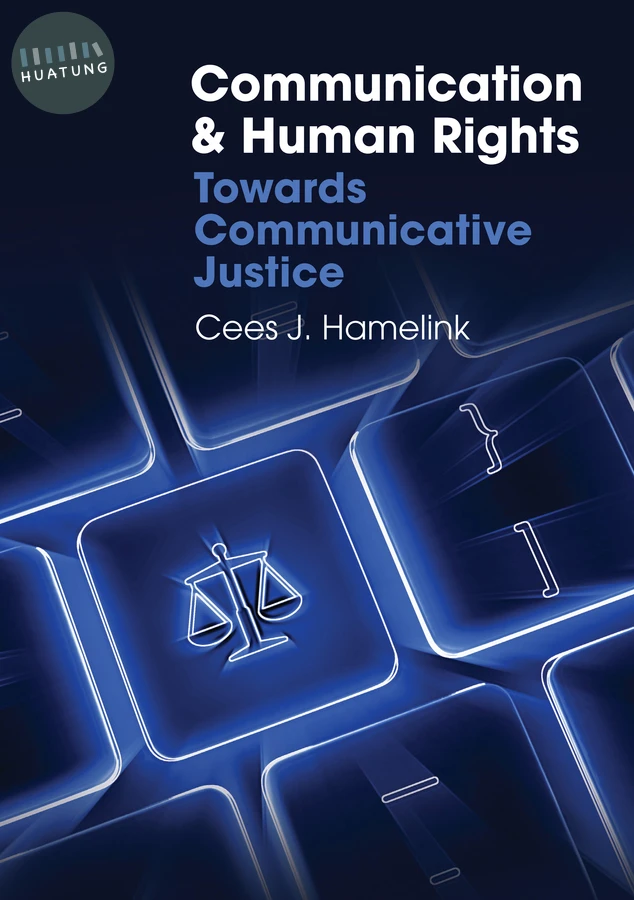

Communication and Human Rights
$718元 定價: $798 9折 可訂購
簡介
Human rights and communication are deeply connected: human rights need communication to expose violations and to offer platforms for dialogue, while communication needs human rights to provide standards for free speech and confidentiality. Together, they confront the reality of today’s social and international order in which justice and understanding often seem unattainable.
In this book, Cees J. Hamelink guides the reader through the historical evolution of communication and human rights. In this original framework, he discusses topics such as the right to communicate and freedom of expression, as well as major challenges posed by the environmental crisis and digital technologies. With authority, he passionately argues that ‘communicative justice’ is the ultimate goal of applying the international human rights regime to different forms of communication. This goal can only be achieved if we manage to move from the prevailing ‘thin’ liberal conception of human rights to a ‘thick’ cosmopolitan conception of them.
Written by one of the world’s leading scholars in this area, this wide-ranging book will be of interest to students of media and communication, human rights scholars, as well as practitioners, activists and anyone interested in applying the notion of justice to the basis of human existence: communication.
目錄
Preface Overview of the chapters
1 Human Rights Before Human Rights
Introduction
Before human rights
The ancient Middle East
Africa
Asia
Latin America and the Caribbean
Judaism
Islam
Christianity
European Enlightenment
A short history of normative principles for human communication
The principle of respect for human dignity
Truth as a sign of respect for human dignity
The principle of protection of privacy and confidentiality of communication
The confidentiality of communication
The principle of freedom
Conclusion
Notes
2 Human Rights and Communication
Introduction
The history of a remarkable document
The Universal Declaration of Human Rights
The Preamble of the Universal Declaration
The commitment
The implementation
The nature of the Declaration and future action Article 19 of the Universal Declaration of Human Rights: Freedom of inform on Freedom of thought
The protection of confidentiality of communicative behaviour
Prohibition of discrimination
The presumption of innocence
The prohibition of war propaganda
The prohibition of incitement to genocide
The public exposure of prisoners of war
Conclusion
Notes
3 Communication Rights
Introduction
On the communication rights of women
On the communication rights of children
On the communication rights of indigenous peoples
Cultural rights
Protection of cultural identity
Knowledge
On the communication rights of migrants
The migrant issue
Identity and language
The right to communicate
The World Summit on the Information Society (WSIS)
Final declaration of the WSIS
Conclusion
Notes
4 Challenges and Communication Rights
Introduction
Challenges of technology
Challenges of the Internet
The Internet governance challenge
The surveillance challenge
The digital trace
The Cloud
New rights?
Artificial Intelligence
Thinking machines
Conversations with your robot
Human rights in robotic times
A new set of human rights?
The challenge of declining biodiversity
Conclusion
Notes
5 The Trouble with Human Rights
Introduction
Halfway?
Universality
Non-citizens
Freedom of speech
Empowerment
The state-centric paradigm
Epistemic coloniality
Development as an interventionist project
Limited visions on human rights
The first vision
The second vision
Abstract notions and sociopolitical realities
Religion
Economics: Globalization
Rights versus rights
Rights versus significant interests
Rights versus cultural values
Rights versus human inclinations
Inclusion versus the tribal instinct
Compassion versus hostility
Actively listening versus silencing
Cooperative communication versus competitive communication
Change versus fear
The politicization of humanitarian interventions
Enforcement
Unwilling states
Failure
The United Nations
Bureaucracies and human rights
Conclusion
Notes
6 Communicative Justice
Introduction
The building blocks
The concept of communicative justice
The human right to communication
What kind of right?
Social order
Moral imbalance
Respect for dignity and humiliation
Right to freedom and institutionalized censorship
Right to equality and institutionalized discrimination
Right to security and the institutionalization of fear
Imagining alternatives
A caring social order
A convivial social order
An egalitarian social order
A secure social order
A tall order
Transformation and communication
The caring social order and communication practice
The egalitarian social order and communication practice
The convivial social order and communication practice
The secure social order and communication practice
Imagination
Conclusion
Notes
7 The Practice of Communicative Justice
Introduction
Political ethics
The bioethical imperative
The eccentric positionality
The ethics of liberation
Moral intuitionism
Towards an ethics of ‘liberating togetherness’
Communication
Cooperative spirit
Amor mundi
Conclusion
Notes
References
Index