Discrimination Testing in Sensory Evaluation
$5648元 定價: $6276 9折 可訂購
簡介
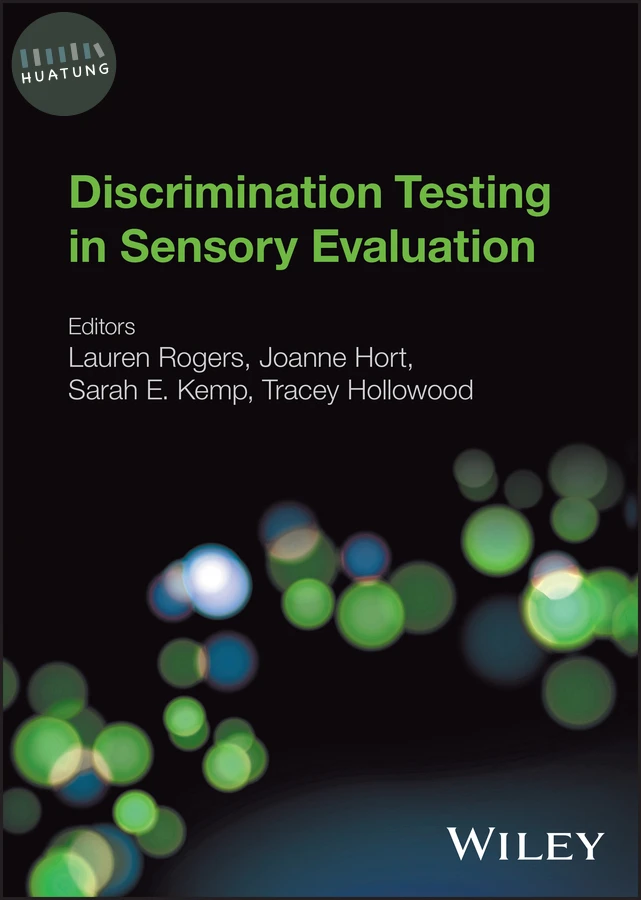
Discrimination Testing in Sensory Evaluation
Provides a complete and unified approach to discrimination testing in sensory evaluation
Sensory evaluation has evolved from simple "taste testing" to a distinct scientific discipline. Today, the application of sensory evaluation has grown beyond the food industry—it is a sophisticated decision-making tool used by marketing, research and development, and assurance in industries such as personal care, household care, cosmetics, fragrances, automobile manufacturing, and many others. Sensory evaluation is now a critical component in determining and understanding consumer acceptance and behavior.
Discrimination Testing in Sensory Evaluation provides insights into the application of sensory evaluation throughout the entire product life cycle, from development to marketing. Filled with practical information and step-by-step guidance, this unique reference is designed to help users apply paired comparison tests, duo-trio tests, triangle tests, similarity tests, and various other discrimination tests in a broad range of product applications. Comprehensive chapters written by leading experts provide up-to-date coverage of traditional and cutting-edge techniques and applications in the field.
Addresses the theoretical, methodological, and practical aspects of discrimination testing
Covers a broad range of products and all of the senses
Describes basic and more complex discrimination techniques
Discusses the real-world application of discrimination testing in sensory evaluation
Explains different models in discrimination testing, such as signal detection theory and Thurstonian modelling
Features detailed case studies for various tests such as A- not AR, 2-AFC, and Ranking among others to enable practitioners to perform each technique
Discrimination Testing in Sensory Evaluation is an indispensable reference and guide for sensory scientists, in academia and industry, as well as professionals working in R&D, quality assurance and control, and marketing. It is also an excellent textbook for university courses and industry vocational programs in Sensory Science.
目錄
List of Contributors xv
Preface to the Series xvii
Preface xxi
Editor Biographies xxiii
Section 1 Introduction 1
1 Introduction 3
Sarah E. Kemp, Tracey Hollowood, Joanne Hort and Lauren Rogers
1.1 Introduction 3
1.2 Developments of Discrimination Testing 4
1.3 Discrimination as a Technique in Sensory Science 11
1.4 Applications 15
1.5 Overview of Book 16
References 19
2 General Considerations in Discrimination Testing 25
Harry T. Lawless
2.1 Introduction: Goals of Discrimination Tests 25
2.2 Types of Tests 27
2.3 General Test Considerations 32
2.4 Basic Statistical Analysis 35
2.5 Test Power and Sample Size; Equivalence and Similarity 38
2.6 Psychological Factors 42
2.7 Summary and Conclusions 43
References 44
3 An Overview of Sensory Discrimination Tests 49
Stella Lignou and Victoria Norton
References 65
4 Determining Individual Variation in Ability to Discriminate: Factors Affecting Responsiveness and Performance 67
Sara Spinelli, Caterina Dinnella and Erminio Monteleone
4.1 Introduction 67
4.2 Overview of the Factors Affecting Individual Differences in Oral and Olfactory Responsiveness 67
4.3 Factors Affecting Consumer and Trained Panelists Ability to Discriminate 74
4.4 Future Developments 76
4.5 Summary 77
Acknowledgments 77
References 77
5 Similarity or Equivalence Testing 85
Linda Lopez
5.1 Introduction 85
5.2 Practical and Common-sense Approach for Similarity Testing 87
5.3 Evolution of Similarity Testing Methodology 92
5.4 Example of Similarity Test Application in Claim and Recipe Change 98
5.5 Conclusion 102
References 102
6 Thurstonian Modeling and Signal Detection Theory 105
Michael J. Hautus 105
6.1 Signal Detection Theory and Thurstonian Modeling 105
6.2 SDT and Two Stimulus Alternatives 106
6.3 The A-Not A Task 108
6.4 The 2AFC (Paired Comparison) Task 120
6.5 Test Sensitivity 124
6.6 Closing Comments 127
References 127
7 Sureness Judgements and R-Index Calculations and Their Applications 131
Danielle van Hout and Hye-Seong Lee
7.1 Quantifications of Sensory Differences 131
7.2 R-Index 132
7.3 Sureness Judgements 133
7.4 Designing an R-Index Study, Using an A-Not A Task 133
7.5 R-Index Data Analysis 136
7.6 Applications 140
7.7 Future Developments 142
Appendix 144
References 148
8 Replicated Discrimination Testing 151
Michael Meyners and Bernard Thomas Carr
8.1 Introduction 151
8.2 General Considerations and Study Design 152
8.3 Notation 154
8.4 Statistical Testing to Show Product Differences 157
8.5 Descriptive Analysis and Parameter Estimation 165
8.6 Tests for Equivalence/Similarity 170
8.7 Replicated Preference Tests 171
8.8 Examples 174
8.9 Conclusions 185
8.10 Recommendations 186
8.11 Glossary and Notation 188
Acknowledgements 191
References 191
Section 2 Applications 197
9 Sensory Quality Measurement Based on SDT Discrimination 199
Hye-Seong Lee, Min-A Kim and Danielle van Hout
9.1 Introduction 199
9.2 A New Classification of Sensory Discrimination Tests and Their Relative Performance 200
9.3 Reference-based Discrimination Test Methodology: SDT Sensory Quality Measurements 209
9.4 Further Development 226
References 228
10 Discrimination Testing in Flavors and Fragrances: A Practical View 233
Karine Miot, Carlos Gómez-Corona and Isabelle Cayeux
10.1 Introduction to Discrimination Testing for Flavors and Fragrances 233
10.2 Discrimination Testing for Flavors 238
10.3 Discrimination Testing for Fragrances 248
10.4 Bringing Social Responsibility into Discrimination Testing for Flavors and Fragrances 256
10.5 What the Future Might Be in the Flavor and Fragrance Industries 259
10.6 Conclusions and Final Considerations 261
References 262
11 Kids as Sensory Detectives: Application of Discrimination Testing with Children to Identify If Differences Exist Between Two or More Products 265
Cindy Beeren
11.1 Introduction: Sensory Testing by Kids 265
11.2 Kids’ vs. Adults’ Sensitivities 266
11.3 Kids vs. Adults’ Preferences 268
11.4 Food Neophobia 269
11.5 So Why Use Kids? 270
11.6 Ethical Considerations 272
11.7 Environment for Testing with Kids 274
11.8 Sensory Screening 276
11.9 Training Session 279
11.10 Test Methods 281
11.11 Final Thoughts 285
References 287
12 Expanding Attribute-Specific Difference Tests with Multisample Paired Comparison Paradigms 291
Curtis R. Luckett
12.1 Introduction 291
12.2 Practical Considerations 299
12.3 Mosteller’s Extension of Thurstone 300
12.4 Bradley-Terry Models 301
12.5 Elo and mElo 302
12.6 Friedman-Style Rank Analysis 302
12.7 Considerations on Choosing an Appropriate Method 303
12.8 Future Developments 313
References 314
13 Summary 317
Sarah E. Kemp, Tracey Hollowood, Joanne Hort and Lauren Rogers
13.1 Introduction 317
13.2 Overall Comparison of Methods 317
13.3 Current/Recent Developments 320
13.4 Future 324
13.5 Conclusions 327
References 327
Index 331