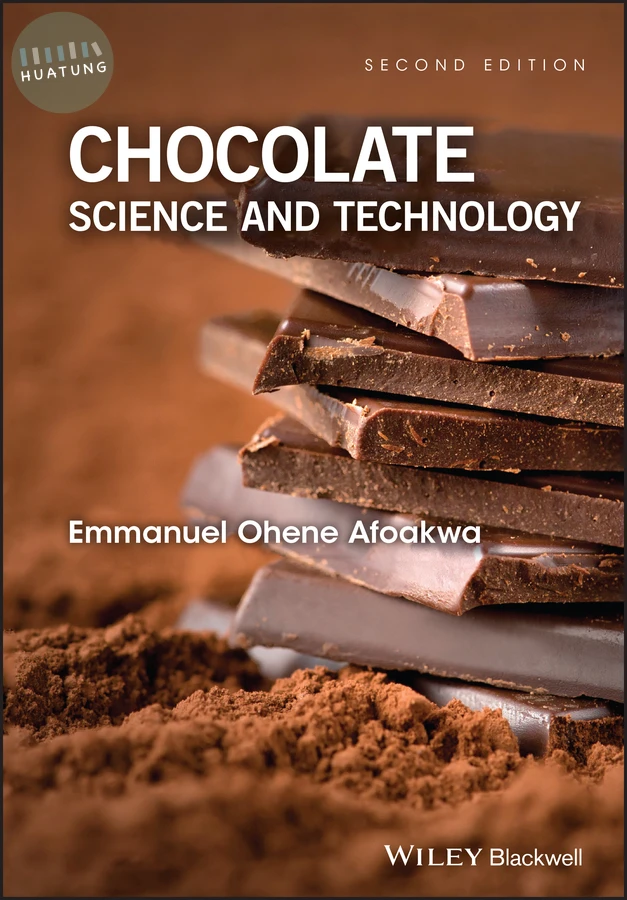
Chocolate Science and Technology
$6105元 定價: $6783 9折 可訂購
簡介
CHOCOLATE
SCIENCE AND TECHNOLOGY This second edition provides information on recent advances in the science and technology of chocolate manufacture and the entire international cocoa industry. It provides detailed reviews of a wide range of topics, including cocoa production, cocoa and chocolate manufacturing operations, sensory perception of chocolate quality, flavour release and perception, sugar replacement and alternative sweetening solutions in chocolate production, industrial manufacture of sugar-free chocolates and the nutrition and health benefits of cocoa and chocolate consumption. The topics cover modern cocoa cultivation and production practices with special attention to cocoa bean composition, genotypic variations in the bean, post-harvest pretreatments, fermentation and drying processes and the biochemical basis of these operations. The scientific principles behind industrial chocolate manufacture are outlined, with detailed explanations of the various stages of chocolate manufacturing, including mixing, refining, conching and tempering. Other topics covered include the chemistry of flavour formation and development during cocoa processing and chocolate manufacture; volatile flavour compounds and their characteristics and identification; sensory descriptions and character; and flavour release and perception in chocolate. The nutritional and health benefits of cocoa and chocolate consumption and the application of HACCP and other food safety management systems such as ISO 22000 in the chocolate processing industry are also addressed. Additionally, detailed research on the influence of different raw materials and processing operations on the flavour and other quality characteristics of chocolates have been provided, with scope for process optimization and improvement. The book is intended to be a desk reference for all those engaged in the business of making and using chocolate worldwide; confectionery and chocolate scientists in industry and academia; students and practising food scientists and technologists; nutritionists and other health professionals; and libraries of institutions where agriculture, food science and nutrition are studied and researched.
目錄
Preface xix
Acknowledgements xxi
About the author xxiii
1 History, origin and taxonomy of cocoa 1
1.1 Introduction 1
1.2 History of cocoa 2
1.3 Taxonomy of cocoa 5
1.4 Morphological and varietal characteristics of cocoa 6
1.4.1 The cocoa plant 6
1.5 Varietal effects on cocoa bean flavour 10
1.6 The concept of this book 15
2 World cocoa production processing and chocolate consumption pattern 17
2.1 Introduction 17
2.2 World production of cocoa 17
2.3 Major changes in world cocoa trade 20
2.4 Cocoa yield in producing countries 22
2.5 World cocoa grindings trends between 2005–2006 and 2014–2015 23
2.6 World stocks of cocoa beans 26
2.7 International cocoa price developments 26
2.8 Cocoa processing trends 31
2.9 Cocoa and chocolate consumption 33
2.9.1 Apparent cocoa consumption 33
2.9.2 World chocolate consumption 34
2.9.3 World consumption of chocolate products 35
2.9.4 World consumption of premium chocolate products 38
2.10 Fairtrade cocoa and chocolate in the modern confectionery industry 39
2.10.1 Sustainable fairtrade cocoa production 39
2.10.2 Future of the fairtrade cocoa and confectionery industry 41
2.11 The organic cocoa in chocolate confectionery industry 42
2.11.1 The global organic food industry 42
2.11.2 The organic cocoa industry 43
2.11.3 Consumption patterns of organic cocoa 44
2.11.4 Certification and market for organic cocoa 45
2.12 The changing chocolate market 48
3 Traditional and modern cocoa cultivation practices 49
3.1 Introduction 49
3.2 Environmental requirements for cocoa cultivation 51
3.2.1 Temperature 51
3.2.2 Rainfall 52
3.2.3 Soils and nutrition 52
3.3 Traditional cocoa cultivation practices 53
3.3.1 Growth and propagation 53
3.4 Modern cocoa cultivation practices using vegetative propagation 54
3.5 Establishment and shade 54
3.6 Flowering and pod development 60
3.7 Harvesting of cocoa pods 64
3.8 Pod breaking 67
3.9 The cocoa pod 68
3.10 Good agricultural practices in cocoa cultivation 69
3.10.1 Quality improvement practices 69
3.10.2 Weed control 71
3.10.3 Pruning 71
4 Cocoa diseases and pests and their effects on chocolate quality 73
4.1 Introduction 73
4.2 Major cocoa diseases 73
4.2.1 Cocoa swollen shoot virus disease (CSSVD) 73
4.2.2 Black pod disease 74
4.2.3 Witches broom disease 76
4.3 Cocoa pests 77
4.3.1 Pod borers (capsids cocoa thrips and mealy bugs) 77
4.4 Cocoa crop protection 79
5 Cocoa bean composition and chocolate flavour development 80
5.1 Introduction 80
5.2 Bean composition and flavour precursor formation 81
5.2.1 Physical structure and chemical composition of the cocoa bean 81
5.2.2 Cocoa pulp: the fermentation substrate 83
5.2.3 Polyphenols and chocolate flavour quality 85
5.2.4 Effects of proteins and sugars on flavour precursor formation 85
5.3 Effects of genotype on cocoa bean flavour 87
5.4 Flavour development during post-harvest treatments of cocoa 87
5.4.1 Changes in biochemistry of the bean during flavour precursor formation in cocoa fermentation 87
5.4.2 Microbial succession and enzymatic activities during flavour precursor generation in cocoa fermentation 90
5.4.3 Drying 94
5.5 Conclusion 98
6 Cocoa processing technology 102
6.1 Introduction 102
6.2 Bean selection and quality criteria 102
6.2.1 Free fatty acid 103
6.3 Cocoa quality grading and storage 106
6.4 Selection of bean blends and chocolate flavour quality 107
6.5 Steps in cocoa processing 108
6.5.1 Cleaning breaking and winnowing 108
6.5.2 Sterilization 109
6.5.3 Alkalization 109
6.5.4 Roasting 110
6.5.5 Nib grinding and liquor treatment 111
6.5.6 Liquor pressing 112
6.5.7 Cake grinding (kibbling) 112
6.5.8 Cocoa powder production 112
6.5.9 Cocoa butter –chemistry, standards and quality characteristics 112
7 Industrial chocolate manufacture – processes and factors influencing quality 117
7.1 Introduction 117
7.2 Chocolate manufacturing processes 120
7.2.1 Mixing 120
7.2.2 Refining 121
7.2.3 Conching 123
7.3 Tempering, lipid crystallization and continuous phase character during chocolate manufacture 126
7.4 Casting and moulding 130
7.5 Cooling 130
7.6 Demoulding 130
7.7 Wrapping/Packaging 132
7.8 Factors influencing rheological and textural qualities in chocolate 132
7.8.1 Particle size distribution 132
7.8.2 The role of fats 142
7.8.3 The role of sugar 143
7.8.4 The role of milk and other dairy components 144
7.8.5 The role of surfactants 145
7.8.6 Moisture and chocolate flow behaviour 146
7.9 Chocolate quality and defects 146
7.9.1 Chocolate quality 146
7.9.2 Chocolate defects 150
7.10 Conclusion and further research 152
8 The chemistry of flavour development during cocoa processing and chocolate manufacture 154
8.1 Introduction 154
8.2 Influence of bean selection on chocolate flavour quality 154
8.3 Effect of roasting 155
8.3.1 Maillard reactions – aldol condensation, polymerization and cyclization 159
8.3.2 Effects of alkalization 161
8.4 Flavour development during chocolate manufacture 162
8.4.1 Conching 162
8.5 Key flavour compounds in milk chocolate 163
8.6 Key flavour compounds in dark chocolate 163
8.7 Conclusion 169
9 Alternative sweetening and bulking solutions in chocolate manufacture 171
9.1 Introduction 171
9.2 Types of sugar substitutes and their characteristics 172
9.3 High-potency sweeteners 173
9.3.1 Stevia rebaudioside A 173
9.3.2 Thaumatin 176
9.4 Bulk sweeteners 178
9.4.1 Polyols (sugar alcohols) 178
9.4.2 Sucralose 181
9.4.3 Tagatose 183
9.4.4 Trehalose 185
9.4.5 Isomultulose 187
9.5 Low-digestible carbohydrate polymers 188
9.5.1 Polydextrose 189
9.5.2 Inulin and oligofructose 191
9.5.3 Maltodextrin 193
9.6 Laxation and low–digestible carbohydrate polymers 193
9.7 Applicability and suitability of different sweeteners and carbohydrate polymers in chocolate processing 194
9.8 Importance of blending different sugar substitutes 200
10 Sensory character and flavour perception of chocolates 202
10.1 Summary and industrial relevance 202
10.2 Introduction 203
10.3 Sensory perception of quality in chocolates 204
10.3.1 Appearance 208
10.3.2 Texture 208
10.3.3 Taste 209
10.3.4 Flavour and aroma 210
10.4 Sensory assessment of chocolates 211
10.5 Factor influencing chocolate flavour 212
10.6 Flavour release and perception of sweetness in chocolate 213
10.7 Dynamism of flavour perception in chocolate 215
10.8 Retronasal flavour release and perception during chocolate consumption 216
10.9 Measurement of flavour release and intensity in chocolates 218
10.10 Electronic noses and tongues as online sensors for sensory assessment of chocolates 221
10.11 Conclusion 222
11 Nutritional and health benefits of cocoa and chocolate consumption 223
11.1 Summary and significance 223
11.2 Introduction 223
11.3 Chemistry and composition of cocoa flavonoids 225
11.4 Chocolate types and their major nutritional constituents 226
11.5 Antioxidant properties and their mechanism of action 229
11.6 Effects on endothelial function, blood pressure and the cardiovascular system 231
11.7 Effects on insulin sensitivity and carcinogenic properties 232
11.8 Cocoa, chocolate and aphrodisiac properties 233
11.9 Conclusion 234
12 Processing effects on the rheological textural and melting properties during chocolate manufacture 236
12.1 Summary and industrial relevance 236
12.2 Introduction 237
12.3 Materials and methods 241
12.3.1 Materials 241
12.3.2 Preparation of chocolate samples 241
12.3.3 Determination of particle size distribution 242
12.3.4 Rheological measurements 242
12.3.5 Tempering procedure 244
12.3.6 Texture measurements 244
12.3.7 Colour measurements of solid dark chocolate 246
12.3.8 Microstructure analysis 247
12.3.9 Determination of melting properties of dark chocolates 248
12.3.10 Experimental design and statistical analysis 248
12.4 Results and discussion 249
12.4.1 Particle size distribution of molten dark chocolate 249
12.4.2 Rheological properties of molten dark chocolate 249
12.5 Relationships between Casson model and ICA recommendations 258
12.6 Textural properties 262
12.6.1 Molten dark chocolate 262
12.6.2 Hardness of tempered dark chocolate 266
12.6.3 Colour measurements 267
12.6.4 Relationships between textural properties and appearance of dark chocolate 268
12.7 Microstructural properties of molten dark chocolate 270
12.8 Melting properties of dark chocolate 274
12.8.1 Effects of particle size distribution 276
12.8.2 Effects of fat content 281
12.8.3 Effects of lecithin 282
12.9 Relationships between rheological, textural and melting properties of dark chocolate 284
12.10 Conclusion 294
13 Tempering behaviour during chocolate manufacture: Effects of varying product matrices 297
13.1 Summary and industrial relevance 297
13.2 Introduction 298
13.3 Materials and methods 300
13.3.1 Materials 300
13.3.2 Tempering procedure 300
13.3.3 Determination of particle size distribution 301
13.3.4 Experimental design and statistical analysis 301
13.4 Results and discussion 304
13.4.1 Particle size distribution of dark chocolates 304
13.4.2 Effect of particle size distribution on tempering behaviour 308
13.4.3 Effect of fat content on tempering behaviour 312
13.5 Conclusion 316
14 Tempering and fat crystallization effects on chocolate quality 317
14.1 Summary and industrial relevance 317
14.2 Introduction 318
14.3 Materials and methods 319
14.3.1 Materials 319
14.3.2 Determination of particle size distribution 320
14.3.3 Tempering experiment 320
14.3.4 Texture measurements 320
14.3.5 Colour and gloss measurements 321
14.3.6 Image acquisition and capture 321
14.3.7 Determination of melting properties 322
14.3.8 Microstructural determinations 322
14.3.9 Scanning electron microscopy 322
14.3.10 Experimental design and statistical analysis 323
14.4 Results and discussion 323
14.4.1 Particle size distribution of dark chocolates 323
14.4.2 Fat crystallization behaviours during tempering of dark chocolate 324
14.4.3 Effect of temper regime and PSD on mechanical properties 325
14.4.4 Effect of temper regime and PSD on colour and gloss 328
14.4.5 Effect of temper regime and PSD on melting properties 330
14.4.6 Effect of temper regime on microstructure 339
14.4.7 Effect of temper regime on scanning electron microstructure 339
14.5 Conclusion 343
15 Fat bloom formation and development in chocolates 345
15.1 Summary and industrial relevance 345
15.2 Introduction 346
15.3 Materials and methods 347
15.3.1 Materials 347
15.3.2 Determination of particle size distribution 348
15.3.3 Tempering experiment 348
15.3.4 Texture measurements 349
15.3.5 Surface colour and gloss measurements 349
15.3.6 Determination of melting properties 349
15.3.7 Microstructural determinations 350
15.3.8 Experimental design and statistical analysis 350
15.4 Results and discussion 350
15.4.1 Particle size distribution of dark chocolates 350
15.4.2 Changes in textural properties during blooming 351
15.4.3 Changes in appearance (Surface Whiteness and Gloss) during blooming 353
15.4.4 Changes in melting behaviour during blooming 357
15.4.5 Changes in microstructure during blooming 359
15.5 Conclusion 364
16 Matrix effects on flavour volatiles character and release in chocolates 365
16.1 Summary and industrial relevance 365
16.2 Introduction 365
16.3 Materials and methods 367
16.3.1 Materials 367
16.3.2 Tempering procedure 368
16.3.3 Determination of particle size distribution 368
16.3.4 Quantification of flavour volatiles by gas chromatography 368
16.3.5 Gas chromatography–olfactometry analytical conditions 369
16.3.6 Experimental design and statistical analysis 369
16.4 Results and discussion 369
16.4.1 Particle size distribution of dark chocolates 369
16.4.2 Characterization of flavour compounds in dark chocolates 370
16.4.3 Effects of particle size distribution on flavour volatile release 374
16.4.4 Effects of fat content on flavour volatile release 374
16.4.5 Relating flavour volatiles release to particle size distribution and fat content: product spaces 379
16.5 Conclusion 381
17 Process optimization and product quality characteristics during sugar-free chocolate manufacture 382
17.1 Summary and industrial relevance 382
17.2 Introduction 382
17.3 Materials and methods 384
17.3.1 Raw materials 384
17.3.2 Experimental design and sample preparation 384
17.3.3 Analytical methods 385
17.4 Results and discussion 387
17.4.1 Rheological properties 390
17.4.2 Casson plastic viscosity 390
17.4.3 Casson yield stress 392
17.4.4 Microscopy 393
17.4.5 Colour 395
17.4.6 Hardness 395
17.4.7 Moisture 396
17.5 Optimization of chocolate formulation 396
17.6 Conclusion 397
18 Food safety management systems in chocolate processing 399
18.1 Introduction 399
18.2 The HACCP system 400
18.2.1 HACCP principles 401
18.2.2 HACCP plan 402
18.2.3 Application of the HACCP system 405
18.2.4 Advantages of HACCP 405
18.2.5 Shortfalls of HACCP 406
18.3 ISO 22000 approach 406
18.3.1 Advantages of ISO 22000 407
18.3.2 Comparison of ISO 22000 with HACCP 408
18.4 Hazards associated with chocolate processing 408
18.4.1 Physical hazards 408
18.4.2 Chemical hazards 409
18.4.3 Microbiological hazards 411
18.5 Critical operations in cocoa processing and chocolate manufacture 413
18.5.1 Cleaning 413
18.5.2 Roasting 413
18.5.3 Breaking and winnowing 414
18.5.4 Refining 414
18.5.5 Conching 414
18.5.6 Tempering 415
18.6 Conclusion 415
19 Application of ISO 22000 and hazard analysis and critical control points (HACCP) in chocolate processing 416
19.1 Summary and industrial relevance 416
19.2 Introduction 416
19.2.1 Hazard analysis and critical control points (HACCP) 417
19.2.2 HACCP principles 418
19.2.3 ISO 22000 419
19.3 Hazards associated with chocolate processing 419
19.3.1 Physical hazards 420
19.3.2 Chemical hazards 421
19.3.3 Microbiological hazards 421
19.4 Preprocessing operations 421
19.5 Cocoa processing into semi-finished products 422
19.5.1 Bean receipt and cleaning – CCP1 422
19.5.2 Silos (Storage) – CCP2 422
19.5.3 De-bacterizer – CCP3 422
19.5.4 The roasting process – CCP4 422
19.5.5 Breaking and winnowing 424
19.5.6 Milling 424
19.5.7 Storage and conditioning – CCP5 424
19.5.8 Pressing – CCP6 425
19.5.9 Centrifugation and filtration – CCP7 425
19.5.10 Kibbling and pulverization 425
19.6 Milk chocolate manufacturing operations 425
19.6.1 Raw materials reception – CCP1 425
19.6.2 Mixing – CCP2 425
19.6.3 Refining 426
19.6.4 Conching 427
19.6.5 Tempering 427
19.6.6 Casting and moulding – CCP3 428
19.6.7 Cooling 428
19.6.8 Demoulding 428
19.6.9 Wrapping/Packaging – CCP4 429
19.7 Hazard analysis 429
19.7.1 Determination of critical control points 435
19.7.2 Determination of prerequisite programmes 435
19.8 Conclusion 435
20 Conclusions and industrial applications 441
20.1 Introduction 441
20.2 Conclusions: Structure–properties relationships in chocolate manufacture 441
20.3 Conclusions: Tempering behaviour from response surface methodology 443
20.4 Conclusions: Effects of tempering and fat crystallization on microstructure and physical properties 444
20.5 Conclusions: Fat bloom formation and development with under-tempering 445
20.6 Conclusions: Flavour volatiles and matrix effects related to variations in PSD and fat content 445
20.7 Conclusions: Process optimization and product quality characteristics of sugar-free chocolates 446
20.8 Industrial relevance and applications of research findings in this book 447
20.9 Recommendations for further research studies 448
References 450
Appendix 1 Abbreviations 487
Appendix 2 Acronyms and websites of organizations related to the cocoa and chocolate industry 490
Appendix 3 Glossary of cocoa and chocolate terminologies 492
Index 497