
簡介
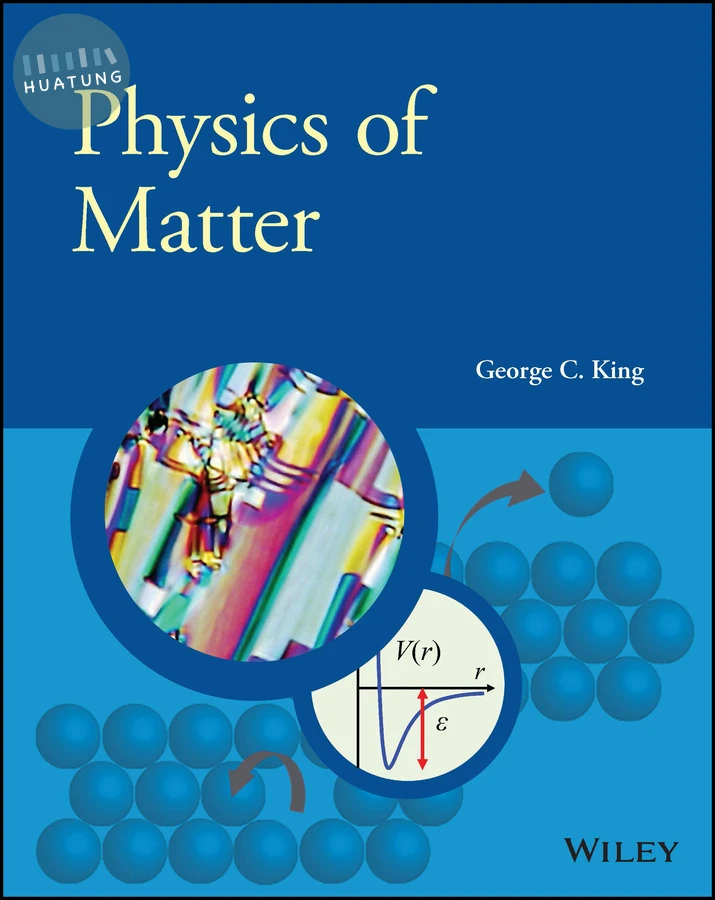
Physics of Matter First year core course introductory textbook on the nature of matter that puts the physics before mathematical description Physics of Matter is an introductory textbook on the nature of matter, based on a description of gases, liquids, liquid crystals and solids in terms of the forces that bind atoms and molecules together and their thermal motion, that discusses the relationship of these phases of matter to heat and the basic principles of thermodynamics. Physics of Matter is unique in its coverage of material and includes topics that have become important in recent times such as graphene and liquid crystals. Material in the book is reinforced by numerous worked examples in the text and problems and solutions at the end of each chapter, the latter ranging in difficulty from simple exercises to challenging problems. The emphasis is on clarity of exposition and explanation, putting the physics before the mathematical with general physical principles that can be more widely applied being stressed. Published in the Manchester Physics Series, which has the reputation of providing insight, depth, and often details on a subject not found in other textbooks, sample topics covered in Physics of Matter include: Characteristics of atoms (sizes and masses) and Avogadro’s number, the forces that bind atoms and molecules together, and the Lennard-Jones potential
Thermal energy, temperature, and the Boltzmann law, covering equations of state, the ideal gas equation, and equipartition of energy
Kinetic theory and transport properties of gases, covering molecular collisions, pressure of an ideal gas, the mean free path and diffusion
Real gases, including Van der Waals equation of state, virial expansion, critical constants, and heat capacities
Reversible processes, entropy, the Carnot cycle, the thermodynamic fundamental relationship, and Gibbs free energy
Solids, including crystal structure, elastic moduli and Einstein’s model of heat capacity
Liquids, including liquid flow and Bernoulli’s equation, and liquid crystals
Physics of Matter is a valuable learning resource for first- and second-year students in physics, chemistry, and engineering, as well as those in adjacent science courses including environmental and biological sciences. The book is written for the subject traditionally called “Properties of Matter.”
目錄
Editors' preface to the Manchester Physics Series xv
Author's preface xvii
1 Atoms, the constituents of matter 1
1.1 The mass of an atom 1
1.2 The size of an atom 6
1.3 Atomic structure 11
2 The forces that bind atoms together 43
2.1 General characteristics of interatomic forces 43
2.2 Interatomic potential energy 47
2.3 Types of interatomic bonding 51
2.4 Why gases, liquids, and solids 65
3 Thermal energy of atoms and molecules 69
3.1 Temperature and the translational kinetic energy of a molecule 69
3.2 Probability distributions and mean values 72
3.3 The Maxwell–Boltzmann speed distribution 80
3.4 Boltzmann's law 86
3.5 The isothermal atmosphere 91
3.6 Derivation of the Maxwell–Boltzmann speed distribution 96
3.7 Equipartition of energy 100
3.8 Specific heats of gases 106
4 Kinetic theory of gases: transport processes 117
4.1 Kinetic theory of gases 117
4.2 Molecular collisions and the mean free path 118
4.3 The distribution of free paths 122
4.4 Diffusion 125
4.5 Thermal conduction 134
4.6 Viscosity 140
4.7 Comparison of transport properties 142
4.8 Effusion 144
4.9 The random walk 149
5 Real gases 157
5.1 The van der Waals equation 158
5.2 P–V isotherms for a real gas 163
5.3 The virial equation 166
5.4 Internal energy and specific heats of a van der Waals gas 169
5.5 Phase diagrams 171
6 The First Law of Thermodynamics 177
6.1 Thermodynamic equilibrium 178
6.2 Temperature 180
6.3 Heat 185
6.4 Internal energy 186
6.5 Work and Joule's paddle wheel experiment 188
6.6 First law of thermodynamics 191
6.7 Work done during volume changes 194
6.8 Reversible processes 196
6.9 Expansion of gases and the first law of thermodynamics 202
6.10 The Joule effect; the free expansion of an ideal gas 203
6.11 Molar specific heats of an ideal gas 205
6.12 Enthalpy 210
6.13 The Joule–Kelvin effect 212
6.14 Thermochemistry 217
7 The second law of thermodynamics 223
7.1 Introduction 223
7.2 Heat engines 224
7.3 The Carnot cycle 229
7.4 Entropy 235
7.5 Entropy changes in reversible processes 238
7.6 Entropy changes in irreversible processes 241
7.7 Entropy and the second law 245
7.8 The fundamental thermodynamic relationship 246
7.9 Phase changes and the Clausius–Clapeyron equation 247
7.10 Gibbs free energy 252
7.11 Thermodynamic identities 255
7.12 A statistical approach to the second law of thermodynamics 259
8 Solids 271
8.1 Types of solids 271
8.2 Crystal structure 273
8.3 The crystal lattice, unit cell, and basis 282
8.4 X-ray crystallography 290
8.5 Experimental techniques of X-ray crystallography 294
8.6 Neutron scattering 298
8.7 Interatomic forces in solids 299
8.8 Vibrations in crystals 301
9 The elastic properties of solids 309
9.1 Stress, strain, and elastic moduli 309
9.2 Poisson's ratio 315
9.3 The velocity of sound in a thin wire 320
9.4 Torsional stress and strain 322
9.5 Elastic moduli and interatomic forces and potential energies 325
9.6 The inelastic behaviour of solids 332
10 Thermal and transport properties of solids 339
10.1 Molar specific heats of solids 339
10.2 Thermal conductivity of solids 350
10.3 Diffusion in solids 353
10.4 Electrical and thermal conductivities of metals 356
11 Liquids 363
11.1 The structure of liquids 363
11.2 Physical properties of liquids 366
11.3 The flow of liquids 374
11.4 The flow of real liquids 380
12 Liquid crystals 387
12.1 Liquid crystal phases 388
12.2 Thermotropic liquid crystal phases 389
12.3 Polarised light 396
12.4 Optical properties of liquid crystals 402
12.5 Liquid crystal displays 410
12.6 Liquid crystals in nature 415
Problems 12 415
Solutions to problems 417
Index 437